

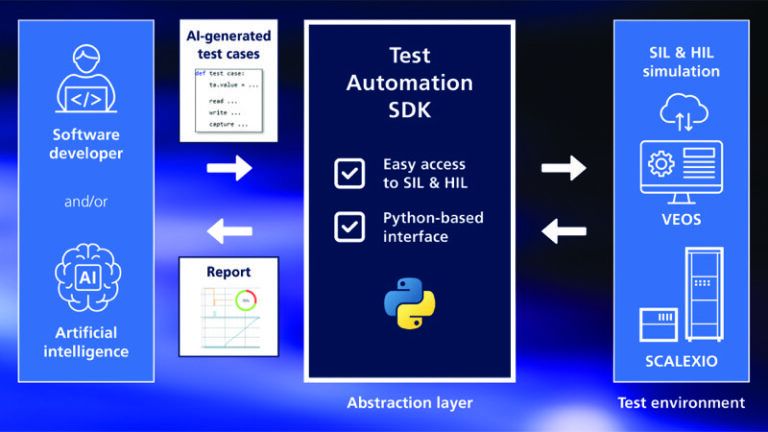
Aerospace systems are becoming increasingly software-defined and interconnected. However, teams are also under pressure to ensure faster development and comprehensive testing across complex architectures. This shift demands a holistic test strategy that minimizes the need to work with many different interfaces and distributed setups. dSPACE has introduced the Test Automation SDK, a software development kit that addresses these challenges.
At its core, the Test Automation SDK is an open, Python-based solution designed to streamline automated testing in future-proof workflows. The Test Automation SDK offers a unified API that serves as an abstraction layer across multiple heterogeneous APIs, enabling teams to create and execute test cases entirely in Python for both software-in-the-loop (SIL) and hardware-in-the-loop (HIL) environments.
This approach reduces the need for users to become experts in various APIs when using different tools and platforms. Instead, engineers define test scripts once and reuse them across simulation and real-time environments by adjusting only the configuration. This reduces the effort required to manage complex test setups, enabling engineers to focus on test design rather than tool integration.
The ability to reuse test scripts across SIL and HIL environments is an advantage in aerospace, where testing campaigns frequently evolve from early virtual SIL testing to system integration testing in an HIL test environment. The Test Automation SDK provides an abstraction layer that connects test cases with underlying simulation platforms, such as VEOS for SIL and SCALEXIO for HIL, ensuring consistency throughout the entire testing chain (see Figure 1).
The approach also ensures traceability and reproducibility by keeping test cases consistent across development phases, teams can reduce the risk of discrepancies and ensure that test results remain comparable from early design iterations to certification-oriented testing.
In addition, the Test Automation SDK is designed for AI-assisted testing. Test cases are written in Python and heterogeneous interfaces are abstracted so that common AI coding agents support the generation, extension, and maintenance of test scripts. This facilitates AI-supported workflows, reducing the manual effort required to create and execute test cases and analyze test reports. This methodology also facilitates support of processes like continuous integration and continuous testing (CI / CT), offering a pathway to increased efficiency without compromising validation strictness.
The use of Python also means engineers can write tests using frameworks such as pytest or Robot Framework and integrate them into established development environments and tool chains, including tools such as VS Code and Git. This code-centric approach aligns with modern CI/CT practices.
By embedding test automation directly into software workflows, teams can scale, adapt, and execute tests more frequently and earlier in development, improving defect detection and accelerating iteration speeds.
The Test Automation SDK open-source model aims to foster a collaborative ecosystem that can evolve alongside industry needs. When programs span long lifecycles and must adapt to new standards, this openness provides flexibility. Teams can tailor the Test Automation SDK to their specific requirements while benefiting from community-driven enhancements and shared best practices.
By unifying SIL and HIL testing, enabling AI-assisted automation, and integrating seamlessly into modern development workflows, the Test Automation SDK provides a scalable foundation for addressing the growing demands of aerospace system validation – today and in the future.