

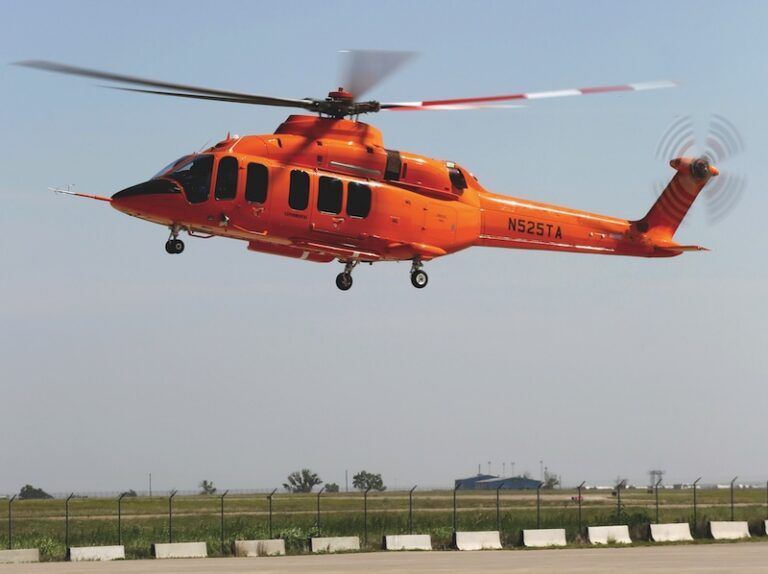
On the morning of July 6, 2016, some 38 miles (62km) south of Bell Helicopter’s XworX facility in Arlington, Texas, the first 525 Relentless prototype tore itself apart in clear skies during a test flight. Experimental test pilots Erik Boyce and Jason Grogan, both former US Marine Corps and graduates of the US Naval Test Pilot School, tragically lost their lives. The aircraft was the flagship of a program meant to give the world its first fly-by-wire commercial helicopter.
The crew was flying the last in a step-by-step series of tests checking how the helicopter recovers from a simulated engine failure at rising airspeeds. This final point was set at the helicopter’s redline speed of 213mph (343km/h), at about 2,000ft.
The test uses a software mode that mimics an engine failure by capping the power available from both engines. The main rotor slows to about 91% of normal speed. The pilot lowers the collective – the lever that controls how hard the blades bite into the air – but the rotor levels off at 92% instead of climbing back through 100% as a proper recovery requires.
At that combination of high forward speed and slow rotor, the five-bladed main rotor enters what engineers call “scissors mode”, rocking the mast back and forth about six times a second. The 6Hz motion bends the airframe and reaches the pilots’ seats, building to peaks of plus and minus 3 g – “nearly 40 times the normal vibration level seen in the experimental aircraft,” the National Transportation Safety Board (NTSB) later records.
Here the fly-by-wire controls turn against the crew. The seat motion drives the pilot’s arm, feeding a matching 6Hz oscillation straight back into the rotor through the collective. At the same time, the sensor package that normally damps unwanted motion mistakes the vibration for aircraft movement and commands a matching correction through the rotor controls, making it worse. Bell engineers tell investigators that “past experience had never shown a need for filtering the collective”.
The vibration runs for roughly 12 seconds after recovery begins. As the rotor speed decays further, blade flapping grows until, about 21 seconds into the test, the main rotor severs the tail boom and the aircraft breaks up. During the accident, the chase Bell 429 crew radio, “Hey, you’re flapping pretty good,” but get no reply.
The NTSB names the probable cause as “a severe vibration of the helicopter that led to the crew’s inability to maintain sufficient rotor rotation speed… and the resultant in-flight breakup”, noting the vibration “was not predicted during development”.
The investigation is hampered because the combined recorder is not powered. The telemetry survives, but the cockpit voice recording does not. Bell responds that “the vibration was the result of an unanticipated combination of very high airspeed with a sustained low rotor RPM condition.”
Bell’s fix is a collective-axis biomechanical filter designed to damp oscillatory inputs. The attitude and heading reference system filters are retuned and an automatic exit from one-engine-inoperative training mode at a critical rotor speed is added, with a distinct low-rotor speed aural tone. The fleet flies again on July 7, 2017, 366 days after the accident.