

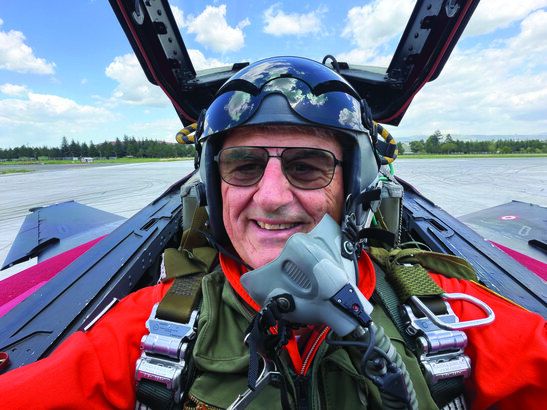
Giorgio Clementi, executive chairman and chief technology officer of the International Test Pilots School (ITPS) in London, Ontario, has flown more than 3,000 hours on over 80 aircraft types across four decades. He holds a postgraduate certificate in aerospace engineering from the University of Bristol. In September 2025 he received the Society of Experimental Test Pilots’ (SETP) JH Doolittle Award, adding to the Tony LeVier and Kelly Johnson awards he collected in 2022. He is a Fellow of both the SETP and the Society of Flight Test Engineers (SFTE), a rare distinction.
How did you get into flight testing?
My progression was unconventional. I started at the lowest rung, as an apprentice aircraft fitter in the South African Air Force. Through a block-release program I alternated practical with academic work, earning credits toward a national diploma in mechanical engineering.
That pattern continued well into my adult life. In the 1990s I completed a postgraduate certificate through the University of Bristol’s Integrated Graduate Development Scheme, the ideal academic complement to my practical experience. It made me a firm believer in exposing young engineers to the practical realities of aerospace early and building on that through academic study.
Is an engineering background important?
Absolutely. A graduate-level understanding is essential. The insight gained from working on structures, systems, powerplants and maintenance is invaluable for any aeronautical engineer, and particularly for flight test engineers and test pilots, who deal daily with design offices, airworthiness authorities and operational users. Working directly on aircraft generates enthusiasm, curiosity and context. Too often we lose potentially excellent engineers because they spend years studying theory before they ever see how it applies.
Why have you stepped back as CEO?
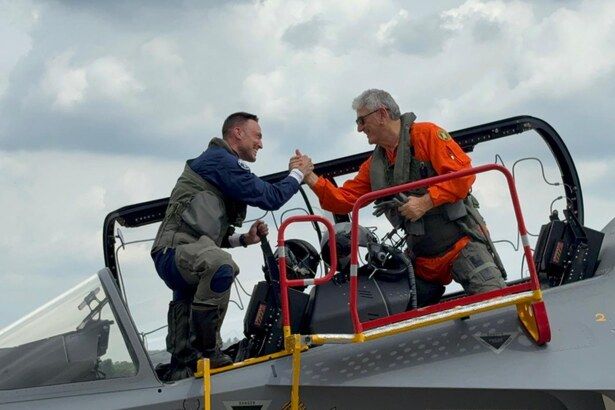
It was not an easy decision. Dave Lohse has impeccable professional credentials and has proven himself repeatedly, but that alone is not enough. Importantly, he has the temperament, judgment and leadership required for a demanding position on which the livelihoods of more than 200 people now depend.
ITPS operates in a highly competitive and rapidly evolving industry, and Dave understands our ethos of rigorous standards, responsiveness to customers and continuous innovation. I also felt it was time to slow down, at least a little, and Dave brought tremendous energy to the position. Long may that continue.
Which awards mean the most to you?
I have been fortunate to work both as an experimental test pilot and as a flight test engineer, so recognition by both societies is deeply meaningful. As a young entrant I read about Tony LeVier and was inspired by his story and later had the privilege of meeting him during an SETP technical tour in 1990.
He worked his way up from humble beginnings, learning aircraft maintenance, financing his own flying lessons and ultimately becoming chief test pilot at Lockheed. That journey resonates because I too began at the very bottom. His award also recognizes flight safety, which is especially meaningful given that we have maintained a fatality-free operation at ITPS for 25 years.
Kelly Johnson is a name known throughout aerospace. His Skunk Works is synonymous with innovation and technical excellence. The Doolittle Award is equally humbling – Jimmy Doolittle was among the earliest to combine exceptional piloting skill, engineering expertise and scientific rigor, and he helped transform aviation itself.
Honestly, I cannot identify one award that means more than the others. Each reflects an aspect of the profession and a personal journey that resonates deeply with me.

How important is writing to the job?
The purpose of flight testing is not simply to fly the aircraft – it is to generate data and knowledge. We tell students that it does not matter how skilled they are as pilots if they cannot accurately communicate what they observed during a flight. If you don’t document and analyze the results properly, the flight has little value.
Flight testing exists to generate data that characterizes aircraft behavior and determines whether it meets design requirements and certification standards. That requires accurate, disciplined reporting, and it is not unusual to spend six to eight hours producing reports after a single flight.
Another aspect people misunderstand is the level of discipline involved. Popular culture portrays test pilots as daredevils, but real experimental flight testing is highly structured and methodical.
Meaning flight testing can be repetitive?
Every flight is carefully planned, scripted, briefed and executed. Specific test points must be flown within precisely defined tolerances, often repeatedly and under tightly controlled conditions. Success depends on precision, concentration and discipline rather than bravado. Some forms of testing can be repetitive, and the ability to maintain focus and accuracy is one of the most important skills a test pilot can develop.
What makes a good test pilot?
Someone who prepares thoroughly. People assume exceptional stick-and-rudder skills are the defining characteristic, but although precise flying is important, preparation is more critical. A good test pilot studies the mission, understands the objectives, considers the associated risks and grasps how the results fit within the broader engineering and operational context.
They must be able to get on condition, stay on condition and execute the test accurately and repeatably. They must be disciplined, methodical and intellectually curious. The best test pilots are not necessarily the most naturally gifted – they are professionals who consistently prepare, execute and report to the highest standard.
How do you teach safety to students?
By the time most students arrive at a test pilot school they are already experienced aviation professionals who understand safety management, risk assessment and operational discipline.
What they often lack is an appreciation of how those principles apply within experimental flight testing, where we may be flying an aircraft in a configuration it has never flown before. That introduces risks that must be carefully identified, assessed and mitigated.
We integrate safety into every phase of training. Each mission includes a risk assessment, hazard analysis, contingency planning and post-flight review. Throughout the course we continuously evaluate students not only on technical competence but on whether they are developing the professional judgment and disciplined mindset required to conduct experimental flight testing safely.
How is the test pilot’s role changing?
Technologies like autonomy and distributed propulsion, and new aircraft types like eVTOL are introducing entirely new dimensions to flight testing. Tomorrow’s advanced vehicles begin as piloted demonstrators today. They are increasingly autonomous, so the industry is grappling with new questions about what constitutes a test pilot and how methodologies should evolve.
The industry is maturing. In the early days many organizations developing these aircraft had little understanding of flight testing. Today most serious manufacturers employ qualified test pilots and flight test engineers and are adopting more structured approaches.
There is debate about the future role of the test pilot. Is the operator of an autonomous vehicle conducting tests from a ground control station still a test pilot? How should we approach uncrewed combat air vehicles? My view is that the presence or absence of a pilot onboard is only one aspect. The essential qualities of a professional flight tester – technical knowledge, disciplined methodology, risk management, analytical thinking and sound judgment – remain unchanged whether the aircraft is crewed, remotely piloted or fully autonomous.
What is behind the success of ITPS?
Civilian test pilot schools provide an alternative to military ones, which have limited capacity and are focused on national requirements. As a commercial organization we can adapt quickly to changing demand and be competitive on pricing by constantly paying attention to efficiency and innovation.
Our aircraft are selected because they provide representative flight test training environments while avoiding the enormous operating costs of frontline military aircraft. We have led innovation in online education, hybrid learning, modular training programs and the integration of flight test training with postgraduate academic studies. These initiatives help make flight test education more accessible.
What is the next growth phase for ITPS?
More than 25 years ago I recognized that flight test training is ultimately a niche market. For long-term sustainability, ITPS needed to diversify. That led first into tactical training and, more recently, into maintenance, repair and overhaul (MRO). What began as internal efforts to maintain and upgrade our own fleet evolved into a considerable business capability.
Today we undertake aircraft upgrades, avionics modernization programs, structural life-extension projects and re-engining initiatives. MRO has become the third major pillar of the ITPS business alongside flight test training and tactical training.
The three divisions complement one another and leverage our core strengths in aerospace engineering, flight operations and technical innovation. Based on the momentum within all three, I believe the future of ITPS is extremely promising.
What advice would you give a budding test pilot?
The traditional route and gold standard remain industry or military sponsorship to a recognized test pilot school. But for those not fortunate enough to be able to follow that path, it is still possible – my own career is proof.
Learn everything you can about the profession. Engage with organizations such as SETP and SFTE, study their membership criteria and understand what qualifications and experience are valued.
Education is vital. There are technical papers, regulatory guidance and advisory circulars freely available. Of course the first requirement is to become a pilot and get experience. EASA-approved test pilot courses require a pilot to have at least 1,000 hours total flight time, including around 400 hours as pilot-in-command, and most candidates have substantially more.
You should try to fly different types, gain exposure to engineering and certification activities and look for entry-level positions on development and test programs. The routes differ between North America and Europe, and between military and civilian aviation. But the underlying principle is the same – never stop learning, never stop dreaming and never give up.