

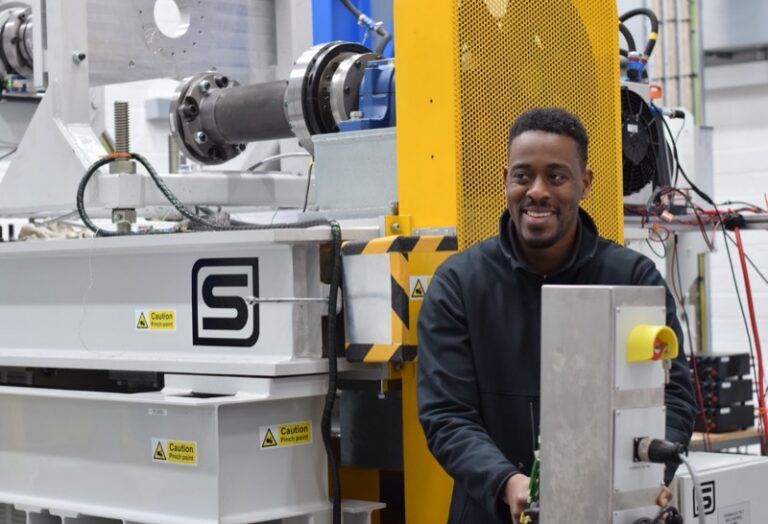
UK-based Hewland Engineering has commissioned a transmission tilt test rig at its Technical Centre in Southam, Warwickshire, allowing gearbox and drivetrain systems to be tested under controlled load at different operating attitudes.
Designed and specified by Hewland’s in-house engineering team, the rig was developed initially to meet the requirements of an eVTOL aircraft program. It is now being offered for wider aerospace, defense and off-highway applications.
The facility is fully accredited to AS9100 standards and forms part of Hewland’s wider testing and validation capabilities. By reproducing different pitch, roll and other operating conditions, engineers can investigate transmission performance before a system is installed in a complete vehicle or aircraft.
This is particularly important for systems in which lubrication and oil distribution can be affected by changes in attitude. The rig enables engineers to characterize factors including bearing durability, lubrication system performance, gear behavior, and noise, vibration and harshness.
The tilt rig provides fully loaded testing of transmission systems in any orientation from 0-90°, together with basic spin testing up to 34kW. The investment is backed by Hewland’s parent company, Hero Motors.
The rig forms part of a broader test suite at the Technical Centre. This includes the 3E test rig, capable of input speeds up to 11,000rpm, a maximum input power of 750kW and torque capacity of 1,200Nm, though power is limited to 500kW in the tilt configuration.
Other capabilities include gear shift quality assessment, which measures characteristics such as shift effort, tactile feedback and gate definition. A battery emulation system enables controlled testing of electrified drivetrains and transmission systems without the complete vehicle powertrain.
Mark Ingram, technical director at Hewland Engineering, said, “The tilt rig allows us to investigate dynamic transmission behaviours much earlier in the programme, giving engineers controlled, repeatable test data before the system reaches vehicle or aircraft-level testing. That can help identify design issues earlier and reduce the time and cost associated with subsequent redevelopment.”