

The UK’s Advanced Research + Invention Agency is investing £70 million to develop aircraft capable of operating persistently in the stratosphere to deliver communications coverage from above the UK.
The Advanced Research + Invention Agency (ARIA) is backing 18 projects through its Enduring Atmospheric Platforms program, with the £70 million (US$94 million) committed over 3.5 years.
The program funds work across three technical areas covering enabling technologies, systems integration and testing, and deployment and communications architecture. Its primary target is for an aircraft to supply 300W to a communications payload for a week while holding station in the stratosphere.
ARIA said the work aims to establish high-altitude pseudo-satellites (HAPS) as an intermediate layer between terrestrial networks and conventional satellites. The agency is deliberately supporting multiple aircraft designs rather than selecting a single approach.
Rico Chandra, programme director for Enduring Atmospheric Platforms at ARIA, said, “This research expands the UK’s leadership in high-altitude platforms to become the place where this industry is designed, built, and scaled. Getting there means backing bold ideas, from fixed-wing solar aircraft to designs nobody predicted, including aircraft that fly on spinning wings instead of propellers.
“Never before have rotorcraft flown the stratosphere. We have teams pioneering just that, which will involve setting new altitude records. This programme gives the UK three independent shots at world-changing breakthroughs.”
According to ARIA, no rotorcraft has previously operated in the stratosphere, and teams pursuing that approach will need to set new altitude records.
Among the funded teams is Menapia, a Leeds-based company whose CAROUSEL project is developing a fleet of multirotor aircraft to operate at altitudes of up to 65,600ft (20km) and form a persistent canopy over the UK.
The company plans to overcome the limited endurance of individual rotorcraft through a fleet-level rotation mechanism, cycling aircraft to sustain continuous coverage.
A separate approach comes from VFP Aerospace, whose Enduring Drone Networks project would use six-axis drones cycling between ground stations and the stratosphere. The company is targeting production costs of around £50,000 (US$67,000) per aircraft and operating costs of less than £10 (US$13) an hour.
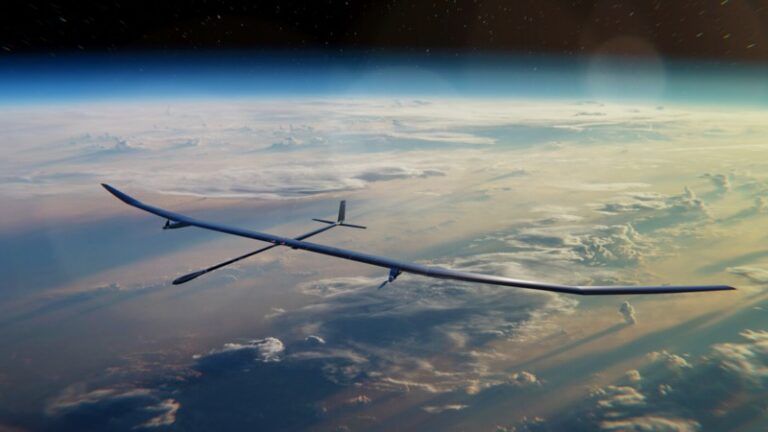
In the systems and testing strand, Prismatic, a BAE Systems company, has been awarded a £15.7 million (US$21 million) contract to fly its solar-powered PHASA-35 as the demonstration platform for a power-beaming system. The technology directs a ground-based energy beam at a receiver in the aircraft’s wing, aiming to sustain year-round flight regardless of daylight.
The program brings together universities, aerospace small and medium-sized enterprises and startups from across the UK, with teams in Aberdeen, Durham, Sheffield, York, London and Bath, alongside two teams from the US and Australia that will establish UK operations. The investment will run for 3.5 years as the projects work toward proving whether aircraft can provide persistent communications infrastructure from the stratosphere.
Major funded projects
The 18 funded teams span three technical areas. The full roster is published by ARIA.
Enabling technologies
- FlightDrive-HAPS — Hypanode (Ben Haberman): a breakthrough energy system intended to serve a range of airframes.
- µSODAR — University of Southampton (Bahareh Zaghari): micro airborne acoustic sensing for real-time atmospheric mapping.
- Structural Solar — University of Sheffield (David Lidzey): integrating perovskite photovoltaics onto carbon fiber to raise the specific power of stratospheric airframes.
- LIVINGSTON — Scalable Laser (Richard Hogg): laser diodes and photovoltaics for power beaming to enduring atmospheric platforms.
- STRAT-NAV — University of Bath (Neil Hindley): a £1.9 million (US$2.5 million) ‘stratospheric sat-nav’ that helps aircraft soar on atmospheric gravity waves to extend endurance. University of Bath
- EnduringWeather — SkySight Weather (Matthew Scutter): a unified HAPS forecasting and mission-planning platform.
- HAWK — Space Solar Engineering (Martin Soltau): radio-frequency power beaming for enduring atmospheric platforms.
- BEACon — MuWave (Gabriel Blackett): beamed energy for airborne continuity.
Systems integration and testing
- CAROUSEL — Menapia, Leeds (John and Peter Mooney): Continuous Atmospheric Relay Operations Using Swapping Electric Liftcraft, a fleet of multirotor aircraft designed to operate at up to 65,600ft (20km) and form a persistent canopy over the UK. Menapia
- Enduring Drone Networks — VFP Aerospace (Andy Cheadle): a relay of six-axis drones cycling between ground stations and the stratosphere for continuous coverage, targeting around £50,000 (US$67,000) per aircraft.
- Beyond fragile solar HAPS — Radical Inc (James Thomas): a robust, low-cost platform for enduring atmospheric operations.
- StratoLink — Voltitude (Steven Tate): a stratospheric platform project.
- PHASA-35 — Prismatic, a BAE Systems company (Chris Roberts): a £15.7 million (US$21 million) contract to fly the solar-powered PHASA-35 as a power-beaming demonstrator for year-round flight. BAE Systems
Deployment and communications architecture
- HAPS architectures for resilient sovereign communications, AI and computing — University of York (David Grace): communications architecture for sovereign, resilient high-altitude networks.
- AI-enabled HAPS communication infrastructure — Imperial College London (Kin Leung): AI-driven design of high-altitude communication infrastructure.
- Strato-Twin — Airspan, Slough (Paul Senior): a £2.3 million (US$3.1 million) AI-enabled digital twin to design, simulate and optimize HAPS communications networks. Airspan
- Project BASE — Foobaero (Hilary Costello, Graham Spelman and Jamie Lowrie): Baseline Assurance for Scalable Enablement, addressing assurance for scalable operations.
- Project Skybeam — Lumino Technologies (Omar Iqbal): a deployment and communications architecture project.