

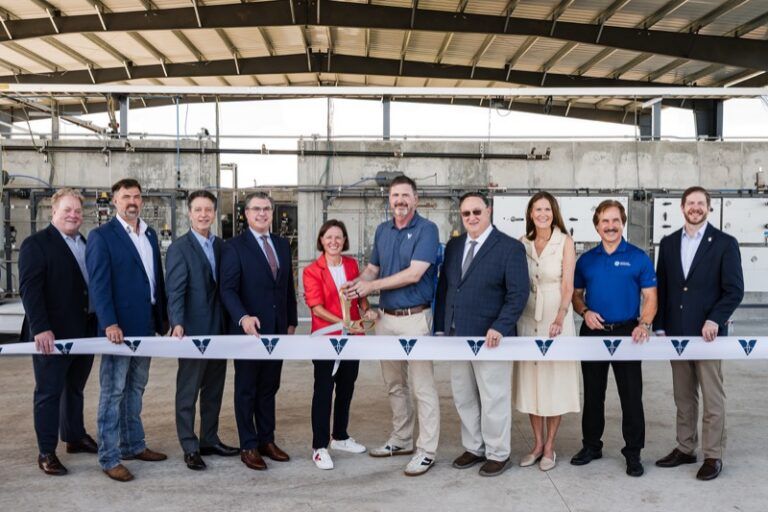
Venus Aerospace has opened a new propulsion test stand at the Houston Spaceport, Texas, to expand testing of its rotating detonation rocket engine technology.
The stand allows the company to test at higher thrust and for longer durations to more closely replicate mission conditions, and adds capacity as it scales integrated propulsion systems toward customer use.
The new stand works alongside Venus’s existing test infrastructure to increase the company’s overall testing capacity as it moves toward customer deliveries.
After a ribbon cutting ceremony last week, guests watched a live hot-fire of a Venus rotating detonation rocket engine (RDRE) on the new stand. An RDRE burns propellant in a continuous detonation wave rather than steady combustion, which developers say can deliver greater efficiency from a more compact engine.
Venus is designing its engine to be scalable and affordable for both defense and commercial missions.
Sassie Duggleby, CEO and co-founder of Venus Aerospace, said, “Building and testing propulsion systems at this pace requires the right infrastructure around the technology. We’re grateful to the Texas Space Commission and the State of Texas for investing alongside companies like Venus.”
The opening comes during a period of rapid growth for Venus, which closed a US$91 million Series B funding round this year and has expanded its leadership team and customer relationships. Founded in 2020, the company is backed by investors including Lockheed Martin Ventures and Airbus Ventures.
The stand builds on Venus’s first flight test of a high-thrust rotating detonation rocket engine in May 2025, which the company describes as a world first and which took place at Spaceport America in New Mexico. The engine is designed to help vehicles reach four to six times the speed of sound.
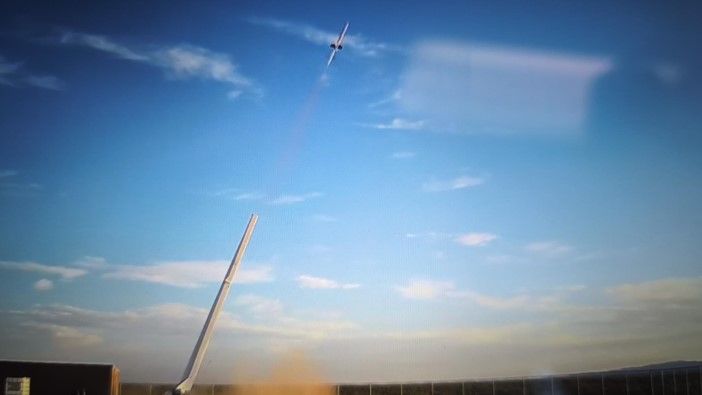
Venus is developing propulsion for defense, space and future high-speed flight. It has previously tested NASA-designed nozzles on its engines and flown a rocket-powered drone at supersonic speed, and says rotating detonation could eventually enable passenger flights such as Los Angeles to Tokyo in under two hours.
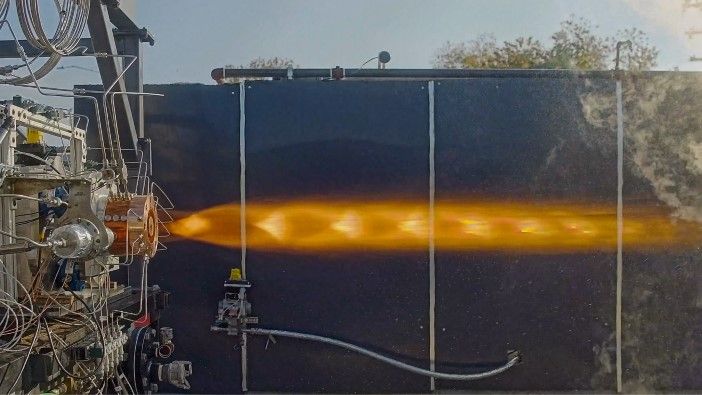
The new test stand was funded through the Texas Space Commission’s Space Exploration and Aeronautics Research Fund, and Venus said it was completed on time and on budget