

Aerospace Testing InternationalAerospace Testing International
  • News
    • A-E
      • Acoustic & Vibration
      • Avionics
      • Data Acquisition
      • Defense
      • Drones & Air Taxis
      • Electric & Hybrid
      • EMC
      • Engine Testing
      • Environmental Testing
    • F-L
      • Fatigue Testing
      • Flight Testing
      • Helicopters & Rotorcraft
      • High Speed Imaging
      • Industry News
    • M-S
      • Materials Testing
      • NDT
      • Simulation & Training
      • Software
      • Space
      • Structural Testing
      • Supplier News
    • T-Z
      • Technology
      • Telemetry & Communications
      • Weapons Testing
      • Wind Tunnels
  • Features
  • Magazines
    • March 2026
    • Dec 2025 / Jan 2026
    • Showcase 2026
    • August / September 2025
    • June 2025
    • March 2025
    • Archive Issues
    • Subscribe Free!
  • Opinion
  • Webinars
  • Events
    • All Events
    • Aerospace Test & Development Show
  • Podcasts
  • Videos
  • Suppliers
    • Supplier Spotlights
    • Press Releases
    • Technical Papers
LinkedIn YouTube X (Twitter)
Subscribe to magazine Subscribe to email newsletter Media Pack
Aerospace Testing InternationalAerospace Testing International
  • News
      • Acoustic & Vibration
      • Avionics
      • Data Acquisition
      • Defense
      • Drones & Air Taxis
      • Electric & Hybrid
      • EMC
      • Engine Testing
      • Environmental Testing
      • Fatigue Testing
      • Flight Testing
      • Helicopters & Rotorcraft
      • High Speed Imaging
      • Industry News
      • Materials Testing
      • NDT
      • Simulation & Training
      • Software
      • Space
      • Structural Testing
      • Supplier News
      • Technology
      • Telemetry & Communications
      • Weapons Testing
      • Wind Tunnels
  • Features
  • Magazines
    1. March 2026
    2. Dec 2025 / Jan 2026
    3. Showcase 2026
    4. August / September 2025
    5. June 2025
    6. March 2025
    7. Archive Issues
    8. Subscribe Free!
    Featured
    24th March 2026

    In this issue: March 2026

    Online Magazines By Web Team
    Recent

    In this issue: March 2026

    24th March 2026

    In this issue: December 2025/January 2026

    23rd December 2025

    In this issue – Showcase 2026

    5th November 2025
  • Opinion
  • Webinars
  • Events
    • All Events
    • Aerospace Test & Development Show
  • Podcasts
  • Videos
  • Suppliers
    • Supplier Spotlights
    • Press Releases
    • Technical Papers
LinkedIn YouTube X (Twitter)
Aerospace Testing InternationalAerospace Testing International
Opinion Structural Testing

The debrief: Boeing 787 – when the wing bent but the model didn’t

Ben SampsonBy Ben Sampson1st April 20263 Mins Read
Share LinkedIn Twitter Facebook Email
The 787 Dreamliner pioneered the large-scale use of composites in commercial aircraft

n May 2009, inside a test hall at Boeing’s facility in Everett, Washington, USA, engineers began bending the composite wings of static test airframe ZY997 upward. It was supposed to be routine – a limit load test applying forces equivalent to the most extreme loads the aircraft would ever experience in service.

It was not routine. Just above the limit load, with the wings deflected around 18ft (5.5m), the carbon fiber reinforced plastic at the wing-to-body join began to delaminate.

The damage centered on the 17 stiffening rods or stringers, running along the upper skin of each wing box. The co-cured composite stringers are bonded to the wing skins in an autoclave during production, forming a single structure.

At their inboard ends, where the Mitsubishi Heavy Industries-made wing box meets the center wing box made by Fuji Heavy Industries (now Subaru Corporation), each stringer terminates in a widened cap that makes the structural connection at the side-of-body join. Under load, the fiber layers at these caps ruptured and separated from the skin. The stringers effectively peeled away from the wing.

Corresponding damage appeared on the fuselage side of the join, inside the center wing box. The problem was bilateral, and significantly more complex to fix than anyone had anticipated.

The real sting was that Boeing’s computational models had not predicted the issue. The analysis showed a clear disconnect between what the finite element models expected and what the physical structure actually did.

The load path through the titanium fasteners at the side-of-body join was not transferring forces as designed. The resulting stress concentrations drove delamination at loads well below the 150% ultimate load target required for certification by the Federal Aviation Administration.
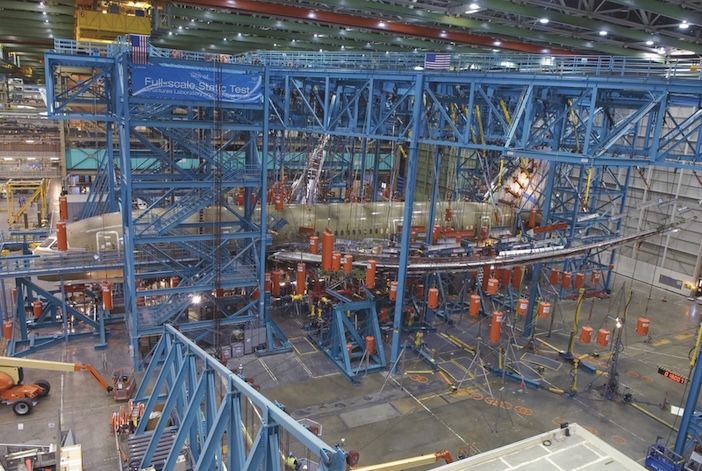
Static testing at Boeing’s Everett facility revealed delamination at the point where the wings join to the fuselage

Boeing attributed the failure to manufacturing problems, while insiders pointed to a design flaw. “The area in question is a few square inches in the side of body,” Scott Fancher, vice president and general manager of the 787 program at Boeing, reassured media at the time.

The fix, however, was anything but small. Engineers designed a modification that included U-shaped cutouts at each stringer end to redistribute load to the titanium fittings, with new reinforcement fittings installed at 34 stringer locations within the wing-to-body join.

On November 30, 2009, the modified ZY997 test airframe was retested and the wings deflected to the limit load with no delamination.

The 787’s first flight finally took place on December 15, 2009, around 18 months later than the schedule in place before the wing test failure.

On March 28, 2010, the aircraft passed its ultimate load test at 150% of maximum expected service loads, with the wings bending approximately 25ft (7.6m) upward.

According to the Seattle Times, Boeing’s chief structures engineer Jim Ogonowski described the moments approaching ultimate load as “the quietest 90 seconds on Earth in the control room.”

What was learned

The 787-wing test failure remains one of the most instructive case studies in composite primary structure certification. It demonstrated that delamination in large co-cured composite assemblies can behave differently from metallic failure modes, and that analytical models may not capture localized stress concentrations where different composite sections meet.

The case reinforces the important principle that the computer is a tool, not an oracle. For novel materials and structural configurations, full-scale physical testing is when you find out what the model does not know.

Share. Twitter LinkedIn Facebook Email
Previous ArticleAssessing the costs and benefits of the Artemis moon mission
Ben Sampson

Ben has worked as a journalist and editor, covering technology, engineering and industry for the last 20 years. Initially writing about subjects from nuclear submarines to autonomous cars to future design and manufacturing technologies, he was editor of a leading UK-based engineering magazine before becoming editor of Aerospace Testing in 2017.

Related Posts

Dr Mike Bromfield
Drones & Air Taxis

Academic insight: Solving cockpit design challenges for eVTOLs

18th March 20263 Mins Read
Opinion

Why materials science is the new frontier of space

4th March 20265 Mins Read
Data Acquisition

Q&A: Roman Bertschi, CEO of Elsys AG

18th February 20263 Mins Read
Latest Posts

The debrief: Boeing 787 – when the wing bent but the model didn’t

1st April 2026

Assessing the costs and benefits of the Artemis moon mission

1st April 2026

Airbus Racer compound helicopter reaches new flight test milestones

1st April 2026
Supplier Spotlights
  • Precision Filters, Inc. (PFI)
  • Evolution Measurement
  • CALCULEX
  • Hottinger Brüel & Kjær
  • AVL List GmbH
  • Tekna
  • InnovMetric
  • CGM CIGIEMME S.p.A.
  • SET GmbH
  • Tyto Robotics
    Tyto Robotics Inc.
  • Bartington Instruments
    Bartington Instruments
  • Ametek
    AMETEK Programmable Power
  • Delta Information Systems logo
    Delta Information Systems
  • Helling GmbH
    Helling GmbH
  • Matec Instrument Companies, Inc.
    Matec Instrument Companies, Inc.
  • Endevco
  • Ipetronik
    IPETRONIK GmbH & Co. KG
  • VJ Technologies
  • Durr NDT
    DÜRR NDT GmbH & Co. KG
  • Dewesoft
  • Bruker Alicona Dimensional metrology & surface roughness measurement
    Bruker Alicona
  • Vzlu
    VZLU – Czech Aerospace Research Centre
  • ATG Advanced Technology Group
    ATG – Advanced Technology Group
  • Dytran Instruments, Inc.
  • Kistler Group
    Kistler Group
  • Diversified Technical Systems (DTS)
  • Scanivalve Corporation
  • G Systems
  • CEC Vibration Products LLC.
  • dSPACE
  • Safran Data Systems
  • Photron
  • YXLON International
  • Telspan Data
  • TotalTemp Technologies, Inc.
  • Vector Informatik GmbH
  • Vibration Research
  • TEST-FUCHS
  • Siemens Digital Industries Software
    Siemens Digital Industries Software
  • PCB Piezotronics, Inc.
  • Testia
  • Treo – Labor für Umweltsimulation GmbH
  • W5 Engineering
  • National Institute for Aviation Research
  • North Star Imaging
  • MK Test Systems Ltd.
  • Intertek
  • I.N.C.A.S. – NATIONAL INSTITUTE FOR AEROSPACE RESEARCH “ELIE CARAFOLI”
  • FMV Test & Evaluation
  • Glenn L Martin Wind Tunnel
  • GRAS Sound & Vibration
  • Elsys AG
  • EMCCons DR. RAŠEK GmbH & Co.KG
  • European Test Services (ETS) B.V.
  • Chemetall GmbH logo
    Chemetall GmbH
  • Curtiss-Wright
  • Data Physics Corporation
  • AOS Technologies AG
  • Airmo Inc. Pressure Technologies
    Airmo Inc.® Pressure Technologies
Our Social Channels
  • Twitter
  • YouTube
  • LinkedIn
Getting in Touch
  • Subscribe To Magazine
  • Contact Us
  • Meet the Team
  • Media Pack
Related Topics
  • Aircraft Interiors
  • Business Jet Interiors
FREE WEEKLY NEWS EMAIL!

Get the 'best of the week' from this website direct to your inbox every Wednesday

© Copyright 2026 Mark Allen Group. All rights are reserved, including those for text and data mining, AI training, and similar technologies.
  • Cookie Policy
  • Privacy Policy
  • Terms & Conditions

Type above and press Enter to search. Press Esc to cancel.