

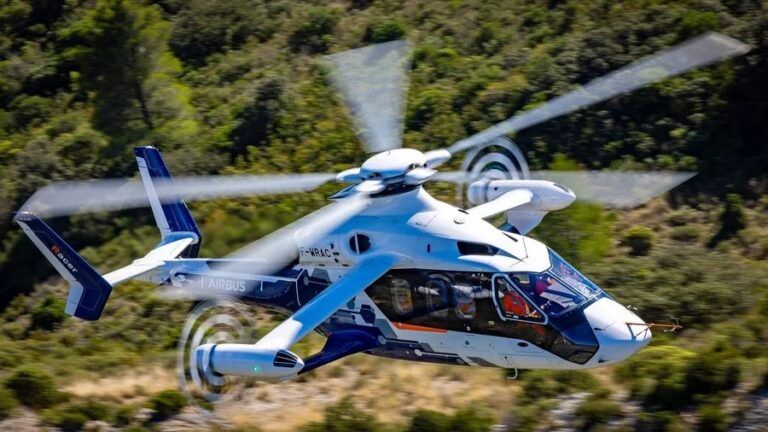
Airbus Helicopters’ Racer high-speed compound helicopter demonstrator has achieved several new flight test milestones as it continues to expand its flight envelope, with more than 50 flight hours now logged.
During the latest test campaign, the Rapid And Cost-Efficient Rotorcraft (Racer) completed a 14-degree slope landing, climbed to 10,000ft in 2 minutes and 44 seconds, and executed 2g turns at 230mph (370km/h). The demonstrator has also proven it can reach a cruise speed of 273mph (440km/h) while consuming 25% less fuel than a conventional helicopter.
Maneuvering milestones
The slope landing exploited Racer’s compound architecture by keeping the main rotor level and using the lateral propellers to angle the aircraft parallel to the terrain. This technique eliminates the complex maneuvering conventional helicopters require to match a slope, expanding potential landing zones.
The climb to 10,000ft was achieved while traveling at 162mph (260km/h), translating to a climb rate of 3,600ft/min — roughly twice that of a conventional rotorcraft. The aircraft was in its standard configuration rather than a stripped-down test setup.
During high-speed turns, the aircraft’s box wings took on the lifting load, freeing the main rotor and lateral propellers to focus on agility. Racer’s compound configuration also enables acceleration and deceleration while maintaining a constant altitude, unlike conventional helicopters that must pitch nose-down to accelerate.
As part of phase one of the European Next Generation Rotorcraft Technologies (ENGRT) program, guest military pilots from France, Germany and Finland flew the demonstrator. Allowing guest pilots on an experimental aircraft is typically permitted by regulators only when a design is proven to be exceptionally mature and stable.
Eco-mode testing to go-ahead
Racer is now preparing to test its eco-mode system, which will allow the pilot to put one of the two Safran Aneto-1X engines on standby during cruise. This is projected to reduce fuel burn by an additional 15% while maintaining a cruise speed of approximately 205mph (330km/h). The team also plans to validate a reduced acoustic footprint of at least 30% by programming optimal attitude and speed combinations into the flight control system.
The demonstrator, funded by the European Union’s Clean Sky 2 program, made its first flight in April 2024 at Marignane, France. It passed its target fast cruise speed of 253mph (407km/h) less than two months later, when chief test pilot Hervé Jammayrac pushed the aircraft to 260mph (420km/h). Racer builds on the Airbus Helicopters X3 technology demonstrator, which broke the helicopter world speed record at 293mph (472km/h) in 2013, and generates 45% less aerodynamic drag than a conventional helicopter.
Data to feed into design of next generation helicopters
Airbus Helicopters recently revealed two next-generation rotorcraft concepts for the NATO Next Generation Rotorcraft Capabilities (NGRC) study, one of which is a high-speed compound design drawing directly on flight test data from both the Racer and its predecessor X3 programs.
Military pilots who evaluated the Racer under the ENGRT program confirmed the performance benefits of the compound configuration, and Airbus said this data forms the foundation for its proposed next-generation military capability.