

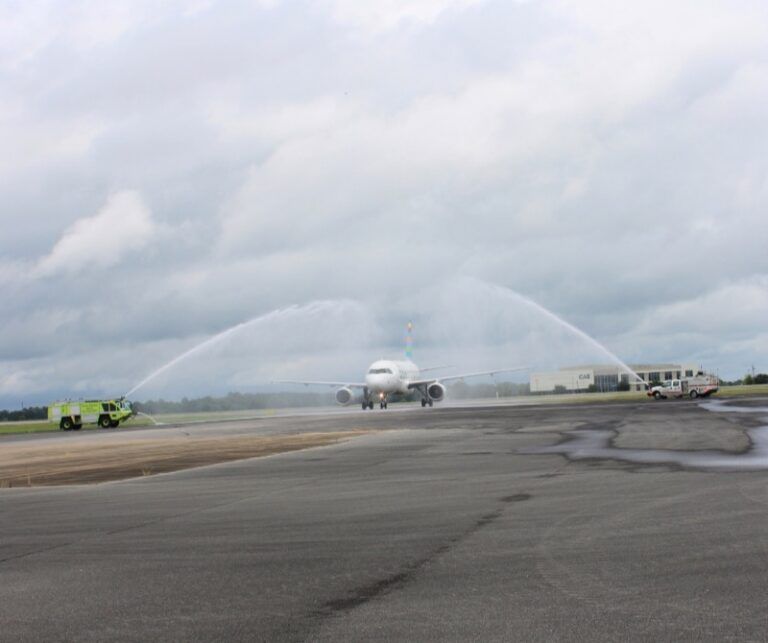
Neptune Aviation Services has taken delivery of its first Airbus A319, marking the start of a modification program that will make it the first operator to deploy the type as a wildfire airtanker.
The aircraft was delivered to Commercial Jet’s 400,000ft² (37,161m²) maintenance facility in Dothan, Alabama, where the conversion work will be carried out. Neptune, based in Missoula, Montana, selected the A319 after more than two years of evaluating candidates for firefighting conversion based on retardant capacity, fuel load, availability, and long-term serviceability.
Converting to the A319 will give an aircraft with a retardant capacity of 4,500 gallons (17,034 liters), compared with a maximum of 3,000 gallons (11,356 liters) in Neptune’s current fleet of BAe 146 airtankers. The aircraft also carries more fuel, reducing the need for frequent reloads and increasing time over active fires, according to Neptune.
Nic Lynn, vice president of operations at Neptune Aviation, said, “The acquisition of our first A319 is a pivotal moment for our organization and the wildland firefighting industry. The upgrade of our airtanker fleet is fully underway. We have a physical aircraft available that we can convert for aerial firefighting. Our team can start performing test flights, and we can start zeroing in on completing the modifications that must be made to have the aircraft ready for 2028.”
Neptune partnered with France-based engineering firm Aerotec & Concept, an Expleo company, to design the modifications that Commercial Jet will implement at its Alabama facility. Neptune recently completed its Critical Design Review of the A319, with all major design decisions finalized and engineers beginning to develop manufacturing drawings.
Test flights are expected in the coming weeks. Commercial Jet is expected to complete modifications within 18 months, putting the aircraft on track for the 2028 wildfire season. Next-generation firefighting aircraft capable of carrying greater retardant loads have been a focus of increasing development activity as wildfire threats grow in scale and complexity. Simulation tools are also being developed to support the certification and training pipeline for these platforms.
Jennifer Draughon, president of Neptune Aviation, said, “As wildfire threats grow in size and complexity, we are investing in the next generation of airtankers to continue to deliver the capabilities expected by our agency partners and the communities we protect. This marks a significant milestone as we work toward adding the A319 to our fleet.”