

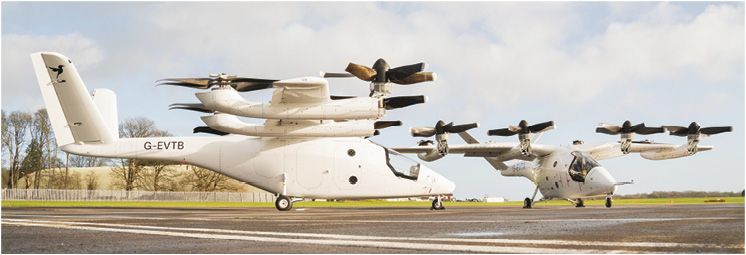
When Vertical Aerospace’s chief test pilot Simon Davies lifted off vertically from Cotswold Airport on April 14 in the VX4 prototype, climbed away on rotor thrust, tilted the front propellers forward to fly on the wing, and then reversed the sequence to land back in a hover, the company joined a handful that have reached that point in eVTOL aircraft development. Vertical’s CEO Stuart Simpson called the two-way piloted transition “the most significant technical milestone in our history”.
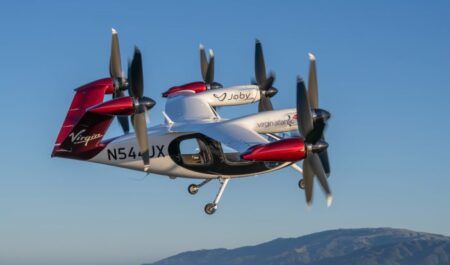
Vertical says it was the first such maneuver flown by any tiltrotor eVTOL under civil aviation Design Organisation Approval (DOA) oversight – a qualifier that excludes Joby Aviation’s earlier two-way transition, which was conducted under FAA Type Certification rules rather than a DOA framework. The distinction matters given Vertical’s target to certify the Valo, its production aircraft, with the UK Civil Aviation Authority (CAA) and the European Union Aviation Safety Agency (EASA) by the end of 2028.
But the flight happened several months later than planned. And now, with up to US$850m in fresh financing agreed, a critical design review (CDR) targeted for the third quarter of this year and US rivals Joby Aviation and Archer Aviation pulling ahead in the FAA process, this is a crunch year for Vertical. One where months matter as its engineers begin work to translate rigorous testing and development into a certified aircraft.
Prototype to production
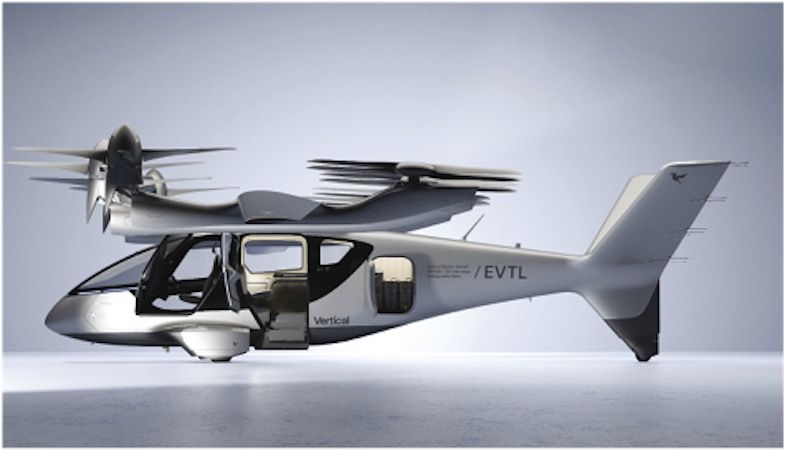
In December 2025, Vertical revealed the Valo, an evolved four- to six-passenger eVTOL with a refined fuselage, reshaped wingtips, contoured propulsion booms, a lowered V-tail incorporating a ventral fin and tailwheel fairing, with a tailwheel in place of the previous tricycle gear. Eight liquid-cooled battery packs sit beneath the floor and power eight propellers, with the four forward units now four-bladed rather than five-bladed and tilting for cruise. Target cruise speed is 150mph (241km/h) over a range of 100 miles (161km).
A third and final VX4 prototype was rolled out in December 2025 to double flight-test capacity and support public demonstrations through 2026, including at the Farnborough International Airshow in July. The aircraft will later be retrofitted as a hybrid-electric demonstrator scheduled to begin flight testing in mid-2026.
Testing-led design
The VX4’s four-phase flight-test program has run parallel to a broad ground-test campaign. In Phase 1, completed in September 2024, the second-generation prototype flew 20 tethered piloted sorties covering 70 individual test points, including deliberate single Electric Propulsion Unit (EPU) failures introduced to validate the automatic aircraft response – the remaining engines ramping to maximum power – under closed-loop flight control.
Phase 2 thrust-borne trials followed, completing in February 2025, and Phase 3 wingborne flights, conducted in 2025 by Davies and test pilot Paul Stone, covered 250 miles (400km) at speeds up to 138mph (222km/h) and altitudes near 2,000ft, generating more than 22 billion data points across aerodynamics, acoustics and system performance.
Meanwhile laboratory and ground-testing was carried out. ATA Engineering – the company that conducted ground vibration testing (GVT) on the US$10bn James Webb Space Telescope – installed eight heavy-duty shakers and 350 accelerometers on a suspended airframe. ATA’s GVT methodology identifies modal characteristics – natural frequencies, mode shapes and damping ratios – to update finite-element models and improve flight-flutter analysis.
Vertical Aerospace also subjected each propeller blade to around seven million fatigue cycles to demonstrate margin over projected service life. The company’s engineers also dropped a complete battery pack from a 50ft (15.2m) height to qualify the pack against rotorcraft fuel-tank crashworthiness standards.
The 50ft drop height aligns with the FAA’s 14 CFR 27.952 and 29.952 rotorcraft fuel-system test, which EASA has adopted as a starting-point Means of Compliance for eVTOL battery systems under SC-VTOL. A full-scale thermal runaway propagation test on a battery sub-pack demonstrated containment of a single-cell failure within its module, with sufficient venting, thermal isolation and structural integrity to allow safe flight and landing. Such work indicates how Vertical is pushing at the limits of the established type-certification basis.
Certification
All of Vertical’s flight testing since 2023 has been conducted under CAA oversight, within the EASA Special Condition VTOL (SC-VTOL) framework, with what Vertical describes as transparent pass/fail criteria. SC-VTOL places Valo in the Enhanced category as intended for commercial passenger operations. This mandates a catastrophic failure target of 10 -9 , equivalent to no more than one catastrophic event in a billion flight hours, the same level required of large commercial transport aircraft under CS-25.
The framework also requires Design Assurance Level A (DAL-A) for electronic hardware under DO-254 and software under DO-178C, the most stringent levels in each standard. They apply to items whose failure would be catastrophic and demand formal verification, structural coverage analysis and tightly controlled development processes. The aircraft uses Honeywell’s compact fly-by-wire system, controlled through the Anthem flight deck and dual sidestick inceptors.
The propulsion system is being qualified to the same standard. In February 2026 Vertical signed a long-term agreement with UK supplier Evolito, which holds its own CAA DOA, to supply EPUs with DAL-A power electronics and to co-certify them with the CAA and EASA. David King, chief engineer at Vertical Aerospace, says the approach is “grounded in rigorous engineering and certification discipline.”
Vertical believes this regulatory focus, applied from day one, will translate downstream and that a CAA and EASA Type Certificate will be readily validated by Brazil’s ANAC, Japan’s JCAB and ultimately the FAA.
Schedule under pressure
If Valo achieves certification on schedule is another question. Briefing analysts on May 6, Simpson said the late-2028 target was “under additional risk” and that the delayed transition flight could “nudge” it further, although he insisted 2028 was “absolutely do-able”. The CDR is now expected in Q3 2026, and the company says the design baseline is largely locked, with all long-lead-time items selected. The maiden flight of the first of seven Valo certification aircraft is forecast for 2027, with further airframes built as ground-test articles.
Meanwhile financially, the company has done what was needed to stay in the race.
Vertical estimated in 2025 that certifying Valo would cost around US$700 million. With cash falling from US$93 million at the end of 2025 to US$58 million by March 24, 2026 against a planned annual spend of US$180-200 million, the financing facility of up to US$850 million agreed in principle with Mudrick Capital and Yorkville Advisors in April lifted immediate going concern warnings.
A crowded race
Vertical is not certifying Valo in isolation. Joby Aviation, the FAA’s reference case for powered-lift certification, flew its first FAA-conforming Type Inspection Authorization (TIA) aircraft on March 11, 2026 and in late March completed Stage 4 of the FAA process – the airworthiness conformity review. In April 2026 Archer Aviation closed Stage 3 of the FAA’s certification process. Both target initial US operations this year under the White House’s eVTOL Integration Pilot Program.
Joby and Archer have larger balance sheets than Vertical. Joby holds approximately US$2.5bn in cash, Archer around US$1.8bn – and has strategic investors Toyota and Stellantis acting as manufacturing partners. Beta Technologies has taken a cargo-first route. Volocopter was rescued from insolvency in March 2025 by China’s Wanfeng Auto Wheel, owner of Diamond Aircraft, while Lilium ceased operations in February 2025.
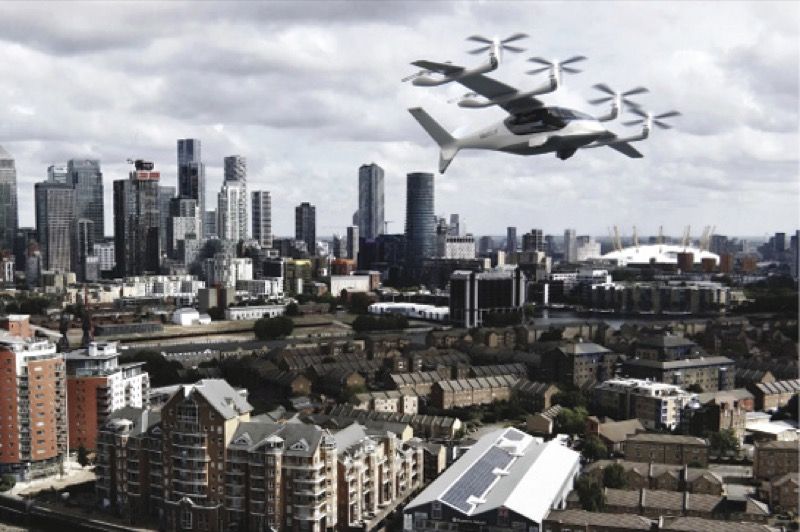
Vertical’s pitch hinges on geography and regulation with a CAA and EASA type certificate and a credible UK launch network. Skyports and Bristow are targeting a London Heathrow to Canary Wharf operation shortly after certification. According to the company the order book stands at around 1,500, with recent additions from JetSetGo in India and Heli Air Monaco. Honeywell Aerospace’s Dave Shilliday, vice president and general manager of advanced air mobility, says Vertical is taking “a rigorous, certification-led approach to electric aviation”.
The next transition
The Valo program has produced the world’s first piloted two-way transition under DOA. For a category of aircraft without a settled type-certification basis, the test data being generated is valuable.
But Valo’s transition into a certified commercial aircraft is an even more difficult and complex challenge, one yet to be achieved by any eVTOL developer.
Like those competitors, Vertical has expectant investors, an order book, and a test and certification campaign running to a tight schedule. The next 18 months has many hurdles: CDR closure, the first Valo flight, the hybrid-electric demonstrator’s entry into testing, and sustaining access to capital, to name but a few. How successful Vertical is in surmounting these will decide if the Valo is certified in late 2028, if it is overtaken before it arrives, or if it gets there at all.