

Researchers at the University of Glasgow have developed flight simulation software capable of modeling the complex interactions between helicopter rotors, wildfire behavior and water drops in real time, in what they describe as a first for aerial firefighting training.
The prototype software, developed as part of the Daedalus I flight simulation framework, runs on consumer-grade GPU hardware and is designed to replace the pre-computed environmental models typically used in conventional flight simulators. The work is published in the CEAS Aeronautical Journal.
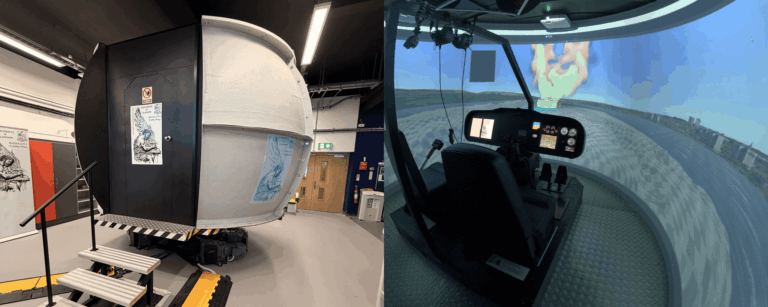
The system uses an in-house aerodynamic solver, HLBM2, based on the Lattice Boltzmann Method, a technique that enables rapid calculation of fluid physics through massive parallel processing on GPGPU hardware. The team ran the software on an Nvidia RTX 4090 graphics card and tested it on the university’s Daedalus 1 flight simulator.
The software models the physics of the atmosphere, the fire, water deployment and the helicopter simultaneously. A key capability is its modeling of two-way coupling between the fire on the ground and the helicopter’s rotor wake. In one test scenario, a simulated helicopter flying at 20kt toward a fire sent its rotor wake ahead, intensifying the blaze and generating a fresh plume that the helicopter then flew through seconds later.
“That kind of interaction is impossible for a pre-computed simulator to create and shows the potential that a more real-time realistic system could have for pilot training,” said Professor George Barakos of the James Watt School of Engineering, the paper’s corresponding author. He added that the software calculates fluid dynamic interactions at 60 frames per second or more, fast enough for seamless communication between the simulation components and the motion platform.
Postgraduate student Oyedoyin Dada, one of the paper’s lead authors, said: “Supercomputers are capable of simulating fluid behavior, but it’s not practical to use that level of power in flight simulators. What is urgently needed instead is more accessible simulations which harness the power of GPU processors to model the interactions between the plume coming from the fire and the wake of the aircraft.”
The system also models individual water droplets as they fall from the helicopter, calculating their effect on the fire and feeding updated data back into both the fire and atmospheric models.
The team said the next step is real-time testing with experienced pilots, followed by the development of an intelligent low-level control system that could learn from the simulation data to stabilize the aircraft in flight, reducing pilot workload during firefighting operations.
The research was supported by funding from the University of Glasgow and the Engineering and Physical Sciences Research Council (EPSRC). Dr Tao Zhang of the University of Glasgow and Dr Lu You of Guizhou University in China co-authored the paper.