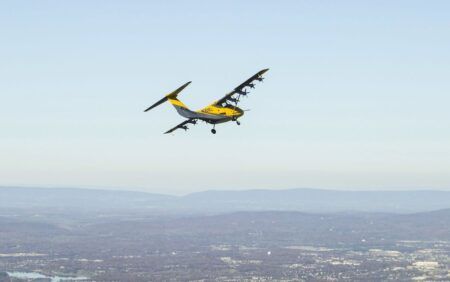


The European Commission has granted its official patronage to Climate Impulse, the project aiming to make the first non-stop, zero-emission flight around the world powered entirely by green hydrogen.
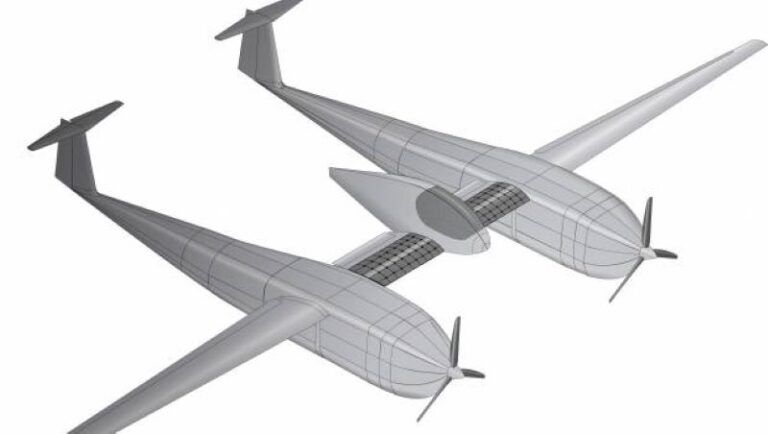
Led by explorer Bertrand Piccard and composite-materials engineer Raphaël Dinelli, Climate Impulse is developing a liquid-hydrogen, fuel-cell-electric aircraft, now under construction in France, with take-off targeted for 2030. The patronage, granted by European Commission Executive Vice-President Stéphane Séjourné, aligns the project with the bloc’s climate, innovation and industrial strategy.
Raphaël Dinelli, co-founder and head of engineering at Climate Impulse, said, “Climate Impulse is first and foremost an engineering challenge. To achieve a non-stop round-the-world flight powered by green hydrogen, we must integrate and optimise technologies that have never before been combined in an aircraft of this scale and mission profile.
“The project requires advances in hydrogen storage, fuel cell integration, energy efficiency, lightweight composite materials, and aircraft systems architecture. The European Commission’s patronage highlights the strategic importance of these innovations and their potential applications beyond aviation.”
The aircraft uses an electric propulsion system powered by fuel cells running on liquid hydrogen. Once built, the propulsion system will undergo a two-year flight-test program ahead of the 2030 attempt, following design work that began in 2021 with support from aircraft manufacturers Airbus and Daher, along with Capgemini and ArianeGroup.
The project’s main partners are Belgian materials company Syensqo, OCP Group and Morocco’s Mohammed VI Polytechnic University, with Breitling and Orange as official partners. Syensqo, the technology partner, is supplying advanced composite structures and fuel-cell materials, including proton-exchange-membrane technology, to improve efficiency and range.
Séjourné said granting the patronage was a natural choice, framing green hydrogen as a strategic sector for Europe’s decarbonization and industrial competitiveness, and describing the aircraft as one that would carry the European flag on the path to a cleaner world.
Piccard, who is also a special advisor on renewables and energy efficiency to European Energy and Housing Commissioner Dan Jørgensen, said, “At a moment when Europe is questioning its role on the global scene, we have to show what European innovation is capable of achieving.”
Piccard made the first non-stop round-the-world balloon flight in 1999 and flew the solar-powered Solar Impulse around the world in 2016, and the new project applies the same demonstrator approach to hydrogen propulsion.