

by Jack Roper
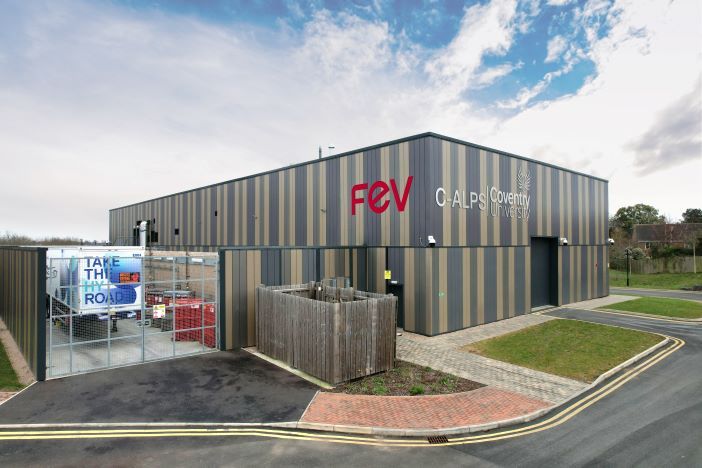
As our climate worsens, decarbonization becomes an increasingly pressing imperative for aircraft, manufacturers. Coventry University and engineering services company FEV co-created the Centre for Advanced Low-Carbon Systems to develop the varied propulsion technologies this endeavor demands.
“We have five propulsion test cells, initially designed to test combustion engines and upgraded to support other low-carbon powertrains,” says C-ALPS director, Dr Simon Shepherd. “Each has gasoline, diesel and hydrogen fuel supply and battery emulation capability.
“Dynamometers provide mechanical load, or we can power an electric drive test bench. The cells have water coolant and air extraction for fumes or leaked hydrogen.”
FEV (Forschungsgesellschaft für Energietechnik und Verbrennungsmotoren) primarily use these test cells for contract powertrain testing, while specialized laboratories accommodate fundamental component and subsystem research. There are laboratories for high and low-voltage electronics, hydrogen testing and
cell prototyping.
“We do battery characterization and research into diagnostic techniques,” says Shepherd. “We want to understand the levers that improve battery performance, whether through faster charging or improved lifetime, energy-density or power density.”
C-ALPS creates an unfenced continuum of academic and commercial research. Coventry University has a history of facilities like the Institute for Advanced Manufacturing and Engineering based on strong industrial partnerships. In 1978, FEV started life as an offshoot of Germany’s Aachen University, where it maintains close research collaboration.

“By 2013, we sought a similar university collaboration to serve our UK customers,” explains FEV UK managing director, Dr Jörn Behrenroth. “Coventry had ambition and consider themselves a disruptor. For German companies, building in the UK is hard, but it’s what the University does. We share facilities, coordinate investment and drive the topics we want to work on.”
FEV’s long-term tenancy gave Coventry confidence to invest in propulsion system test capabilities at a scale beyond most universities. FEV co-funds PhD studies and underwrites the industrial relevance of academic research.
“Our international operations mean we understand industry needs and can provide industrial data,” says Behrenroth.
“A PhD student developing a battery optimization control algorithm can spend months creating a model to test the algorithm. FEV already has those models, meaning that they can focus on developing and testing the solution.”
Hydrogen conversion
First conceived as an engine testbed, C-ALPS evolved to accommodate electrification projects. By 2020, it was clear that hydrogen, too, had a role in transport decarbonization and the partners invested £3 million (US$3.7 million) over two years in hydrogen testing capabilities.
“Coventry University funded conversion of one test cell to show it made sense,” Behrenroth says. “FEV followed up with a major upgrade of the other cells. It is sometimes hard for commercial organizations to make an upfront investment case. Now, we can start with a small, tentative step to test the market.”
Already, C-ALPS has secured £4 million (US$5 million) in hydrogen testing contracts and committed to a long-term supply of hydrogen in industrial quantities, benefitting both commercial and academic research. Completed in 2021, a 100m2 fuel cell laboratory enables cost-effective short-stack research.
“A short, 10kW fuel cell stack may be a subset of the 100kW stack needed for vehicle propulsion,” Shepherd explains. “It allows sub-scale testing of new materials or core performance in different conditions at reduced cost prior to scaling up.”

Scaling up
Dr Oliver Curnick leads Coventry University’s Hydrogen Energy Research Group, which studies both hydrogen propulsion and production. Curnick sees hydrogen conversion as primarily a challenge of scaling, which partnership with FEV enables Coventry scientists to realistically address.
“University labs usually have subscale systems,” says Curnick. “Fuel-cell electrodes may be 25cm2. FEV’s more capable infrastructure facilitates testing at application scale, with several hundred electrodes, making our research relevant to the scale-up challenges facing the industry. We’re developing in-situ sensors to measure oxygen concentrations inside fuel cells. Evaluation at proper scale shows us how to improve their performance in real systems.”
Coventry University works with industrial partners on FEV-led projects and through its own direct contracts. C-ALPS battery prototyping facilities enable academics to fabricate and test new cell technologies in automotive application formats. C-ALPS participates in government- or EU-funded collaborative projects such as CoacHyfied, to which FEV involvement maintains good post-Brexit access.

“We have PhD research studies fully or part-funded by industrial partners, with access to some facilities,” says Shepherd. “Those have a slower drumbeat but can kickstart ideas with low investment. We can have a student working on a tiny scooter motor and a full-scale commercial engine test in adjacent rooms.”
The C-ALPS approach is multi-sector and technology agnostic. While hydrogen may prove apt for zero-emissions coaches and trucks, passenger cars seem set on a different course for electrification. Here, work is focused on improving the practicality of battery-electric vehicles (BEVs) by enabling rapid charging without compromising battery lifetime.
“Battery prototyping helps customers look at new materials,” says Shepherd. “Developing advanced sensing techniques to monitor and understand the internal parameters of batteries could enable us to better model and manage them in use.”
Battery and hydrogen propulsion systems must aspire to the maturity of traditional engine technology optimized over a hundred years. Today, BEV owners are advised not to fully charge and effectively carry 20% spare capacity just to safeguard battery lifetime.
“Engine testbeds measure cylinder pressure, internal temperatures and model swirl patterns,” says Behrenroth. “We want to do the same for other technologies. In-situ sensors will reveal how electrochemical processes impact cell longevity and enable smaller, lighter batteries to operate with less safety margin.
“The University is developing a microprocessor to distribute internal sensor information to a battery management system.”
Novel in-situ sensors will illuminate processes internal to both batteries and fuel cells. By 2040, FEV projects that 86% of passenger cars will be battery-electric, 12% powered by fuel cells and 2% by hydrogen combustion. Curnick anticipates a niche market for hydrogen cars.

Large aircraft
Aircraft fulfill extended mission profiles and while batteries may power urban air taxis, Shepherd perceives a consensus that hydrogen turbines or fuel cells must propel larger, regional aircraft. C-ALPS can test fuel cell powertrains to 500kW-scale and short-stack tests could deliver power-density increases to meet volumetric and weight constraints in aircraft design.
“eVTOL aircraft may benefit from cross-fertilization with validated automotive powertrain optimization,” says Behrenroth. “We do commercial cell-testing for aerospace manufacturers. We can put a powertrain with a fuel cell in a test cell, apply a load and run powertrain-in-the-loop simulations to derisk development.”
Curnick doubts the sufficiency of hydrogen storage for long-haul flights on wide-body aircraft. Currently, he believes combustion offers the most viable hydrogen propulsion system, but expects fuel cell systems to exceed the power density of turbines and become viable for smaller aircraft by the mid-2030s.
“Even light aircraft will need liquid hydrogen to achieve required power densities,’ says Curnick. “Therefore, we must develop methods and technologies for handling hydrogen at cryogenic temperatures – transfer lines, compressors, dryers, flow-meters – robust and reliable enough for commercial aerospace.”
C-ALPS research into hydrogen production explores novel technologies for improved efficiency of energy-intensive hydrogen compression. Some 95% of UK-produced hydrogen is derived from methane, a greenhouse gas 30 times more potent than CO2 undesirable in the energy system. C-ALPS aspires to develop efficient means of electrolysis yielding more hydrogen per kilowatt-hour of electricity.
“The fundamental source of renewable energy underlies any mix of technologies, whether we use it to make hydrogen or charge batteries,’ says Shepherd. “The roadmap to that doesn’t yet exist. Then building the hydrogen economy is a chicken-or-egg problem. Nobody will buy hydrogen vehicles with nowhere to refuel them – so investors see no market for hydrogen production.”
A shortage of expertise is a barrier to developing battery and hydrogen propulsion systems. Coventry University is fast-tracking people with relevant skills.
“Rapid transition away from combustion engines is creating opportunities,” says Shepherd. “There are new players and OEMs trying to shift their technology. But everyone’s struggling to find people with the relevant skills. We’re transitioning our degree programs and offering industrial partners retraining courses.”
Transfixed by the magic of electrolysis as an undergraduate, Curnick has seen successive cycles of hype and disillusionment around hydrogen. This time, he believes it will stick, but he still sees commercial and technical risks in developing propulsion systems or electrolytic production capacity.
“Development needs to be supported by government policy,” he says. “The Potsdam Institute recently compared historical scale-up rates of different technologies. It found a 6000-fold increase in electrolytic capacity would be needed to reach net zero by 2050. The only technology in history to scale faster than that was Covid-19 vaccines.”