

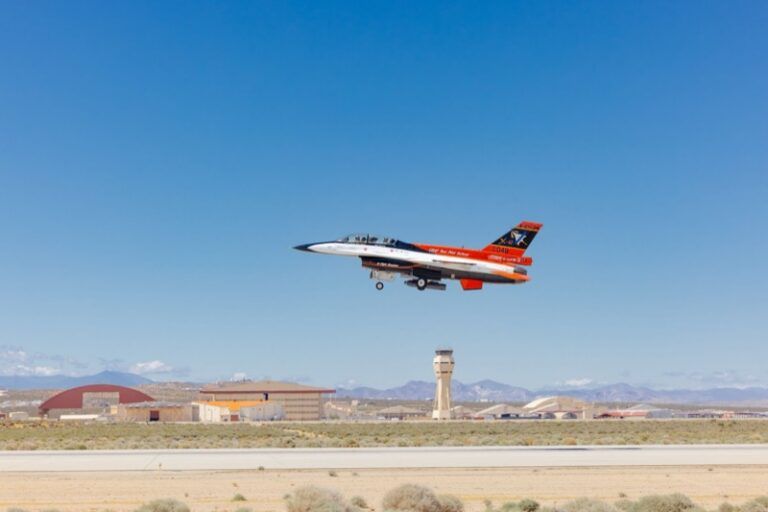
The X-62 VISTA has demonstrated an artificial-intelligence agent autonomously intercepting an airborne target using live infrared sensor data, during two accelerated test campaigns at Edwards Air Force Base in California.
The US Air Force Test Pilot School (TPS) Research Division ran the two programs, HAVE HEAT and HAVE HOLIDAYS, in parallel throughout April 2026. Both were driven by the Test Resource Management Center’s X-62 Mission Systems Upgrades (MSU), part of a drive to safely accelerate artificial intelligence (AI) and autonomy for military use.
In HAVE HEAT, the X-62 used Lockheed Martin’s Infrared Search and Track Legion Pod to feed live infrared data to onboard AI agents, which directed the aircraft to intercept an airborne target in real time. The school described the result as AI-driven control of multiple sensors and air vehicles.
Lt Col Joshua Strafaccia, dean of faculty for research at the Test Pilot School, said, “HAVE HEAT represents a meaningful expansion of avionics capability towards integrated, AI-driven control of multiple sensors and air vehicles for mission autonomy. This bridges a capability gap and positions us to test advanced autonomy faster.”
HAVE HOLIDAYS focused on integrating a suite of modular technologies into the X-62’s Enterprise Open Mission System Architecture computer. This included adding a non-prime, third-party autonomous agent, testing enhanced safety rules that stop autonomous aircraft breaching user-set operating limits, and further chip integration for advanced sensor exploitation.
The system-of-systems test served as technical risk mitigation for the logistics and integration frameworks needed to maximize flight opportunities after the upgrades. All ground testing was completed within three months, with both campaigns run in parallel under compressed timelines.
The next phase of the Mission Systems Upgrades will add the RTX PhantomStrike radar, expanded sensor and computing capacity, and modern networked data communications. The Air Force said completing the work would make the X-62 a foundational enabler for its highest-priority programs.
Col Maryann Karlen, commandant of the Test Pilot School, said, “X-62 is continued proof that an agile, dedicated team can rapidly advance Department of War initiatives through intentional collaboration. Accomplishing these significant milestones is a direct reflection of the adaptability and warfighter focus personified by all members of the school.”
Maintained through the Test Pilot School under the Air Force Test Center, the X-62 VISTA – the Variable In-flight Simulator Test Aircraft – is a modified F-16 used as an in-flight simulator and autonomy testbed. The school is to host the inaugural X-62 Research Symposium at Edwards on August 11-13.