

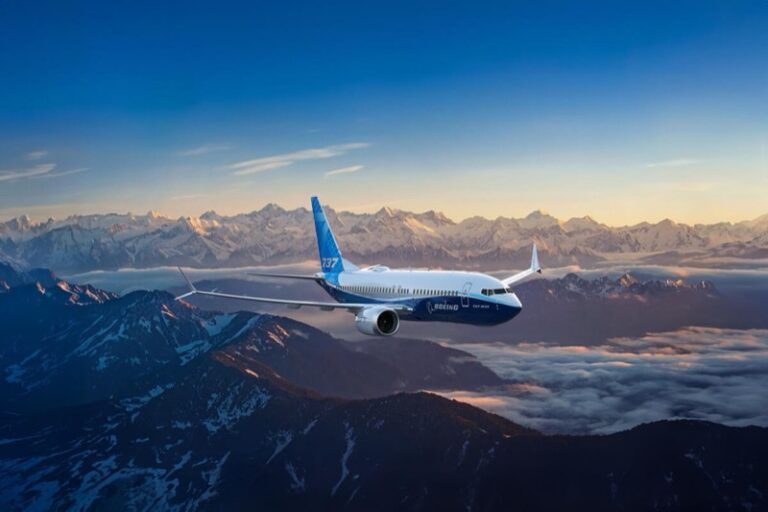
The US Federal Aviation Administration has certified Boeing’s 737-7, clearing the smallest member of the 737 MAX family for commercial service after nearly a decade of review.
The regulator granted an amended type certificate and updated production record, adding the variant as a derivative of Boeing’s existing 737 type certificate.
Before approval, the Federal Aviation Administration (FAA) required the 737-7 to incorporate major safety changes, including revised flight-control software, an updated flightcrew alerting system and a redesigned engine anti-ice system.
Those changes address requirements in the Aircraft Certification, Safety, and Accountability Act and recommendations from the National Transportation Safety Board (NTSB) that followed the fatal 737 MAX 8 crashes in 2018 and 2019.
The FAA said the approval capped almost a decade of review to resolve complex technical issues across flight controls, system safety assessments, human factors and flightcrew alerting.
Boeing’s certification campaign, which began in 2018, involved more than 1,000 hours of flight and ground testing alongside extensive system safety analysis and human factors reviews. Flight testing uncovered a potential condition in the engine anti-ice system, prompting the redesign now required across the program to stop the engine inlet overheating and weakening the surrounding structure.
Stephanie Pope, president and CEO of Boeing Commercial Airplanes, said, “This certification validates the rigor of our airplane’s design and recognizes the determination and resilience of our 737 MAX development team.”
Mike Sinnett, senior vice president of product strategy, product development and development programs at Boeing said, “With this certification program, we have developed a clearer understanding of the latest regulatory requirements, which is expected to accelerate future airplane development with a renewed emphasis on human factors, safety and quality.”
FAA safety inspectors will remain at Boeing production sites to monitor manufacturing, including the company’s safety management system and safety culture.
The 737-7 seats 135 to 160 passengers in a two-class layout and is the smallest and longest-range MAX variant, with a range of about 4,370 miles (7,040km).
Boeing is preparing the first delivery to launch customer Southwest Airlines, which expects to put the 737-7 into service in early 2027, according to Leeham News. The analysis site reported that Southwest still holds more than 250 unfilled 737-7 orders, with around 30 aircraft already built, while other early customers such as United Airlines and WestJet switched their orders to the larger 737-8 during the delay.
Across the family, the 737 MAX order book stands at more than 7,200 aircraft, with more than 2,300 delivered by the end of June 2026. Boeing said it is working to certify the largest variant, the 737-10, this year.