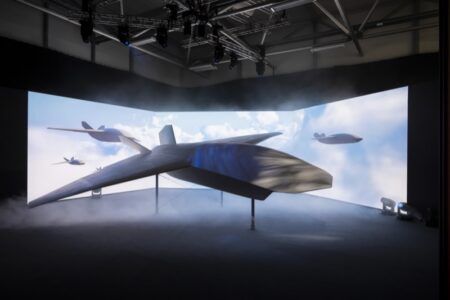


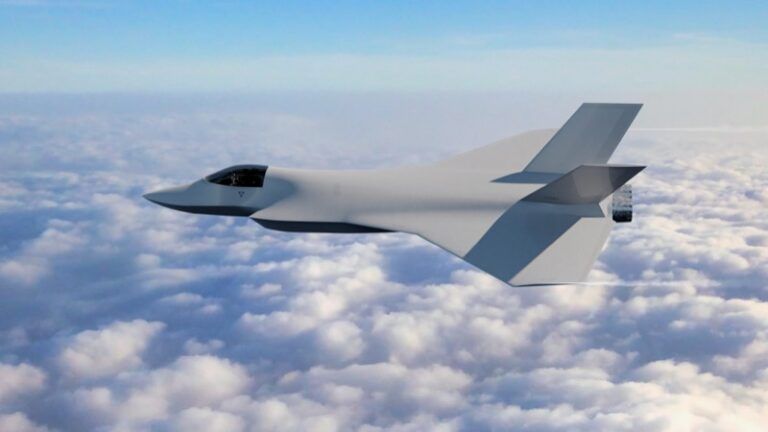
- More than 11,500 parts designed and released, around 90% of the demonstrator’s weight
- Three wings and three fins built, each will go through structural testing in late 2026
- Power-on is planned for mid-2027, aircraft ready by the end-2027 with flight test starting from early 2028
- Over 300 hours flown on ground rigs using flight-standard compute and actuation
- The Excalibur flying testbed, a modified Boeing 757 is flying from Boscombe Down to test sensors and avionics
- GCAP in-service target is 2035, concept and assessment closing December 2027
The Global Combat Air Programme (GCAP) is funded, the concept and assessment stage is closing out. The technology inside the aircraft now has to prove itself.
On July 3, 2026 the GCAP Agency awarded Edgewing, the trinational prime contractor owned equally by BAE Systems, Leonardo and Japan Aircraft Industrial Enhancement Co, a £4.6bn (US$6.1bn) contract running to December 31, 2027. The contract kicks off the detailed design phase for a crewed sixth-generation fighter that Italy, Japan and the UK intend to field in 2035.
The contract award ended an uncomfortable year. Edgewing was due its first design contract by the end of 2025. This slipped while the UK settled its Defence Investment Plan (DIP). Work carried on in the meantime thanks to a £686m (US$923m) bridging contract that funded work to June 30, 2026. The DIP, published that day, allocated £8.6bn (US$11.6bn) to GCAP over four years. A further £708m (US$953m) followed on July 22 for the UK’s Future Combat Air System (FCAS) technologies.
Speaking at the Farnborough Air Show on July 20, GCAP Agency CEO Masami Oka rejected the idea that the delay had cost the program time. “I have no concerns about this,” he said. “If you look at what we have gone through in the last few months, we have been making significant progress, and we have not really delayed.”
Edgewing, incorporated in June 2025, shares its Reading, UK headquarters with the treaty body that directs the program and is the design authority for the aircraft. Asked at Farnborough how the national shareholders plan to stay aligned when other partnerships, such as the Franco-German-Spanish Future Combat Air System, have failed, Edgewing’s CEO Marco Zoff said, “Edgewing is an equal partnership that is creating the conditions not to fight between the shareholders.”
Three wings and fins
The UK’s own portion of GCAP work is represented through Team Tempest, formed by 2018’s Combat Air Strategy. More than £5bn (US$6.7bn) of public money has gone into FCAS, part of the Combat Air Strategy since 2018, with about £800m (US$1.07bn) from industry.
The most tangible output of Tempest so far is a crewed demonstrator in final assembly in Lancashire. “We are really at the business end of this program now,” said Tony Godbold, FCAS delivery director at BAE Systems at the Farnborough Air Show on July 22.
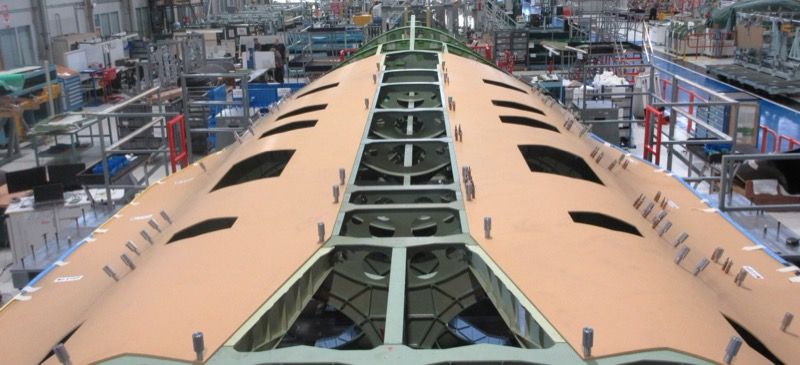
11,500 parts have been designed and released to manufacture, accounting for around 90% of the aircraft’s weight. More than half are already made and either installed in the major units or kitted ready for installation. The front, center and rear fuselage sections built at Samlesbury will be joined there before the end of this year, into what the team calls the cigar tube.
The assembly then moves to Warton at the end of the year to meet the wings and fins. Low observable requirements drove the aircraft’s size and shape, and with them its carbon structure. The wing carries “the largest and most complex panels we’ve ever designed and then manufactured”, Godbold said.
Three wings and three fins are being built. “One of each of the units will be subject to some structural testing, which will take place again in the second half of this year,” he said.
300 hours before first flight
Systems work is running ahead of the airframe. BAE Systems is simulating the demonstrator’s flight controls using auto-coding software generation, running the resulting code on the compute hardware that will fly in the aircraft and connecting it to real actuation hardware.
“We’re actually flying this aircraft now, and we’ve got over 300 flying hours experience with that,” Godbold said. The feedback loop matures the design earlier and in shorter cycles than the company has managed before, and Godbold identifies it as a key innovative feature of GCAP.
Certification planning has begun with the UK Ministry of Defence and the airworthiness authority. Godbold said it would be the first fast jet taken through Military Aviation Authority regulations from first principles since those regulations came into force in April 2010, and that the learning would be “significant” for both parties.
Power on is planned for around the middle of next year, followed by engine ground runs and taxi trials. First flight is planned for before the end of 2027. During early 2028 the program plans to be achieving test points and demonstrating capabilities in line with the GCAP requirements.
A flying power station
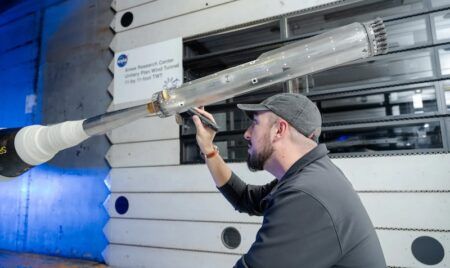
Rolls-Royce is not building a new engine for the demonstrator. It is using two EJ200s and fooling them they are somewhere else. “We are tricking the engine, using some clever control system algorithms, so that when it’s flying in this new aircraft, it thinks it’s in a Typhoon,” said Phil Townley, director of future programmes at Rolls-Royce at Farnborough.
In Typhoon the engine face sits close to open air. In the demonstrator it sits behind a long duct. Knowing that the next-generation aircraft would have embedded engines, Rolls-Royce ran a fabricated duct on its own test bed several years ago, “proving out our digital models, validating them through real life testing”, said Townley.
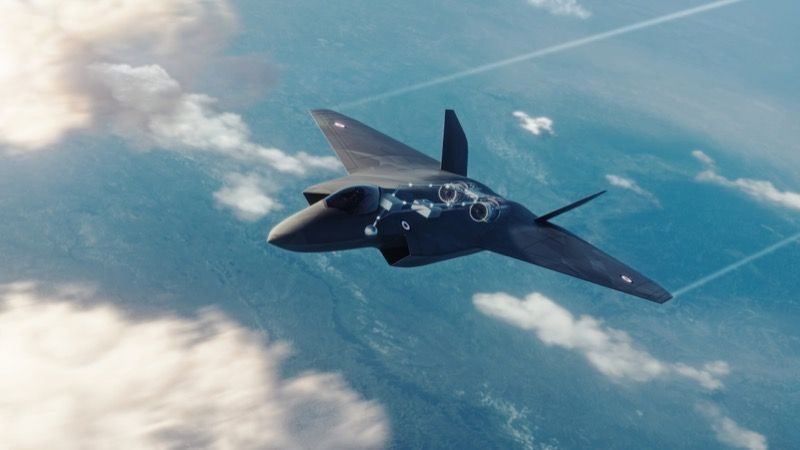
The twin-spool power generation concept, set out at the start of Tempest, has matured as sensor and effector power demands have become clearer. “This isn’t just an engine. This is a flying power station in the sky,” Townley said. “We’re not just going to propel the air vehicle. We’re going to power it too.”
Additive manufacturing is being used to produce the combustor to make the part lighter and smaller and the engine more compact. Rolls-Royce has opened a digital additive cell at Bristol, which it describes as one of the largest in the world, to print it.
“We can operate the combustor to temperatures we didn’t think were possible before,” Townley said.
Townley offered Orpheus, a small clean-sheet engine for uncrewed applications, as evidence of the pace of modern engine development at Rolls-Royce. Orpheus went from clean sheet to a whole engine on test in 18 months, “in half the time it used to take with half the people”.
However, Orpheus will not power Tempest. The GCAP fighter’s own powerplant is a separate, trinational effort. Rolls-Royce, Avio Aero and IHI said on July 20 that design reviews had moved their center line demonstrator toward final approval after more than 100 subscale component tests.
Engineering in the air
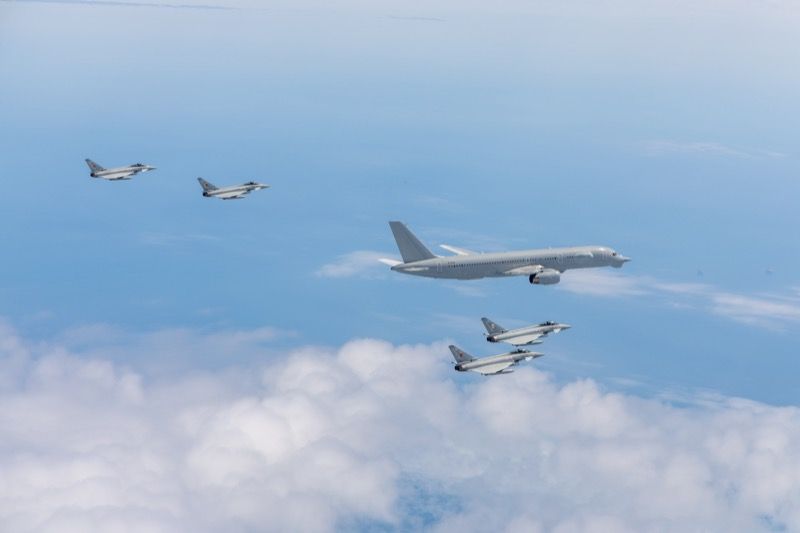
Leonardo’s GCAP contribution is already flying. Excalibur, the flight test aircraft, is a Boeing 757 modified by 2Excel at Lasham in Hampshire and now operating from Boscombe Down. The aircraft is waiting to begin work as a flying testbed for the technology demonstration programs (TDPs) Leonardo has run for six years: radar, electronic warfare, infrared search and track and electro-optics.
Modifying the nose of the 757 was the hardest part. “We had to split the pressure hull at the front and essentially re-engineer the whole front end,” said Andrew Howard, director of future combat air at Leonardo, with structure behind the radome to carry a radar and a substantial shift in the aircraft’s center of gravity. A chin fairing gives test space for different array types.
Affecting handling was a risk, but Howard said the 757 had “absorbed the structural modifications really well”. The aircraft has since flown with Typhoons in formation.
Excalibur’s cabin is fitted with consoles and onboard computing. Current modeling and simulation approaches can take sensor performance predictions into the high 90s, Howard said, but a gap remains on airborne performance. The onboard computing will mean engineers can retune sensors during flights, rather than between sorties, to close that gap more efficiently.
In addition, Excalibur’s pods are sized for different sensors rather than specific ones, which Howard expects will make the aircraft useful to collaborative combat aircraft programs. “It feels like, for the most part, the TDPs were good choices,” he said.
Years to 18 months
MBDA UK is approaching its work from two directions – effects optimization and digital weapons integration. Algorithms have been matured in what MBDA calls the algorithm readiness level into software, which is then tested in the laboratory and on hardware at Stevenage with an operator in the loop.
The work aims to cut weapon integration from years to 18 months. Modeling is displacing electromagnetic testing in chambers and on aircraft – virtualization replaces platform and missile hardware with off-the-shelf software, and machine learning is analyzing trials data and drafting the evidence that goes to the regulator.
The demonstrator is where these methods will meet the real world. “We will, for the first time this century, be conducting a test release of weapons at supersonic speed from the demonstrator,” said Chris Allard, vice president for the FCAS program at MBDA UK.
The new techniques will run alongside conventional integration to show the modeling holds before the evidence is carried into GCAP.

Cost, workshare and factories for GCAP are not settled. Neither the GCAP agency nor Edgewing will put a figure on total costs. Italy has disclosed the most. A document sent to its Senate defence commission in January 2026 put concept assessment, preliminary design and full development at €18.6bn (US$21.8bn) at 2025 prices, and its lower house defence committee authorized €8.77bn (US$10.1bn) of that in February 2026. Japan’s FY2026 line is ¥160.2bn (US$1bn). No partner has published a whole-life figure.
Canada became GCAP’s first observer nation on July 21, a first step towards future participation and proof to some of the programme’s viability. When Zoff was asked at Farnborough whether he was confident the aircraft would work on a technical level, his answer was brief. “Yes,” he said. “Otherwise, I would not be here.”