

Collins Aerospace has completed altitude testing of the Enhanced Power and Cooling System, which is intended to more than double the cooling capacity available on the Lockheed Martin F-35 Lightning II.
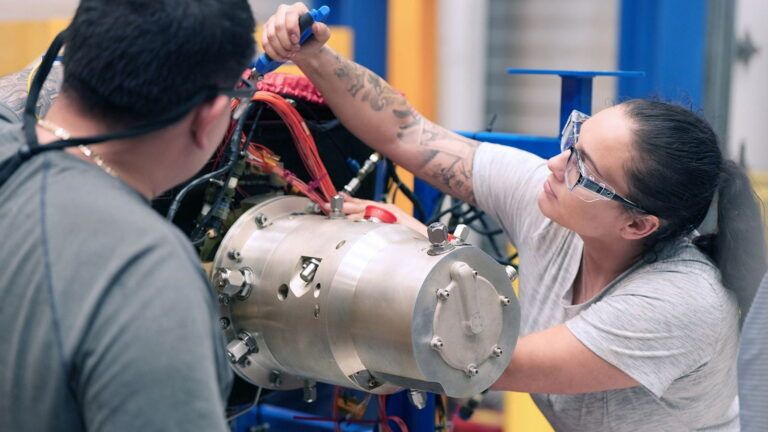
During testing, tthe Enhanced Power and Cooling System (EPACS) was run for several days at power levels replicating mission requirements and pushed to its operational limits across a range of altitudes. The testing gathered performance data and demonstrated that the system can deliver the emergency power expected during operation.
Altitude testing is an early development and risk-reduction step for a new power and thermal management system (PTMS), and the resulting data is used to validate performance models. Ground-based altitude simulation reproduces the low pressures and temperatures a system encounters in flight without the cost and schedule of flying it.
Ira Grimmett, vice president of environmental and airframe control systems for power and controls at Collins Aerospace, said, “Successful altitude testing validates system performance in real-world flight conditions. Completing this phase of testing advances EPACS maturity and reinforces confidence in the system’s capability and performance.”
In laboratory testing in 2024 the system demonstrated 80kW of cooling, more than double supplied by the Honeywell PTMS currently installed on the aircraft. EPACS is intended to be compatible with all three F-35 variants.
The system reached technology readiness level 6 in February 2025, which Collins said made it ready for aircraft integration. Collins has said the existing PTMS is overtasked, requiring the F135 engine to operate beyond its design parameters and adding to lifecycle costs.
Collins has said EPACS is designed to minimize integration and operational risk by fitting within the aircraft’s existing installation, and the F-35 program office had sought 80kW of cooling in an earlier request for information.
The additional cooling is needed because the radar, electronic warfare and processing upgrades planned under Block 4, the aircraft’s next major capability increment, generate more waste heat than the original system was sized to reject.
The F-35 Joint Program Office has yet to select a long-term solution. An analysis by the program office and Lockheed Martin, which targets 62-80kW of cooling to support Block 4 and later capabilities, is due to conclude by the end of 2026, with production of a new PTMS not expected until 2033, according to Aviation Tech Today.
Honeywell is offering a phased upgrade of its existing hardware, starting with a software change the company says would lift capacity to 40kW within two to three years. Collins has said the technology behind EPACS also has applications on future defense and commercial aircraft.