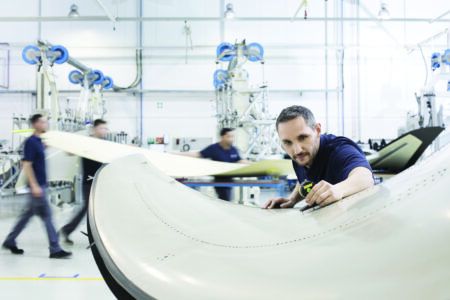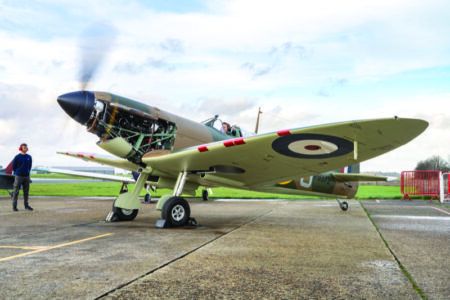


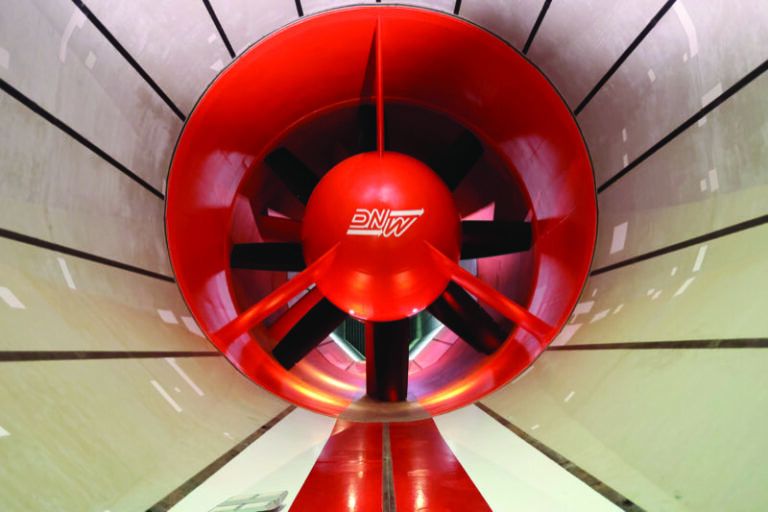
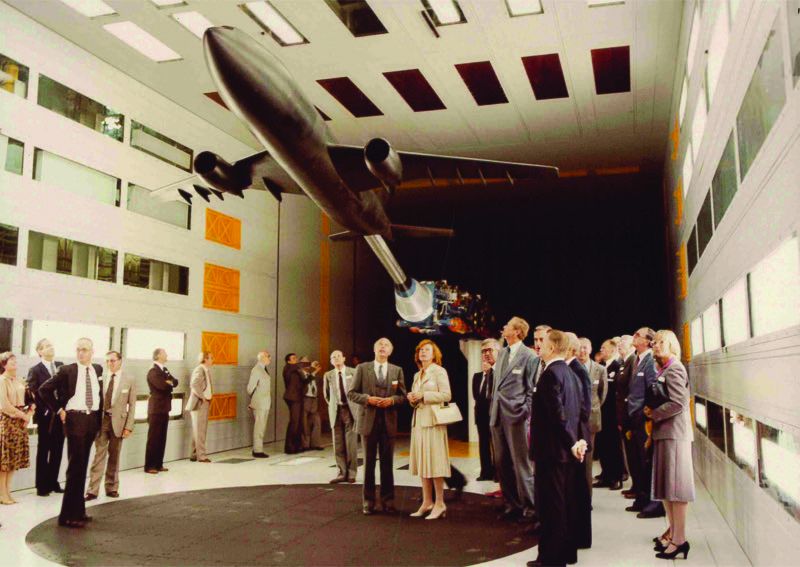
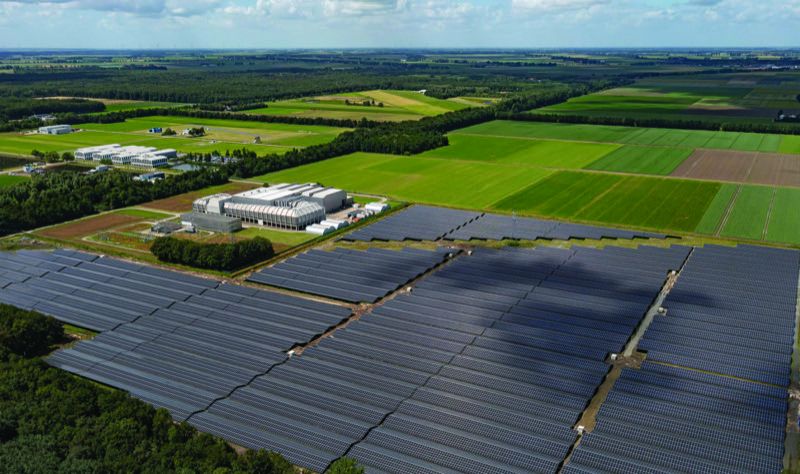
When German-Dutch Wind Tunnels was founded on June 30, 1976, its Large Low-Speed Facility at Marknesse in the Netherlands was given a working life of 20 years. Half a century later, the tunnel is running close to full capacity and some clients are turned away not for lack of interest but because the order book won’t accommodate them.
So, there was an ebullient atmosphere at German-Dutch Wind Tunnels (DNW’s) 50th anniversary celebrations in Marknesse during June, which included a formal event, an open day that drew more than 1,500 locals through the Flevoland site, and the publication of a history of the facility, DNW50 .
The same optimism frames how the organization’s two general directors, Joost Hakkaart for the Dutch side and Holger Mai for the German, describe where the facility now sits and its future. Mai joined DNW in April 2025 and took over as German director on June 1, 2025 succeeding Andreas Bergmann.
A key partnership
The foundation of DNW is a cross-border arrangement that predates many similar international agreements. “This international, multi-site cooperation in this business of wind tunnel testing is unique,” says Mai. “I am not aware that there are wind tunnels worldwide that are operated cooperatively by two countries.”
The cooperation was born of necessity. Both Dutch and German governments had higher ambitions than budget, pushing NLR (Royal Netherlands Aerospace Centre) and DLR toward each other. That constraint shaped the design in a vital way. “NLR originally wanted a single wind tunnel configuration with a fixed test section. That moved toward a configuration with different test sections to include German requirements, which turns out to be very flexible and beneficial for us,” says Hakkaart. “The concept is so successful that it’s been copied by several other countries.”
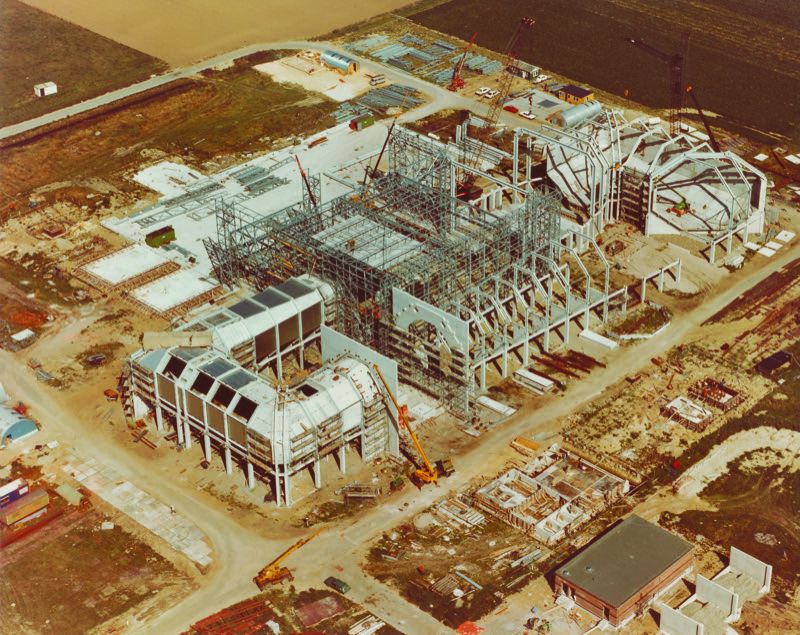
The flexible design is only part of the explanation for the Large Low-Speed Facility (LLF) and Marknesse’s success. Hakkaart and Mai credit the technical backing of the two parent institutes, DLR (German Aerospace Center) and NLR, as setting it apart from commercial tunnel operators. “Our parent institutes provide a lot of technology and help develop new systems,” Mai says. “We are always at the forefront with measurement technologies and can make use of new developments at our parent institutes.”
Fifty years of shared operation has produced a working culture the directors describe as genuinely integrated. “There’s a great international spirit, there is always a mixture of different people here,” says Mai.
“Our clients come from all over the world,” adds Hakkaart. “There are interactions with different test teams from Brazil to Korea, to Germany, the UK, Italy, Spain, Sweden and France.”
What the site shares with its customers are methods, not designs. “You share the experience with the measurement and simulation techniques, but not the experience with the test object configuration,” says Hakkaart. “It would kill us if we say, modify your pylon in this way because we’ve seen it successfully in another test. We can say, use particle image velocimetry with helium-filled soap bubbles, because that gives a very good view on large fields and with that a detailed local flow analysis. That’s the kind of advice we give.”
An industrial proving ground
The customer list runs through most of European aerospace, but Hakkaart singles out one aircraft as standing out: “Looking at the European industry, it’s the Airbus A320, its cash cow, which did wind tunnel testing here to mature the configuration.
“The efficiency of the aircraft, and in that sense the commercial results, are partly thanks to DNW being a large-scale facility where engineers could test with a proper engine simulation and a combined moving belt simulation, doing the thrust reverser development. It’s the combination of acoustics, ground simulation, propulsion simulation – everything is possible in one place.”
Paul White, senior expertise leader for wind tunnel technology development at Airbus Operations UK, agrees. His presentation traced Airbus’s relationship with DNW decade by decade at the anniversary event, from the A300 in the 1970s through turbine power simulation on the A320 in the 1980s to the A350XWB and the A320neo.
White says, “In the early days when we were testing new wing designs, the wind tunnel was faster than the computer, which is not the case these days.”
Instead, modern wind tunnel work has moved to where computation is weakest. “The wind tunnel is now used more at the edge of the envelope where the computer has difficulty predicting.”
The tunnel has stayed relevant by changing what happens inside it rather than being replaced. Hakkaart says, “We have a capability to continuously improve and react to what’s changing in the world. For example, we have been using turbine powered simulator units for engine simulation for decades, but due to the power-density improvement of electric motors, we can now use them for scaled engine simulation in the wind tunnel. This enables us to also simulate acoustics with the motor simulation on top of the performance.
“Each facility works on continuous improvement to stay relevant. If you only react on your current clients, you might be too late.”
Complex times
DNW is busier now than at any point in recent memory, a recovery from a downturn at the end of the last decade and start of the 2020s. Hakkaart says, “The operational team has doubled in the last five years. We are now going to 120 staff across the different sites combined, and we can run all of the facilities in parallel. That was not possible five years ago. We run double shifts when required.” Test campaigns range in length from one day up to half a year, with overall project durations of a few years.
Part of the surge is the industry’s push toward more sustainable ways of flying, which DNW supports heavily. Several eVTOL programs are also using the facility.
The overall trend is that there is an increase in the configurations now being designed and tested. “We had a long period where the aircraft was a cylinder with a wing, relatively simple, and that was validated by CFD,” says Hakkaart. “Now we see a lot of new configurations. That increases the relevance of the wind tunnel again, because you need to experimentally validate those configurations, which have not yet been validated in CFD.”
That has reversed a long-standing assumption about physical testing’s decline. “Forty years ago it was predicted we would only have wind tunnel testing for the next few years, and then CFD will do everything,” Hakkaart says. “People don’t say that anymore.”
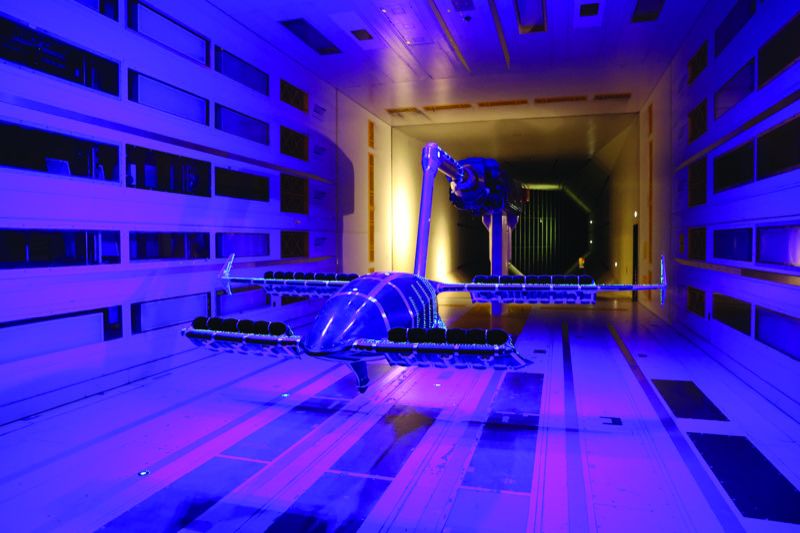
Wind tunnels add value now at the extremes that CFD handles poorly, for example the engine-airframe interference that dominates take-off and landing, but also the aerodynamic-structural interaction.
“The interference will always be difficult, especially in start and landing conditions, where you have all the flaps and the slats deployed, resulting in very complex flow fields. Engine integration will remain a very important topic here,” says Hakkaart.
Rolls-Royce makes the same case in commercial terms. Speaking at the anniversary event, John Bolger, the company’s head of fluid mechanics, listed a run of test rigs at DNW stretching from open rotor work in the 1990s through the F-35B lift fan to the current UltraFan program. He suggests the reason for staying with physical testing is risk management. “The worst thing for a business is finding out we have got something wrong late in the cycle,” Bolger says.
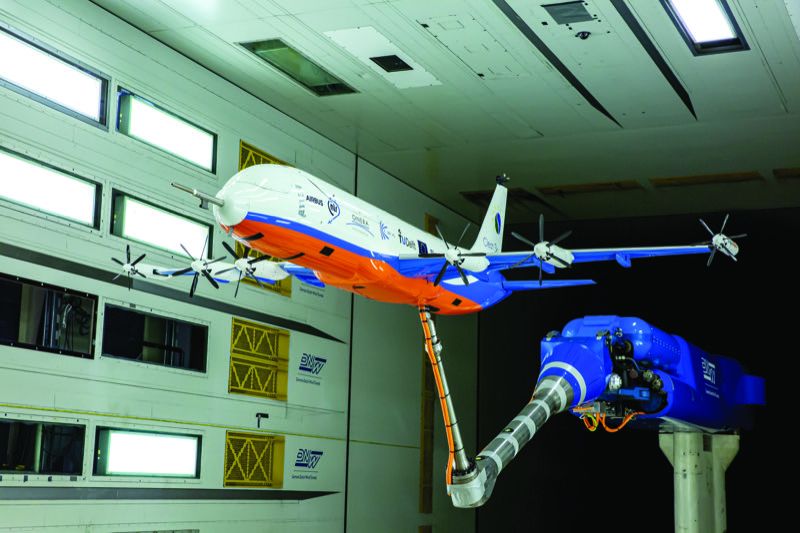
A coupled short-intake and low-speed fan campaign for ultra-high-bypass engines is scheduled at the LLF in 2026 under the EU’s HEAVEN (Hydrogen Engine Architecture Virtually Engineered Novelly) program, and the hardware is in the test hall during the anniversary event. Bolger does not expect the balance to tip away from physical testing anytime soon. “Our strategy is to design in the computer, but the computer does not get it right at the extremes,” he says. “I don’t believe there will be a time when we don’t do wind tunnel testing.”
Defense surge
The strongest growth is in military testing, though the directors are careful about the money behind it. “I’m not sure if we directly see the public money,” says Mai. “In Germany there’s a €100bn fund, but it’s the industry itself that has increased testing.”
The pull, he says, is sovereignty. “The role of national and European facilities is increasing. Companies ideally want to stay national, but at least European. That’s also why we see a large demand across all facilities in Germany and the Netherlands.”
Among current users, Hakkaart notes one that signals where the sector is heading: “Shield AI develops an unmanned platform that’s about 20-30% of the price of an F-35. That’s not just a drone, that’s a significant platform, and they’re doing wind tunnel testing at our facilities.”
An emerging line of work is testing multiple objects at once – the formation flying of manned aircraft and drones. “So far, it was mainly focusing on one aircraft dropping a weapon system or an empty tank, but that develops into how multiple aircraft flying together impact each other,” says Hakkaart. “That means changes to our facility – we need two robotic arms to control that.”
The downturn in 2018 left a demographic gap the directors are now working to close. “A lot of older colleagues will retire within the next five years, and there’s a gap in the average age,” says Mai. “We hired a lot of young staff, and the transfer of knowledge is important to us. We established a Knowledge and Technology manager last year.”
The role has spawned cross-site working groups on specific measurement techniques. “Every few weeks the different groups come together – a group on balance and force measurements, on pressure measurements, on optical measurements,” says Hakkaart. “It’s DNW-wide, so the people from Amsterdam talk to the people from this facility, to the people from Braunschweig, and share their developments.”
Interest has come from outside, too. “Industry contacted us when they heard we were planning training courses,” says Mai. “They asked if they can send their people, because they’re facing the same challenges.”
Both directors expect the fundamentals of wind tunnel testing to hold in the future, while everything else changes. “You will always have a tube with an airflow, you will put a model in, but the models will look different, and the way of testing and measurement techniques will change,” says Mai.
Both directors predict that there will be tighter integration of CFD and physical testing, with the development of a digital model of the tunnel itself. Mai is running exactly that under a NATO project.
“We build up a CFD model of the empty wind tunnel to validate it and gain knowledge on what you have to simulate to what detail,” he says. “In the future, the client can put their model into a digital wind tunnel in advance, to more efficiently prepare for the test. It’s more or less a digital twin.”
The relationship between computation and physical testing now runs both ways, Hakkaart believes. DNW recently used CFD to upgrade its high-speed tunnel, testing new steel wind tunnel parts against the simulation and feeding the results back. “The CFD boosts the wind tunnel, and the wind tunnel boosts the CFD,” he says.
Fifty years on from a facility built to last 20, the question at Marknesse is no longer survival. It is how far the tunnel’s usefulness can stretch – into automotive, into defense, into whatever configuration the industry can use. As Hakkaart says, the core capability is fixed and everything else is negotiable: “What will be the same is we have the airflow.”