

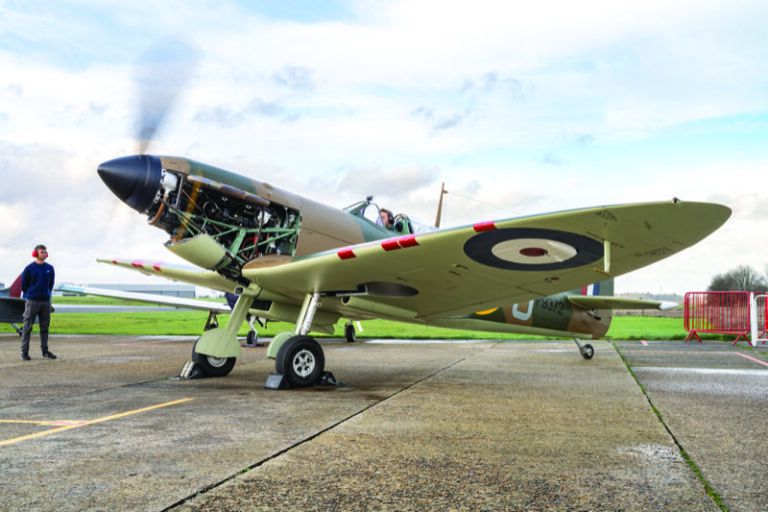
The Spitfire is 90 years old in 2026. Using modern test techniques, component manufacturers including Supermarine Aero Engineering, and restoration specialists like The Spitfire Factory, are working together to build better Spitfires than ever before.
Restoring and operating vintage military aircraft, popularly termed warbirds, constitutes a growing niche within the aviation industry. Where once these aircraft were restricted to airshows or carefully cosseted in private collections, today it is relatively easy for those with the funds and inclination to take a ride in a Mustang, Spitfire or even a Hurricane. Ex-military trainers, transports and even bombers are also available for pleasure flights or taxi rides, leading to a burgeoning number of aircraft restorations and an expansion in regular maintenance demands.
Most of these aircraft were designed, engineered and built to wartime standards. Manufactured in days – sometimes hours – it was expected that they would be abused at maximum power levels and flown under the extreme stress of combat throughout their brief operational careers. How then is the continuing airworthiness of a Spitfire, an aircraft design whose first flight occurred 90 years ago, assured in today’s benign operating environment? What is the role of modern test techniques in keeping these old airplanes flying and satisfying a growing demand for new components?
Remaking a classic
A Spitfire can be restored using only a limited amount of original material, and most projects combine parts from the original airframe, unused or refurbished period spares, and newly made components. For those new parts, the specified materials are often no longer available, and in some cases the original manufacturing methods have also been lost. As a result, components must be tested not only for quality, but also for compatibility with the airframe and any nearby original materials.
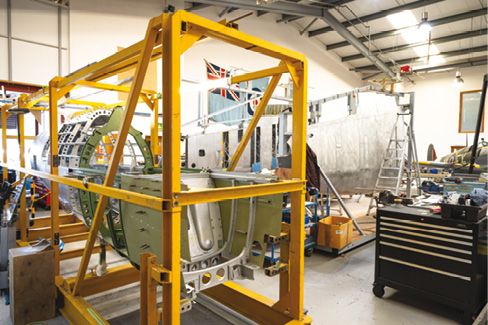
David Brothers, oversight manager at The Spitfire Company in Biggin Hill, UK which is better known as The Spitfire Factory, says accurate parts manufacture is a critical element in Spitfire restoration and maintenance. The Spitfire Factory is authorized to copy parts using existing drawings and original parts as templates, and repair structures. When other new components are required, the company uses third-party suppliers, including Supermarine Aero Engineering, which produces a huge range of smaller items.
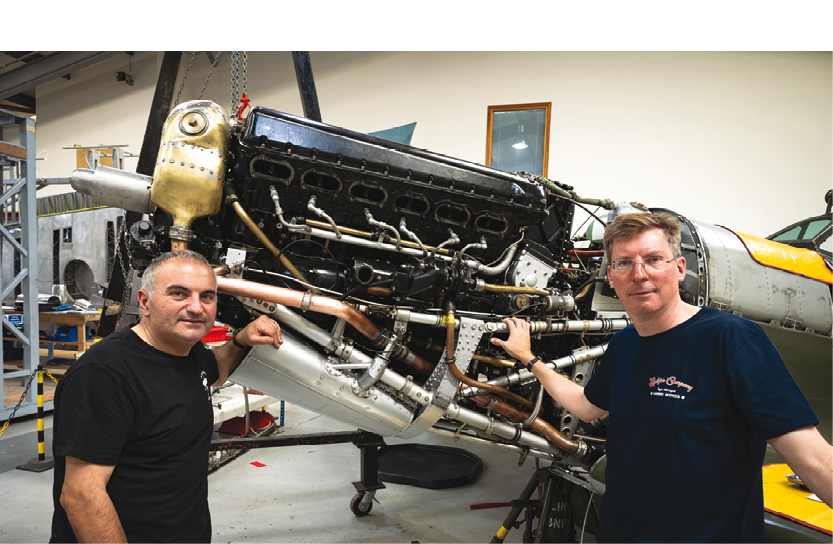
Chief engineer Franco Tambascia says The Spitfire Factory holds a significant library of original drawings, perhaps sufficient to construct a complete new Spitfire through the process of copying original parts, but there are caveats: “The drawings detail military specification materials that we often can’t obtain, but we have a CAA-approved materials substitution list that allows us to use a replacement material. We can then fabricate parts using the new material, get them NDT’d and cadmium plated, with certification from each of the specialist companies involved, then install them.”
Sometimes a modification is needed because replacing the original component is impossible. In that case, extensive testing to determine suitable materials and subsequent NDT are required on the newly fabricated parts. An example is the so-called blow-down bottle, an emergency undercarriage extension device.
Tambascia says, “It is similar in size to a small beer bottle and the methods for its construction and pressurization with CO2 have been lost. We had a modification manufactured using nitrogen, which needed a larger bottle because the gas is less dense than CO2 . But the modern bottle will accept a pressure gauge so we can see that it’s charged and can activate it during an annual service. Without the modification we couldn’t test the system, but now it’s safer, reusable and approved.”
Another important aspect to the restoration process is the use of what Brothers terms “new old-stock items”. These might be, for example, a box of bolts still in their original packaging from 80 years or more ago. “We check the contents carefully to ensure they haven’t been altered or faked and that their military labeling is correct, then send a selection for NDT. Equally, if a client provided an original undercarriage leg for their Spitfire restoration, we would strip it down to component parts for NDT. It might then need replating before we install new seals, reassemble and test it against original specifications.”
New old parts
Based in Stoke-on-Trent, the UK’s Supermarine Aero Engineering specializes in manufacturing machined Spitfire components, pipework and sub-assemblies such as pneumatic and hydraulic actuators, as well as consumables such as rubber fluid couplings, engine mounts and mainwheel brake components. Supermarine Aero Engineering’s website states about the Spitfire: “Today, there exists no single comprehensive record of its build, specification or modification record and no one alive has the memory of how all that was done the first time around.” What then is the process of metrology, manufacture and test that goes into making a new component in the modern environment?
Production manager at Supermarine Aero Engineering, Andy Minton, responds, “We hold a large collection of original drawings and where these are not available, a part will be reverse engineered using original parts as patterns, along with any mating parts to ensure the tolerances selected ensure interchangeability.
“This allows a modern drawing to be produced, usually using AutoCAD. A selection of traditional techniques using vernier calipers, micrometers, height gauges and so on is used for dimensional measurement and we are currently looking at using 3D laser scanning, either in-house or as a sub-contract function.
“We are CAA-approved to reverse engineer components using the original parts as patterns and we produce drawings in-house. If any advice regarding material selection is required, we have the services of a qualified stress engineer and metallurgist available.”
Choice matters
Material selection is by one of three routes. Ideally the original drawing will specify a material that is still available. More often, that material is no longer available and a regulator-approved alternative is used. If no alternative is available, the component may be investigated to determine its chemical composition and physical properties at a test house.
Supermarine manufactures components to slightly tighter tolerances than the originals and inspects them all. Considering fasteners and similar items, from a batch of 500 nuts, for example, 10% would be inspected. Minton says this attention to detail ensures full compatibility with original components and other newly manufactured items. Meanwhile, all drawings are checked by a second engineer before manufacture begins and all materials are traceable back to their origin – for steel and aluminum that means the mill that supplied them.
New parts might be installed alongside original components 80 years old and made from different materials. Ensuring the safe interaction between new and old is primarily a concern for aircraft restorers, but Minton says, “Wherever possible we try to prevent the issue of dissimilar metal corrosion by the extensive use of cadmium plating or chromic anodizing on our components and, where appropriate, the use of assembly compounds.
“If any original parts are re-used in an assembly, they are thoroughly checked dimensionally and subject to NDT inspection – fluorescent penetrant inspection or magnetic particle inspection [MPI] depending on material type.”
Tambascia says The Spitfire Factory also makes extensive use of NDT, including dye penetrant inspection, MPI and X-ray. Engine oil is analyzed for metal particles and the type of material detected can indicate which bearing or other component is wearing.
“In the past we x-rayed our original Spitfire wing spars every ten years, but now our two-seat aircraft all have new wing spars, so they are good for another 50 years,” says Tambascia. “There is no written fatigue life on a Spitfire because the understanding of fatigue really came post-war with the investigations into the de Havilland Comet accidents.”
Testing for better parts
Supermarine’s components resemble as closely as possible the original items, but Minton notes considerable variation in how assemblies and some molded rubber components are tested. “For example,” he says, “the hydraulic actuators for the main undercarriage were originally pressure tested for a total of 10 minutes. Ours are tested for 24 hours because we’ve found that they can start leaking several hours into testing.
“The main fuel tanks must be removed for an actuator leak to be eliminated after they have been fitted to the aircraft, so by providing a more reliable unit we save the operator a considerable amount of work.
“Similarly, the mainwheel brakes are pneumatically actuated by a flat-section rubber ring known as a brake bag, a component we have produced for some years. Its production involves sacrificially pressure testing two bags from each production batch by subjecting them to 3,500 pressure cycles while being heated to operating temperature. Only if both pass the test do we give the go ahead for manufacture. This is far more than the testing carried out originally and results in a product that rarely fails.”
Tambascia believes that NDT is a driving force behind continuing Spitfire engineering improvements and enhanced safety, citing previous issues with the bolts holding the undercarriage pivot, or pintle, onto the wing. An airworthiness directive was issued after fatigue affected these vital fixings.
Tambascia says, “We check them after every 200 landings. Landings on grass count as two because the surface is rougher. The process involves removing the undercarriage and performing NDT on the bolts, which are then replaced as required.
“We replace and test components based on cycles, like the undercarriage bolts, hours or calendar. The latter tend to be rubber items, like engine hoses, which we replace every 10 years or, if they successfully pass a pressure test, 11 years.”
The Spitfire prototype first flew 90 years ago, in March 1936. The aircraft entered service in 1938 and remained on the frontline throughout World War II and beyond. Today the type is subject to a resurgence in interest, and modern manufacturing and test techniques seem likely to keep it flying for perhaps another 90 years.
So, what would an RAF technician from 1940 make of Supermarine Aero Engineering’s modern operation? Remarkably, Minton thinks he would feel at home: “With the exception of a small number of CNC machine tools, AutoCAD and digital measuring equipment, he would recognize most of the equipment and techniques we use.”
Tambascia believes the technician would be equally familiar in The Spitfire Factory’s hangar at London Biggin Hill; he might even recognize the airfield. “We aren’t reinventing the wheel,” Tambascia emphasizes. “We use many of the same tools but combined with modern test and other techniques. Our work is to a much higher standard though and likely to last longer because we aren’t facing wartime pressures.”