

Rolls-Royce Pearl 700 engines have powered high-altitude flight tests measuring how 100% neat sustainable aviation fuel reduces the particle emissions that form contrails.
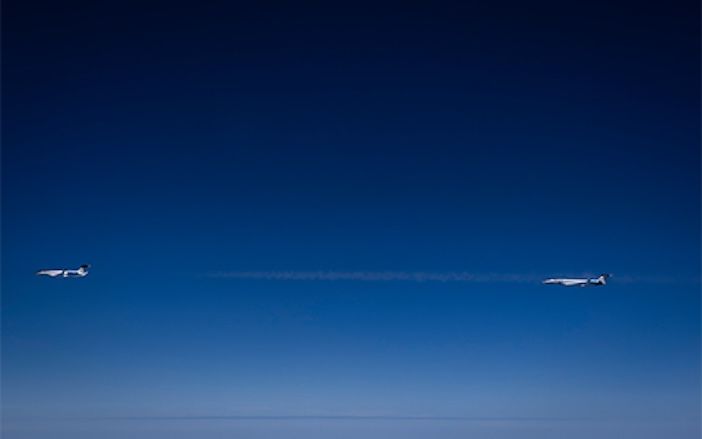
The tests formed part of a flight test campaign in which a Gulfstream G800 flew on 100% sustainable aviation fuel (SAF), paired with a specially modified Gulfstream G700 converted into a flying emissions measurement laboratory. Both aircraft are powered by Pearl 700 engines.
Operating in close formation, the aircraft captured real-world measurements of particulate matter and contrail-forming atmospheric characteristics at altitudes of up to 50,000ft. This is higher than commercial airliners fly, while business jets typically fly at altitudes of between 45,000 and 50,000ft.
The campaign was led by Gulfstream Aerospace in collaboration with the Federal Aviation Administration (FAA), NASA, the German Aerospace Center (DLR), Missouri University of Science and Technology, Rolls-Royce, Aerodyne Research, Montana Renewables and World Fuel Services. It was designed to isolate how different fuel compositions influence non-CO2 emissions.
To do this, the team compared conventional Jet-A fuel, low-sulfur Jet-A, and neat hydro-processed esters and fatty acids (HEFA) SAF, which contains no sulfur or aromatics. Preliminary results suggest a measurable reduction in the particulate emissions that contribute to contrail formation when operating on neat SAF.
Alan Newby, director of research and technology, Rolls-Royce, said, “Sustainable Aviation Fuels in combination with compatible, ultra-efficient aero engines have been shown to reduce certain non-CO2 emissions.
“The valuable insights we have gained from these latest tests at high altitudes, as well as the data from projects like QRITOS or ECLIF3, are driving real progress in understanding aviation’s non-CO2 climate impacts and potential mitigation options.”
The data will be used with the broader aviation and atmospheric science communities to refine analytical models, inform future fuel standards, and support operational strategies to reduce the environmental impact of air travel.
The tests showed that Rolls-Royce’s in-production Trent and business aviation engines can operate with 100% SAF, laying the groundwork for moving the fuel toward certification. At present, SAF is certified only for blends of up to 50% with conventional jet fuel.
According to Rolls-Royce, SAF has the potential to reduce net CO2 lifecycle emissions by about 80% compared with conventional jet fuel.