

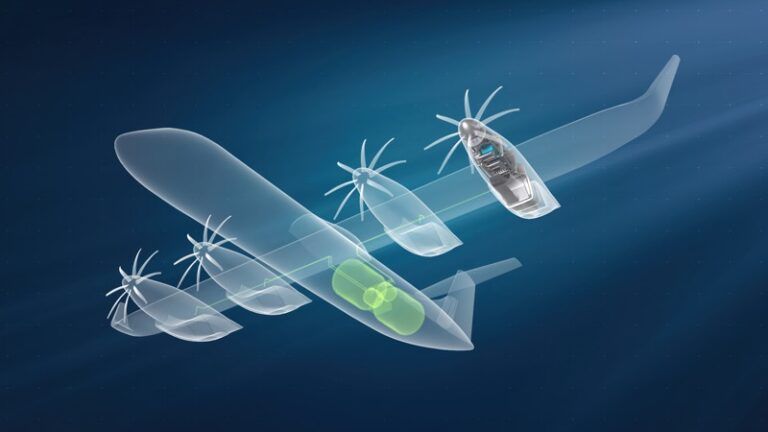
Airbus and MTU Aero Engines are to establish a joint venture dedicated to developing and commercializing a fully electric hydrogen fuel cell engine for commercial aircraft.
The new entity will lead the development, design, testing and certification of a propulsion system based on a hydrogen fuel cell, drawing on engineering and manufacturing teams from both companies. The partners aim to accelerate the program through a dedicated, agile organization.
The plan builds on an agreement the two companies signed at the Paris Air Show in June 2025, which set out a three-step roadmap toward a hydrogen fuel cell engine for the commercial market. The venture is a non-binding agreement, subject to regulatory approvals, with operations expected to begin in 2027.
Bruno Fichefeux, head of future programs at Airbus, said, “Our planned joint venture is the next logical step in our shared vision of a hydrogen-based propulsion concept for aviation. By pooling our respective technology and expertise into a dedicated entity, we are establishing a European powerhouse capable of transforming advanced research into industrialised, certifiable electric propulsion systems.
“This new company will help secure strategic sovereignty in the next generation of aviation technologies while strengthening our ability to achieve the long-term ZEROe ambition.”
Dr Stefan Weber, senior vice president engineering and technology at MTU Aero Engines, said, “This project is a crucial milestone on our path to the first hydrogen-powered engine – and this is true European technology leadership. To that end, we want to create a company that covers the entire life cycle of fuel cell powertrains – from development and testing through certification to commercialisation.”
The venture combines Airbus’ commercial aircraft, fuel cell propulsion and liquid hydrogen experience with MTU’s engine design, integration, validation, certification and maintenance expertise. MTU’s fuel cell work dates back several years, including a collaboration with the German Aerospace Center (DLR) to develop and validate a fuel cell propulsion system using a Dornier 228 flying testbed.
At the 2025 Paris Air Show, MTU confirmed it had completed the design of its 600kW Flying Fuel Cell for regional aircraft and begun manufacturing fuel cell stacks for a demonstrator. The company also ran its eMoSys electric motor for the first time, with efficiency exceeding 96% in take-off and cruise conditions, and brought its first test cell into operation in Munich.
Airbus said in March 2025 that it was focusing its ZEROe research on a fully electric fuel cell propulsion system, after prototype and powertrain testing supported the technology’s viability.
Hydrogen fuel cell technology generates electricity through an electrochemical reaction between hydrogen and oxygen, producing only water vapor. In flight, this would eliminate carbon dioxide and nitrogen oxide emissions.
Beyond the engine, the partners said they would continue supporting a hydrogen aviation economy and the regulatory framework needed for hydrogen-powered flight at scale.