

The paradigm of modern aerospace structural testing is undergoing a fundamental shift from merely accumulating vast quantities of data towards rapidly generating actionable insights.
For decades, the industry has equated more telemetry with better results, yet this philosophy has now reached a critical tipping point. While sensors now provide an unprecedented volume of information, they often create operational bottlenecks, forcing engineers to perform arduous manual reconciliation tasks due to asynchronous and temporally misaligned streams.
The industry must transition towards an ecosystem that prioritizes synchronized information and edge computing nodes, while accelerating decision-making and staying ahead of aggressive development timelines. At the heart of this vital shift is the Autonomous Structural Health Monitor (ASHM) sensor, a solution designed to operate as an autonomous, comprehensive edge-computing node. By using pre-integrated, pre-processed data frameworks, the path to structural certification for the next generation of aircraft is being significantly shortened.
The intelligent node
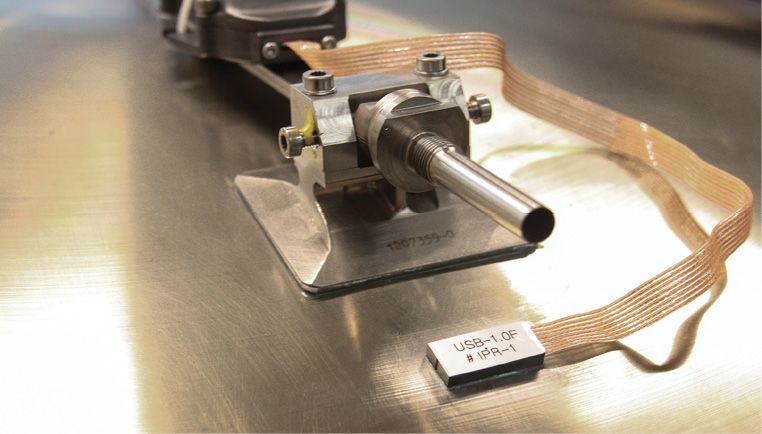
The ASHM sensor marks an advance in integrated technical specifications, setting a new standard for what engineers can expect from a single instrumentation unit. Each unit is a multi-modal powerhouse, offering three-axial strain measurement with an impressive range of plus or minus 10,000 microstrains and three-axial acceleration sensing with a range of plus or minus 40Gs.
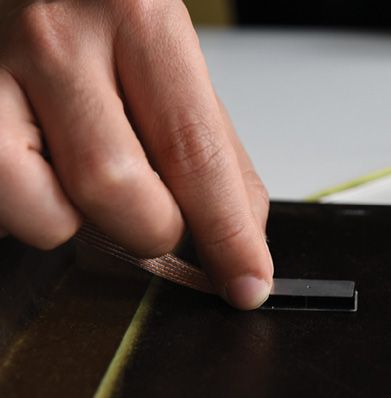
In addition to these core parameters, the sensor can monitor environmental variables critical to maintaining ground test accuracy, such as temperature, relative humidity and barometric pressure. Specifically engineered for high-precision structural testing, these sensors maintain a miniature form factor of 27.5mm by 27.5mm by 4mm and weigh just 5g.
The small footprint enables high-density placement on test articles without influencing the specimen’s structural dynamics, ensuring the measurement process does not interfere with the physical behavior being measured. Furthermore, the internal architecture supports high-frequency sampling while maintaining low power consumption, enabling the system to capture transient events often missed by traditional, bulkier data acquisition systems.
A scalable ethernet backbone
A modern Ethernet-based architecture facilitates the transition from individual, isolated nodes to a robust and unified sensor network, successfully overcoming the inherent limitations of legacy point-to-point analogue systems. Utilising a sophisticated hybrid communication layer that bridges low-overhead SPI or UART protocols directly to Ethernet gives the system industrial-grade noise immunity and massive scalability.
This networked approach is essential for complex structural ground testing such as full-scale fatigue or static strength tests on primary airframe components. Leveraging Power over Ethernet technology enables the installation team to deliver power and high-speed data through a single cable, drastically reducing the physical footprint and overall complexity of the instrumentation setup.
A high degree of synchronization is a technical requirement for advanced modal analysis, where even a single microsecond of jitter can lead to significant errors in structural damping and stiffness calculations. A core advantage of this approach is the ability to monitor high-fidelity structural behaviour during extreme loading scenarios without saturating the available network bandwidth.
Strategic edge processing
Rather than streaming continuous and often redundant raw telemetry throughout multi-week test cycles, these sensors use an optimized data strategy that focuses on real-time structural monitoring. On-board algorithms perform sophisticated pre-processing to transmit only the necessary mathematical features and significant event summaries.
For example, during static or dynamic tests, the network can autonomously monitor strain distributions and/or vibration profiles and identify deviations from predicted behavior. Processing this data at the edge provides the test director with an immediate and synchronized view of the structure’s response, ensuring that data is optimally processed at the source without compromising the fidelity required for post-test verification of structural integrity.
This level of responsiveness enables deviations to be identified in real time, preventing potential damage to expensive test articles and facilitating a more dynamic testing environment.
Validating the digital twin
Integrating these advanced sensors also addresses the physics of structural response, which is central to modern aerospace engineering. By capturing high-fidelity data at the exact point of interest, the network provides the empirical evidence required to validate complex finite element analysis models during the preliminary design review phase.
Closing the loop between the virtual model and the physical test article in this way is vital for reducing risk and ensuring that the structural behaviour is fully understood before moving into production.
As the ASHM sensor moves towards full certification, efforts are currently focused on ensuring that the sensor meets the most rigorous industrial standards for reliability and accuracy, specifically RTCA DO-160 and MIL-STD-810H. Comprehensive validation includes testing against electromagnetic interference and environmental extremes often encountered in specialized ground test facilities.
Ultimately, integrating these smart sensors into a synchronized, Ethernet-linked ecosystem will provide the technical foundation for the next generation of structural testing, where the speed of data processing and subsequent decision-making will finally match the requirements of rapid aerospace development.