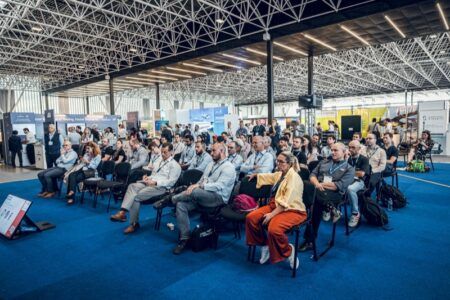


The Royal Academy of Engineering in London during May is a fitting venue for a pre-Farnborough airshow briefing for one of the UK’s oldest and largest engineering firms, GKN.
The distinguished surroundings also play well to GKN Aerospace’s (GKNA) notion that it is different from its competitors – as a “Super” Tier 1 aerospace supplier. Self-accreditation can also be seen as self-aggrandizement, nevertheless the company’s CEO Peter Dilnot is unabashed. “The super part is about our design capability,” he says. “We are a design-led engineering company. It’s at the heart of everything we do.”
Getting back to the heart of the business has been important for the last eight years at GKN. In 2018, when turnaround specialists Melrose acquired the company for £8.1bn (US$10.2bn), the setup was very different. The firm had sites in 19 countries and employed 58,000. Today GKNA is in 12 countries and employs 16,000, thanks mainly to hiving off the automotive parts of the business and a restructuring that has closed sites and reduced the workforce.
“We’ve gone from 50 sites down to 32, exited non-core businesses and doubled down on our technology,” says Dilnot. “We are aerospace and defense focused and world leaders in structural airframe components and load-bearing components in engines.”
When Spirit AeroSystems was folded back into Boeing in 2025, GKNA became the world’s largest independent aerostructures business. The company’s product range can be split broadly into two: 60% structures, for example fuselages, wings, doors, and 40% load-bearing engine parts, such as casings, turbine blades and exhausts.
Another quirk of the company is its bias toward Airbus. “They tend to lean more into the supply chain for design,” says Dilnot. “We are the only partner on both current next-gen engine programs, the CFM Rise and the Ultrafan. Then there are three major structural growth drivers on the defense side.”
Civil & Defense
Dilnot is keen to emphasize the 30/70 split of its customers between the defense and civil sector at the press briefing. He anticipates that this ratio will change in the coming years: “Without a doubt there is a shift toward building up European and national sovereign capability – our peers are looking at doing more defense spending in Europe rather than in the US. Raw spend has gone through the roof in the last 18 months.
“As well as a drive for European sovereignty, there is also the MAGA movement. Our US businesses are super-busy and we are doubling down at our sites there.”
Another driver is that wars are increasingly being fought remotely with drones, as shown in the Russia-Ukraine conflict. Dilnot explains, “There is a fundamental shift in warfare to use uncrewed vehicles. These have a lower cost and shorter developmental cycles, leading to a proliferation of those projects.
“Unquestionably we have pivoted the business toward that, because that is where the opportunity lies. But other areas of technology, like Additive Fabrication, are the long-term drivers of growth.”
3D Printing matures
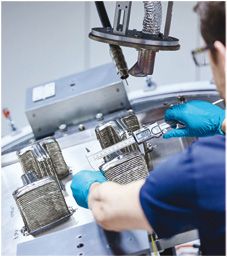
Dilnot calls Additive Fabrication a “breakthrough” technology that can replace the manufacturing processes of forging and casting. More commonly known as additive manufacturing (AM) or 3D printing, it is a decades-old technology that once was restricted to making plastic models. Has GKN finally managed to fully industrialize metal-AM for aerospace?
The answer, according to GKN Aerospace’s chief technology officer, Russ Dunn, is yes. GKNA now uses the technique to produce several load-bearing components for jet engines, and is expanding its use to more parts. The company is working with manufacturers, such as GE Aerospace and Rolls-Royce, to use these AM technologies.
“Additive uniquely combines the material and the process. You are making new material as you carry out the process, so the parameters you apply to the process change the characteristics of the material,” says Dunn.
“It’s a highly digital and closely monitored process. Inspections and testing build the evidence base for material quality. That work was time-consuming, but we now have a large data set that helps us understand how different variables affect the final result.”
By combining data with design expertise, GKNA can optimize parts for performance and supply chain resilience, taking advantage of different additive and subtractive processes. The company is printing using technologies such as laser powder bed fusion and laser-directed energy deposition (LDED) to make higher-temperature, high-performance parts from titanium and alloys like Inconel 718 and Haynes 282.
GKNA’s acquisition of Sweden-based company Permanova in 2022 was a key enabler in the rollout of Additive Fabrication, says Dunn. Permanova’s LDED technology has given engineers end-to-end control over the material data and the manufacturing system.
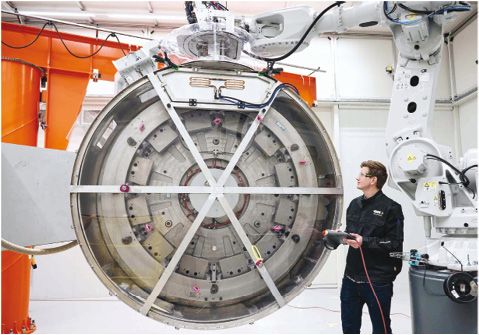
An example is the fan case mount ring for the PW1000G geared turbofan (GTF) engine, made using LDED. The LDED-manufactured fan case mount ring was recertified in 2023 after seven years. The company has made over 600 of the parts since. “The reason it took so long is that it had never been done before in the industry,” says Dunn. “Taking the airworthiness authorities through a fundamentally different way of making things took a long time.
“Now our customers are more mature and have their own steps to certify these types of structures. We are talking about a couple of years. Ultimately, we will get to a point where we can qualify the process.”
Industry bottlenecks
Forging parts is expensive, and while casting can be cheaper, Dunn says the number of companies able to supply large, complex castings of a sufficiently high quality has shrunk. “The reality is we have pushed casting technology beyond what it is really ideal for,” he says.
Dilnot says, “The availability of forgings and castings is a gating factor on the industry, particularly in engines. Additive Fabrication is a better way of making things and it addresses a fundamental supply issue.”
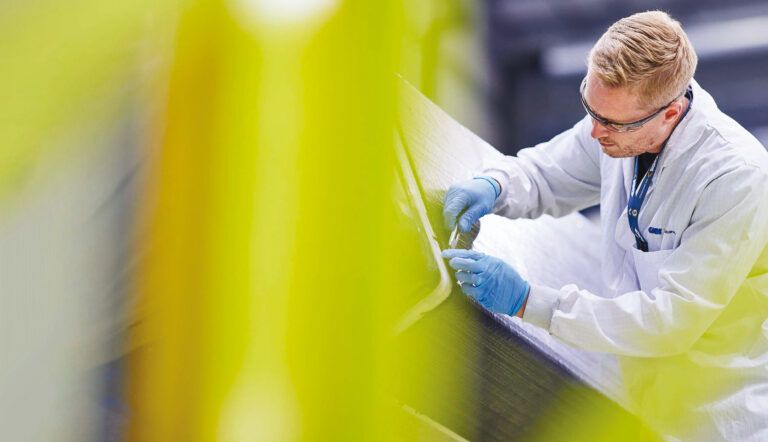
GKNA has also invested heavily in large composite manufacturing technology, and supplies wing spars to Airbus for the A350 and its Wing of Tomorrow R&D program. Such investments enhance its position to supply military drone and commercial eVTOL programs, where there is “huge demand for composites” says Dilnot.
The company is also partnered with US-based defense firm Anduril to supply UK drone and defense programs and is working with Archer Aviation to supply aerostructures for its commercial eVTOL aircraft.
Dilnot says, “We are an airframe business – composite structures and wiring – and unusually we’ve got the propulsion too. What we don’t do is the avionics and the payload. We build the body and heart, but not the brain.
“The integrated airframe and engine, alongside our design capability, is what makes us unique.”
Defense shift
Dunn acknowledges GKNA’s shift toward defense, while stressing that it has a long history of supplying to the military. GKNA has been the Type Certificate holder – responsible for airworthiness and fleet availability – for the RM12 engine used in Saab’s Gripen fighter since 1997. Engineers at the company are looking at developing the next generation of this engine, in anticipation of the Swedish government making decisions about a Gripen replacement in the mid-2030s, he confirms.
Central to such work is GKNA’s “notional concept” approach to technology development, which sees engineers design things that the customer might want in the future, but not make them. Instead, the designs and prototypes are used to shape customers’ thinking on potential capabilities and requirements.
Another example of this approach is a CTOL (conventional takeoff and landing) drone demonstrator project that included the use of micro jet engines. The project ran in 2020, and several years later engineers are tapping into knowledge created by that program to create interest and lead discussions with customers about autonomous drones.
“We have the ability through our notional work to design those sorts of airframes, do the aerodynamic and load performance and design a propulsion solution through to manufacture,” says Dunn.
“We can offer an integral vehicle that others can customize. There are also other routes, direct engine opportunities, airframe or subsystems.”
A line can be drawn from the 2020 program to an 18-month contract GKNA engineers started in November 2025 to develop a clean-sheet, low-cost drone for Sweden’s Defence Materiel Administration (FMV). The program aims to develop a family of drones of different sizes and power. “We are at the point of architectural freeze and on the verge of beginning manufacturing,” says Dunn. “We are talking about supplying the airframe and engine for this vehicle.”
Back to basics
While leading clean-sheet development projects may elevate GKNA’s Tier 1 status to Super, there is little doubt that aerospace manufacturing remains the company’s core business.
Dilnot points to improvements on safety and quality to demonstrate the progress the company has made since the Melrose acquisition: “We have gone from 35 lost-time accidents down to one last year. On the quality side, our performance is materially better. We are in a much better place than a few years ago which helps when you are growing the business as a reliable supplier.”