

As higher levels of autonomy are introduced to aircraft and their systems, developers face the challenging task of creating systems that can reliably perceive, interpret, and respond to their environment under all operating conditions.
Modern aircraft, from autonomous unmanned platforms to highly automated next-generation crewed systems, depend on vast software stacks integrating perception, sensor fusion, decision-making, and control algorithms. Ensuring that these systems behave safely and predictably requires test coverage that traditional system and flight testing alone cannot deliver.
Flight testing remains indispensable but is inherently constrained. Environmental factors such as weather cannot be controlled, and many critical edge-case scenarios are either too risky or too costly to reproduce using real hardware. As autonomy grows, so does the need for large numbers of repeatable, high-fidelity test scenarios that reflect the complexity of the real-world operations while the aircraft is still on the ground.
This is where virtual validation, supported by an end-to-end development tool chain, becomes essential. A tool chain that seamlessly links function design and testing tasks provides the foundation for a more efficient and reliable control-engineering process. It enables consistent reuse of data, simulation models, and test cases across all stages. This continuity is important for data-driven development approaches that rely on iterative testing and rapid feedback loops, where consistent tools and interfaces across all stages are essential for shortening development cycles, reducing error potential, and accelerating iteration speed.
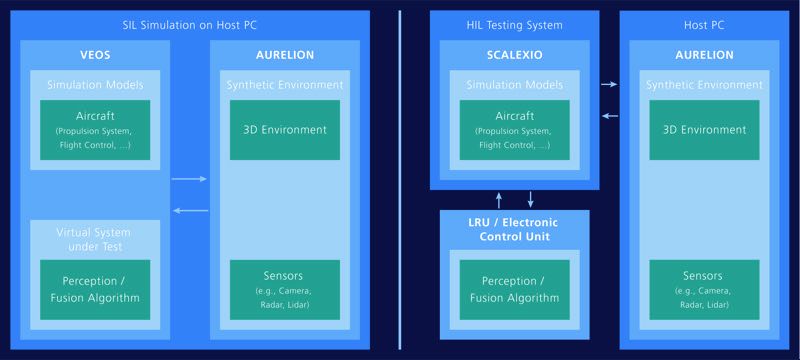
During early development stages, software-in-the-loop (SIL) testing allows engineers to test the system under test (SUT) independently of specific simulation hardware. VEOS, a PC-based simulation platform from dSPACE, integrates a range of simulation models, including functional algorithms, bus systems, virtual electronic control units (ECU), and vehicle models. While the SIL setup is PC-based (see Figure 1), hardware-in-the-loop (HIL) testing establishes a critical bridge between virtual and physical components. Here, software interacts with real hardware under controlled and repeatable conditions provided by HIL simulators, such as Scalexio from dSPACE. The SUT ranges from individual electronic control units to complex, distributed architectures, typical of autonomous and highly automated aerospace systems. A key success factor is the compatibility between SIL and HIL setups, for example, by using container formats such as the standardized Functional Mock-up Unit (FMU) or virtual ECUs on VEOS and subsequently testing the corresponding real ECU on Scalexio without changing the overall test concept.
The test setup is complemented by the dSPACE products Aurelion, for sensor-realistic environment simulation, and the ASM suite, for plant modeling. Aurelion provides high fidelity virtual worlds with realistic environmental modeling, including weather dynamics and terrain. Easy parameterization and positioning of camera, radar, and LIDAR sensors, combined with real-time simulation, enable cost-effective generation of realistic sensor data. Additionally, Aurelion delivers pixel-accurate ground-truth data for all sensor types supporting AI use cases with synthetic data generation. The ASM suite, in turn, offers highly accurate models, for example, for vehicle dynamics and energy systems. These models are open, highly realistic, and can easily be adapted as well as expanded by the developers, for example, with aircraft-specific dynamics models.
These dSPACE products enable the creation of digital twins of complete aircraft systems, encompassing onboard control logic and perception algorithms. Autonomy functions such as obstacle detection, navigation, and mission planning can be virtually tested before a physical prototype becomes available. Moreover, engineers can perform scenario based testing with more precision than is possible with live trials. By repeatedly simulating edge cases, including low visibility conditions, sensor anomalies, or system fault situations, teams can explore operational limits safely and at scale.
The integrated end-to-end tool chain from dSPACE provides a cohesive ecosystem tailored to the demands of autonomous aerospace systems engineering, helping developers transform concepts into solutions ready for deployment.