

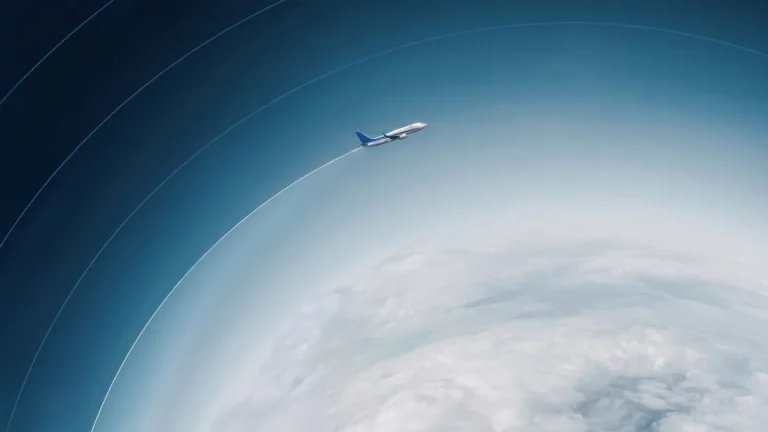
Google is to work with a consortium of aviation, meteorological and academic organisations on a trial that will use artificial intelligence forecasts to route aircraft around the parts of North Atlantic airspace where warming contrails form.
Operation Blue Skies will run within Shanwick airspace, the eastern half of the North Atlantic corridor, which Google said accounts for around 5% of global contrail warming. The company described the programme as the first state-backed trial to avoid contrails across an entire oceanic airspace.
The 30-month programme is made up of two operational trials, each lasting around four months. About 10,000 flights pass through Shanwick airspace during trial hours each year, and a small proportion of those that would otherwise cross contrail-sensitive airspace will be given slight route deviations.
Google UK is developing the artificial intelligence (AI) models used to forecast where warming contrails will form, and will apply machine learning and satellite imaging to track and verify the effect. Air navigation service provider NATS is responsible for trial airspace operations, air traffic control coordination, safety assessment and controller training.
Contrails.org is leading forecast assessment, trial design and data analysis, while the Met Office is developing a UK contrail forecast capability for the programme. Imperial College London and the University of Cambridge will evaluate the outcomes and provide independent verification of the climate impact.
The programme is co-funded by its industry partners and by the Department for Transport through the ATI Programme, a partnership between the Aerospace Technology Institute, the Department for Business, Innovation, Science and Trade, and Innovate UK. Google said all of the government grant funding is allocated to academic, non-profit and aviation partners.
Google UK is taking part on a pro-bono basis and is contributing £1.4 million in kind through AI research expertise, engineering time and high-performance computing infrastructure.
Contrails form when water vapour condenses around soot particles in jet exhaust. Google said warming contrails account for roughly one third of aviation’s total climate impact.
The trial extends earlier work with American Airlines, EUROCONTROL and flight planning software provider FlightKeys, which Google said showed that contrail avoidance is both scientifically validated and operationally practical. Those forecasts have been used by flight crews and air traffic controllers to make targeted adjustments within normal flight operations.
Google said the programme aims to provide a validated blueprint for how airspace can be managed to reduce the climate impact of aviation.