
Aerospace Testing InternationalAerospace Testing International
  • News
    • A-E
      • Acoustic & Vibration
      • Avionics
      • Data Acquisition
      • Defense
      • Drones & Air Taxis
      • Electric & Hybrid
      • EMC
      • Engine Testing
      • Environmental Testing
    • F-L
      • Fatigue Testing
      • Flight Testing
      • Helicopters & Rotorcraft
      • High Speed Imaging
      • Industry News
    • M-S
      • Materials Testing
      • NDT
      • Simulation & Training
      • Software
      • Space
      • Structural Testing
      • Supplier News
    • T-Z
      • Technology
      • Telemetry & Communications
      • Weapons Testing
      • Wind Tunnels
  • Features
  • Magazines
    • March 2026
    • Dec 2025 / Jan 2026
    • Showcase 2026
    • August / September 2025
    • June 2025
    • March 2025
    • Archive Issues
    • Subscribe Free!
  • Opinion
  • Webinars
  • Events
    • All Events
    • Aerospace Test & Development Show
  • Podcasts
  • Videos
  • Suppliers
    • Supplier Spotlights
    • Press Releases
    • Technical Papers
LinkedIn YouTube X (Twitter)
Subscribe to magazine Subscribe to email newsletter Media Pack
Aerospace Testing InternationalAerospace Testing International
  • News
      • Acoustic & Vibration
      • Avionics
      • Data Acquisition
      • Defense
      • Drones & Air Taxis
      • Electric & Hybrid
      • EMC
      • Engine Testing
      • Environmental Testing
      • Fatigue Testing
      • Flight Testing
      • Helicopters & Rotorcraft
      • High Speed Imaging
      • Industry News
      • Materials Testing
      • NDT
      • Simulation & Training
      • Software
      • Space
      • Structural Testing
      • Supplier News
      • Technology
      • Telemetry & Communications
      • Weapons Testing
      • Wind Tunnels
  • Features
  • Magazines
    1. March 2026
    2. Dec 2025 / Jan 2026
    3. Showcase 2026
    4. August / September 2025
    5. June 2025
    6. March 2025
    7. Archive Issues
    8. Subscribe Free!
    Featured
    24th March 2026

    In this issue: March 2026

    Online Magazines By Web Team
    Recent

    In this issue: March 2026

    24th March 2026

    In this issue: December 2025/January 2026

    23rd December 2025

    In this issue – Showcase 2026

    5th November 2025
  • Opinion
  • Webinars
  • Events
    • All Events
    • Aerospace Test & Development Show
  • Podcasts
  • Videos
  • Suppliers
    • Supplier Spotlights
    • Press Releases
    • Technical Papers
LinkedIn YouTube X (Twitter)
Aerospace Testing InternationalAerospace Testing International
Opinion

Using micro-CT scans to improve parachutes

Cutler Phillippe, Research Assistant at University of Illinois Urbana-ChampaignBy Cutler Phillippe, Research Assistant at University of Illinois Urbana-Champaign11th December 20243 Mins Read
Share LinkedIn Twitter Facebook Email
researchers at the University of Illinois
Francesco Panerai (left), Cutler Phillippe (center) and Laura VillafaƱe Roca in front of the micro-CT scanner at the Beckman Institute ,the University of Illinois (Image: Lauren Otolski)

Parachutes are essential in decelerating spacecraft, delivering airdropped payloads, aiding pilot ejections, and more. Traditional methods of assessing parachute performance measure permeability and tensile strength, but recent advances in computing enable more sophisticated modeling and simulation of parachute dynamics. Modeling can reduce the cost, labor, and time needed to create mission specific textiles, by connecting fabric porosity, microstructure, and canopy mechanics to overall performance. But, the models require high-fidelity experimental data for accurate validation.

In our study, we subjected military-standard parachute textiles to radial in-plane loads in a step-wise load-to-failure pattern using a bespoke tensile testing apparatus and used micro-CT (computed tomography) imaging to examine how microstructural variations impact tensile response.

A high-precision linear actuator with 4µm steps controlled displacement and could withstand up to 120lbf.

The use of x-ray micro-CT to capture sub-micrometer details and semi-automated tools to extract data about the textile’s architecture from 3D images enables a faster way to produce the data and characterize these materials.

Fabric samples were cut into 55.9mm-diameter circular coupons and imaged with a 3.7mm field of view (FOV) positioned to exclude large ripstop tows, allowing focus on the bulk weave structure. Imaging at 1.9 µm/pixel resolution with a 4Ɨ lens provided high-detail data for targeted analysis.
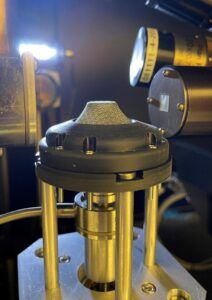
The tensile tester
The tensile tester, loaded with a parachute textile (Image: Cutler Phillipe)

For image analysis, we employed a 3D U-NET segmentation technique, a method proven effective for low-contrast imaging in medical fields, to differentiate warp and weft tows – the perpendicular weave axes, in the images. Using an in-house framework, we semi-automatically extracted critical metrics such as dimensions, crimp angles, spacing between tows and pore sizes and assessed them relative to the radial stress applied.

Our findings show that the anisotropic response of parachute textiles under planar loads is strongly influenced by manufacturing methods, pretension, and the composition of warp and weft tows in terms of fiber count and size. Even with homogenous tow composition, manufacturing-induced pretension caused anisotropic behavior, with warp pretension accelerating weft decrimping under load. This resulted in weft-axis strains approximately 10% to 20% larger than those along the warp axis.

Understanding this difference can inform processes like parachute assembly. Parachutes are made of different textile pieces that are attached to each other, and the orientation of these pieces influences the properties of the overall parachute. Choosing the best parachute materials is crucial for safety and mission goals. This research can inform models that will be used to identify promising candidate textiles.
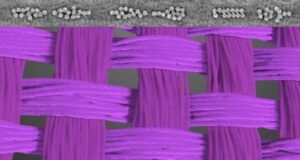
a micro-CT scan
A cross-section view of a parachute textile, taken with a micro-CT scanner

Improving models for screening parachute materials makes parachute manufacturing and applications more cost effective and time efficient. In addition to scientific missions, this work can be applied to parachutes in other settings: for instance, use in relief efforts or in recreation.

The study was published in the American Institute of Aeronautics and Astronautics Journal in August 2024. The next stage of the research is using microscopy imaging to better understand how textile pores impact airflow, as well as imaging textiles with flow passing through them to visualize the 3D deformation.

Share. Twitter LinkedIn Facebook Email
Previous ArticleUS researchers develop speedy AI solver for engineering problems
Next Article XTI Aerospace presents TriFan 600 VTOL to FAA
Cutler Phillippe, Research Assistant at University of Illinois Urbana-Champaign
  • Website

Related Posts

Opinion

The debrief: Boeing 787 – when the wing bent but the model didn’t

1st April 20263 Mins Read
Dr Mike Bromfield
Drones & Air Taxis

Academic insight: Solving cockpit design challenges for eVTOLs

18th March 20263 Mins Read
Opinion

Why materials science is the new frontier of space

4th March 20265 Mins Read
Latest Posts

The debrief: Boeing 787 – when the wing bent but the model didn’t

1st April 2026

Assessing the costs and benefits of the Artemis moon mission

1st April 2026

Airbus Racer compound helicopter reaches new flight test milestones

1st April 2026
Supplier Spotlights
  • Precision Filters, Inc. (PFI)
  • Evolution Measurement
  • CALCULEX
  • Hottinger Brüel & KjƦr
  • AVL List GmbH
  • Tekna
  • InnovMetric
  • CGM CIGIEMME S.p.A.
  • SET GmbH
  • Tyto Robotics
    Tyto Robotics Inc.
  • Bartington Instruments
    Bartington Instruments
  • Ametek
    AMETEK Programmable Power
  • Delta Information Systems logo
    Delta Information Systems
  • Helling GmbH
    Helling GmbH
  • Matec Instrument Companies, Inc.
    Matec Instrument Companies, Inc.
  • Endevco
  • Ipetronik
    IPETRONIK GmbH & Co. KG
  • VJ Technologies
  • Durr NDT
    DÜRR NDT GmbH & Co. KG
  • Dewesoft
  • Bruker Alicona Dimensional metrology & surface roughness measurement
    Bruker Alicona
  • Vzlu
    VZLU – Czech Aerospace Research Centre
  • ATG Advanced Technology Group
    ATG – Advanced Technology Group
  • Dytran Instruments, Inc.
  • Kistler Group
    Kistler Group
  • Diversified Technical Systems (DTS)
  • Scanivalve Corporation
  • G Systems
  • CEC Vibration Products LLC.
  • dSPACE
  • Safran Data Systems
  • Photron
  • YXLON International
  • Telspan Data
  • TotalTemp Technologies, Inc.
  • Vector Informatik GmbH
  • Vibration Research
  • TEST-FUCHS
  • Siemens Digital Industries Software
    Siemens Digital Industries Software
  • PCB Piezotronics, Inc.
  • Testia
  • Treo – Labor für Umweltsimulation GmbH
  • W5 Engineering
  • National Institute for Aviation Research
  • North Star Imaging
  • MK Test Systems Ltd.
  • Intertek
  • I.N.C.A.S. – NATIONAL INSTITUTE FOR AEROSPACE RESEARCH ā€œELIE CARAFOLIā€
  • FMV Test & Evaluation
  • Glenn L Martin Wind Tunnel
  • GRAS Sound & Vibration
  • Elsys AG
  • EMCCons DR. RAÅ EK GmbH & Co.KG
  • European Test Services (ETS) B.V.
  • Chemetall GmbH logo
    Chemetall GmbH
  • Curtiss-Wright
  • Data Physics Corporation
  • AOS Technologies AG
  • Airmo Inc. Pressure Technologies
    Airmo Inc.Ā® Pressure Technologies
Our Social Channels
  • Twitter
  • YouTube
  • LinkedIn
Getting in Touch
  • Subscribe To Magazine
  • Contact Us
  • Meet the Team
  • Media Pack
Related Topics
  • Aircraft Interiors
  • Business Jet Interiors
FREE WEEKLY NEWS EMAIL!

Get the 'best of the week' from this website direct to your inbox every Wednesday

Ā© Copyright 2026 Mark Allen Group. All rights are reserved, including those for text and data mining, AI training, and similar technologies.
  • Cookie Policy
  • Privacy Policy
  • Terms & Conditions

Type above and press Enter to search. Press Esc to cancel.