


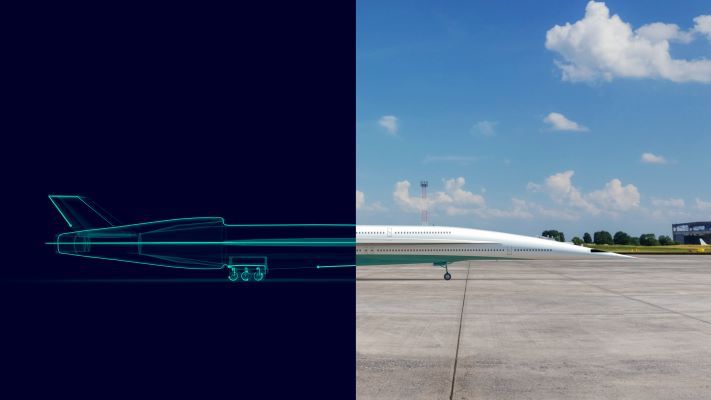
As the aerospace and defense industry faces increased product complexity and a worsening global shortage of aerospace engineers, digital transformation will be vital in staying competitive. While the implementation of digital transformation in the industry has significantly improved in recent years most companies have only started scratching the surface.
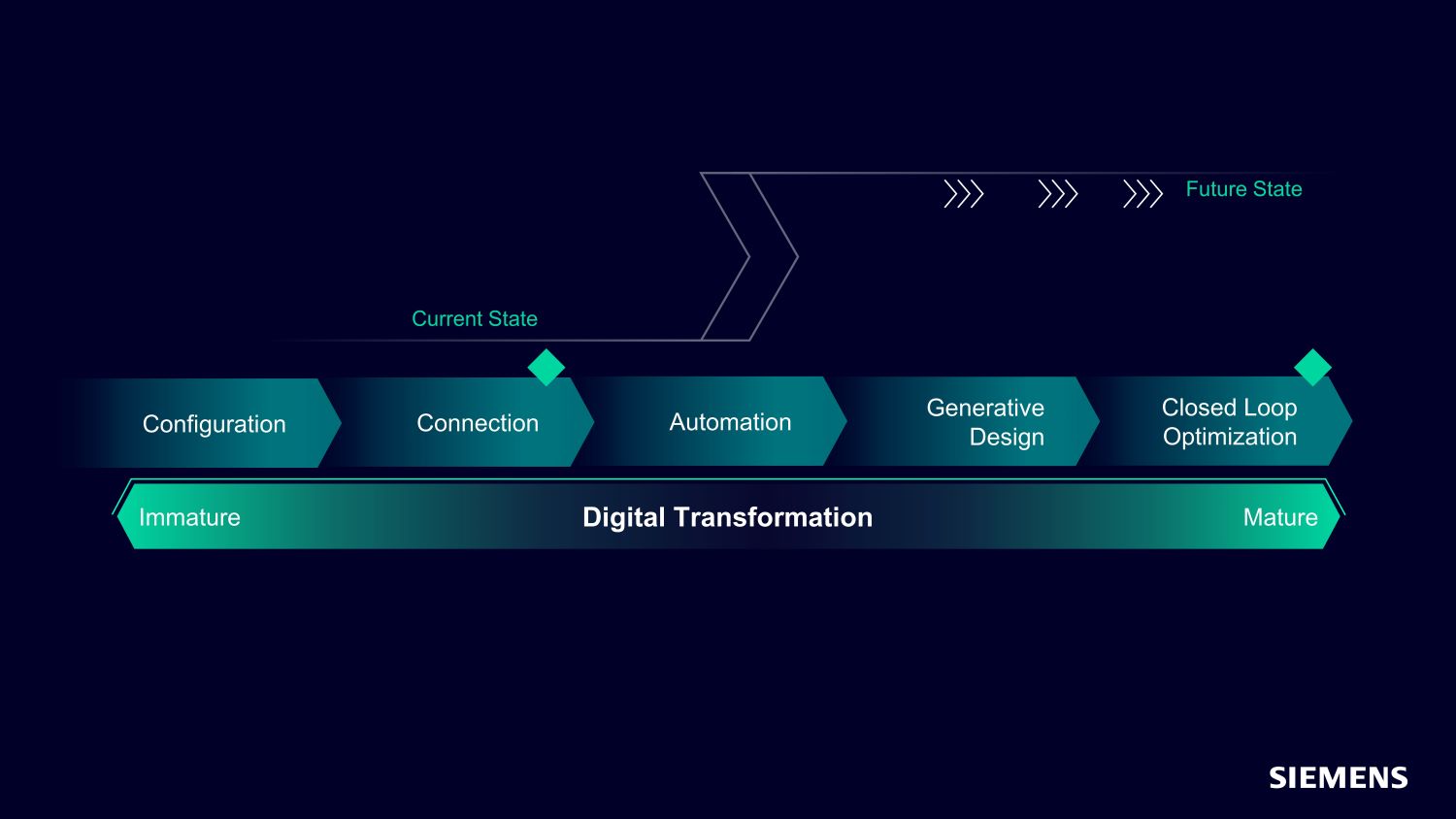
Digital transformation offers capabilities beyond just data configuration and connection. Although companies are using the digital twin to make virtual representations of products and have started using or plan to use digital threads to configure and connect data across engineering domains, there are further steps they can take to shift more responsibility onto computers, allowing them to automate mundane tasks, generate designs, and carry out fully virtual closed-loop optimization.
Defining digital transformation
Digital transformation is taking advantage of high-end computer systems and software to revolutionize the way products are developed, produced, and optimized. Foundational to such a transformation is the digital twin, a virtual model that lets engineers test and evaluate products and systems before building them, and digital threads, virtual connections between tasks and processes throughout the product lifecycle.
Most aerospace and defense (A&D) companies have begun their digital transformations and achieved some degree of data configuration and/or connection. Configuration refers to the creation, change, and archiving of all data related to a product in a safe place. Meanwhile, the connection is bridging the data of a product from requirements to design, verification/certification, manufacturing, and support, all the way to disposal. It also involves creating common data models to facilitate the movement of data across engineering domains, tools, and databases, as well as establish data traceability. More and more companies have been adopting connective practices to bridge critical data gaps and overcome siloed engineering domains.
Connection is only the beginning
While data connection is undeniably beneficial, many companies are not leveraging the full potential of their digital transformations. In a recent research report conducted by CIMdata on behalf of the A&D PLM Action Group, the vast majority of respondent companies defined the purpose of digital threads as traceability and connection. While most of them expressed plans to invest more in digital threads for this purpose, few indicated plans to expand digital threads beyond connective capabilities. Digital threads and digital transformation can do far more, but companies that do not continue to mature their digital transformations will struggle to keep up with those that do.
Consider a company working to design a new aircraft with today’s methodologies. An aircraft consists of numerous systems from the airframe to propulsion to power and many others, all of which are becoming increasingly complex. In an ideal world, the engineers would finish the high-level design of the whole aircraft before moving toward the detailed designs of each subsystem one by one. However, A&D projects must be brought to market faster than a serial design process allows. This means subsystem designs often progress in parallel with higher vehicle-level analysis and requirements development, leaving little time to optimize the aircraft in its entirety.
Engineers end up struggling to manage all the information in these parallel design processes. As soon as the teams leave a meeting to collaborate on design updates, their subsystem designs must change to comply with a higher-level architecture change. This leaves teams scrambling because a change in one domain generally affects many others.
For example, a switch from batteries to hydrogen fuel cells changes several subsystems including the aircraft structure, electrical power system, and the propulsion system. Each of these changes require a large amount of design and analysis before the benefits and full impact of the change can be evaluated. Each team is optimizing their part, and there is little time left to optimize the whole aircraft.
Each subsystem design team is measured based on how well they meet their particular subsystem requirements. Throughout the design process, each team holds its own design margin. This allows them to implement high-level design changes while still meeting their individual team’s requirements. While this margin hiding helps each subsystem, it results in a sub-optimized design. The design margin would be better held at the highest level and allocated as needed when the design changes.
The data connection can help bridge the gaps between the engineering teams in this scenario, but it is not the final step. There is still room to improve how engineers acquire and analyze data, as well as decrease sub-optimization. Digital transformation is a never-ending journey, and to utilize the full benefits, one must go further along.
The next steps
Fortunately, many of the tools that permit these extra steps are already being developed, as is the case with automation. There have been many advancements in algorithms and AI in recent years, which help to reduce the need for human interaction for certain tasks. For development and design, these can include many of the tasks required to set up and maintain PDM and PLM systems. Most notably, algorithms can be used to automatically move data across engineering domains, allowing engineers to spend more time-solving problems rather than hunting for data. Connection closes the gaps between domains, but automation amplifies its impact and empowers engineers’ design processes.
Continuing the advancement of automation can allow companies to one day implement the real game-changing steps, beginning with generative design. Some software tools already contain elements of generative design that automate certain methodologies, but the end goal should be an AI-powered system that can generate thousands of detailed designs based on parameters defined early by engineers. Such a system can perform this on any design from individual systems to full products.
Once this advanced level of truly generative design is reached, the next step a system of closed-loop optimization also powered by AI can be implemented. This kind of system can evaluate generated designs against key performance indicators (KPI) in an entirely virtual space, adjusting design goals and relaunching the generative design process repeatedly until a design is optimized. Thousands of evaluations can be performed in record times, giving engineers more than enough data to finalize their designs.
Tying it all together
These additional steps would close many of the data gaps found in the earlier example of aircraft design and give engineers new ways to design their products holistically while staying on time. With a connected product lifecycle, data is more easily shared and traceable between teams, keeping them synced with each other. Automation further ensures this synchronicity, automatically sending engineers the data they need. More important, though, is the potential of generative design and closed-loop optimization. Engineers can input high-level design decisions and have a computer generate thousands of different iterations and evaluate them. Engineers then review only the best designs, then make the critical decisions necessary to choose the best, most optimized design.

Maturing their digital transformations will allow A&D companies to innovate, design, and build more complex, more sustainable products much faster with a reasonable number of engineers versus hiring thousands of new engineers they will never find. Human engineers will not be erased from the equation. Rather, mature digital transformation optimizes what humans and computers each do best, amplifying the abilities of both to accelerate the design process.
The A&D industry has taken significant steps to digitally transform its design processes, but there is always room to do more. Many companies working their way toward connecting data can leverage digital technology further to introduce automation, generative design, and closed-loop optimization to create new, innovative design methodologies. Digital transformation is a journey with no end point that allows companies to endlessly explore and optimize their design processes to stay ahead of the competition. The seeds for these technologies are already out there. It is up to the industry to recognize them and seize the opportunity.