

Saab has completed the first flight of the Gripen F, the two-seat version of its Gripen E fighter, marking the start of the new aircraft’s flight test campaign.
The aircraft took off at 09:40 local time from Saab’s airfield in Linköping, Sweden, with chief test pilot Jakob Högberg and Brazilian Air Force test pilot Lt Col Abdon de Rezende Vasconcelos in the cockpit. It remained airborne for 40 minutes, verifying the functionality of the core systems and initial flight performance.
Lars Tossman, head of Saab’s Aeronautics business area, said, “This first flight represents an important step forward for both Saab and the Brazilian Air Force.
“Seeing Gripen F take to the skies is particularly significant for all the Swedish and Brazilian teams whose years of engineering work have helped turn this aircraft into a reality. It is designed to accelerate pilot training while enhancing operational performance in advanced combat missions.”
Flight testing of the Gripen F will now start. After initial production acceptance flights, the program will move into progressive envelope expansion, clearing the aircraft’s full performance limits, including speed, altitude, G-load and angle of attack.
Tactical capabilities and rear-cockpit functions specific to the two-seat configuration will also be evaluated. The campaign will be run by Saab’s flight test center in Sweden, after which the aircraft will be prepared for delivery to the Brazilian Air Force.
The Gripen F shares the airframe, engine and E-series systems of the single-seat Gripen E, including its active electronically scanned array (AESA) radar, adding a second cockpit with full flight and tactical controls in the rear seat. The two-seater is around 28in (70cm) longer than the E to house the extra station, but keeps the same sensors, thrust and weapons hardpoints.
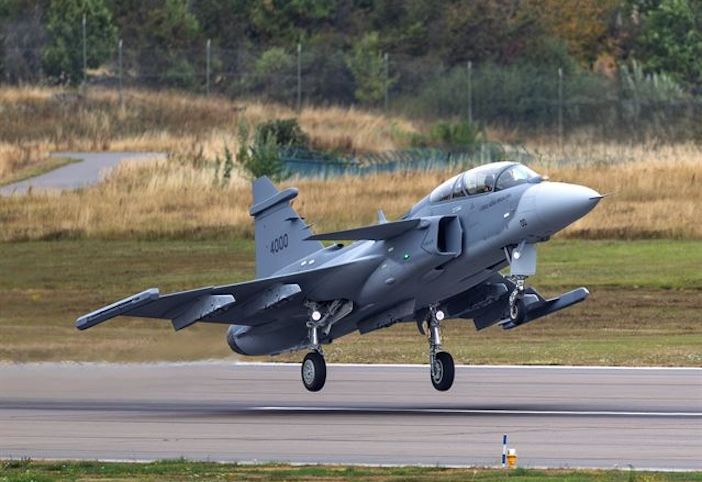
A two-seat variant supports pilot training and conversion – where a pilot learns the intricacies of a particular aircraft type – allowing a student in the front seat to fly while an instructor in the rear retains full control to supervise or intervene. The second seat also eases workload on demanding missions, letting a second crew member manage tasks such as electronic warfare, tactical communications and targeting in high-threat environments.
Developing the two-seater was also central to the strategic partnership between Saab and Brazil, the launch customer for the variant, giving Brazilian industry direct participation and technology transfer. More than 350 Brazilian engineers, technicians and pilots have worked on the aircraft’s development, production, testing and maintenance under a 2014 order for 28 single-seat Gripen E and eight two-seat Gripen F fighters.