


The growing interest in bringing back commercial supersonic flight raises the need to further understand the effects of supersonic heating on aircraft structures during sustained supersonic cruise.
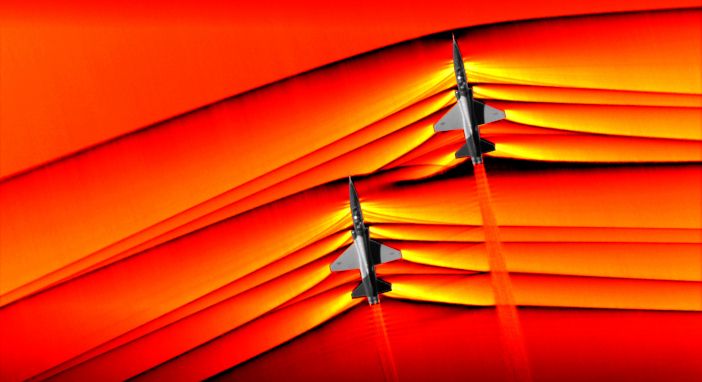
At speeds above Mach 1, aerodynamic heating is generated through viscous friction within the boundary layer and heat convection from supersonic shockwave formation into aircraft structural components, such as rivets. The rivet head is directly exposed to supersonic heating, while the mandrel is heated by conduction from the rivet head and aircraft skin.
Furthermore, the aircraft undergoes repeated thermal expansion and contraction during each flight cycle. Understanding these aerodynamic and thermal loading conditions is important for improving structural durability and supporting the design of future supersonic aircraft.
But how can we understand the aerodynamic and thermal loading conditions if we do not simulate the exact type of conditions that the aircraft will undergo when in actual supersonic flight?
One way is to place materials in a wind tunnel and subject it to Mach 2 for a prolonged period. This would need to be for longer than what current wind tunnels offer, at least close to the flying times of the Concorde to ensure temperature increases to 130˚C (266˚F) at the most extreme regions.
Myself, Professor Munroe and the researchers Kenzie Hansenli and Tiancong Shen at the University of New South Wales (UNSW) are to run a project that aims to develop and validate a computational methodology for resolving localized heating around small structural features such as rivets, to support safer and more efficient aircraft design.
The initial phase will validate a two-dimensional axisymmetric titanium cone-cylinder model in Ansys Fluent by coupling steady compressible-flow analysis with transient conjugate heat transfer. Mesh-sensitivity studies and computational-feasibility assessments will establish numerical reliability and practical computational requirements. The resulting shock structure, pressure distribution, wall heat flux, and internal temperature fields will provide a foundation for subsequent wing simulations.
Following validation, the methodology will be extended to more representative wing geometries based on real supersonic aircraft, including configurations with rivets. Existing studies generally focus on global aerodynamic heating, smooth bodies or overall structural response.
Individual fasteners remain comparatively underexplored because of high meshing demands, uncertain thermal contact properties, high computational costs, and limited technique in wind tunnel data collection. This progressive computational fluid dynamic approach reduces technical risk and establishes a starting point for larger-scale supersonic rivet heating studies.
The greatest challenge out there is that there is no wind tunnel that can be used to simulate these conditions, easily accessible to researchers.
Our project is just a starting point. Much more R&D is needed across the aeronautical industry to ensure supersonic aircraft of the future can cope with the strains of flying at such high speeds.