

Vertical Aerospace completed the first piloted transition with its full-scale eVTOL aircraft, taking off vertically and accelerating into wingborne flight at its test facility in Gloucestershire, UK.
The flight took place on April 2 at Vertical’s Flight Test Centre at Cotswold Airport, with test pilot Paul Stone at the controls. The eVTOL aircraft lifted off vertically before the front propellers tilted forward, enabling a smooth acceleration into wingborne flight as the rear propellers stowed, followed by a conventional runway landing.
The test represents the completion of the first half of the two-way transition sequence required for commercial operations. In a full two-way transition, the aircraft takes off vertically, cruises on the wing and then decelerates to land vertically, eliminating the need for a runway.
The milestone was achieved under a Permit to Fly regime overseen by the UK Civil Aviation Authority (CAA), which is working in collaboration with the EASA toward certification of Vertical’s commercial aircraft, Valo. Each expansion of the flight envelope requires the submission of detailed structural testing, systems validation and simulator data to regulators before further testing is permitted.
David King, chief engineer at Vertical Aerospace, said, “Completing this piloted transition milestone is a profound achievement and the result of years of engineering innovation and disciplined test execution.
“The aircraft performed exactly as designed, transitioning smoothly and under full control – proving the core elements of Vertical’s distributed electric propulsion and tiltrotor technology at full scale, in real flight conditions. This is not yet final mission accomplished, but it is a pivotal technical proof point on our path to two-way transition.”
Stone said, “This aircraft was made to transition. From the moment the front propellers tilted and the aircraft began to accelerate, the response was exactly as the simulation predicted – smooth, stable, and fully under control throughout. What the engineering team has built here is genuinely extraordinary. The aircraft handled the transition with a level of confidence that gives me great optimism for everything that comes next.”
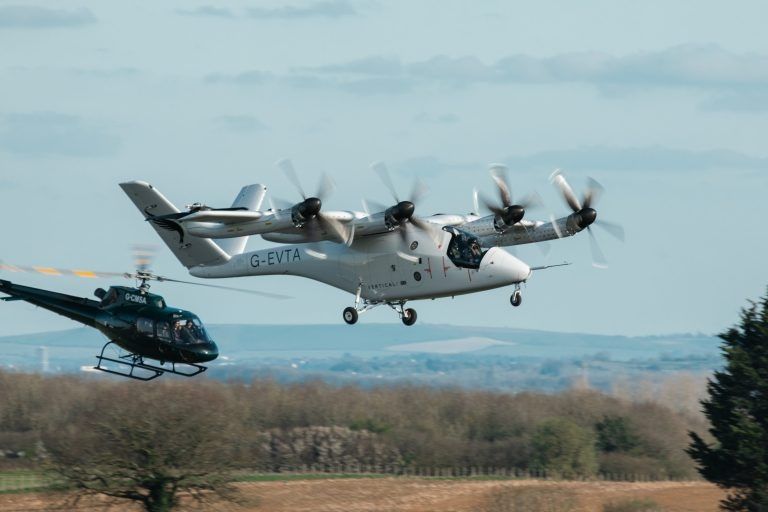
The transition flight builds on nearly two years of piloted testing, progressing through tethered hover tests in September 2024, thrustborne vertical take-off and low-speed maneuvers in February 2025, and wingborne flight including a 17-mile (27km) airport-to-airport demonstration at the Royal International Air Tattoo in July 2025 that reached 115mph (185km/h) and an altitude of 1,800ft (549m).
Vertical is now working toward two-way transition, which will add the return from wingborne cruise to a vertical landing.
UK-based Vertical, says it has around 1,500 pre-orders for its Valo commercial aircraft. The company recently announced a funding package of up to US$850 million to pay for type certification and commercial operations.
In addition the company recently brought its battery pilot production line online at its Vertical Energy Centre in southwest England to build the final battery packs for seven Valo certification aircraft.