

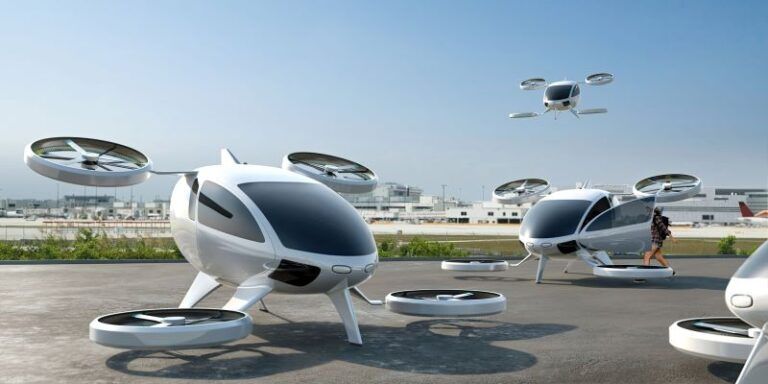
The UK Civil Aviation Authority has published its electric vertical take-off and landing Delivery Model, establishing a regulatory framework that will enable commercial electric aircraft operations in UK airspace by 2028.
The framework confirms SC-VTOL (Special Condition for VTOL) as the certification basis, aligning with EASA standards. The model permits both day and night visual flight rules (VFR) and instrument flight rules (IFR) operations from initial deployment, provided aircraft and pilots meet qualification requirements.
The CAA’s framework addresses training requirements, aerodrome specifications, and rulemaking timelines for the emerging sector. The regulatory model also includes provisions for hybrid propulsion systems, expanding operational capabilities beyond pure electric configurations.
Sophie O’Sullivan, director future safety and innovation at the UK Civil Aviation Authority said, “Our eVTOL Delivery Model outlines how we as a regulator are working to enable this new industry to operate with the highest safety standards, and our ambition to put in place the regulatory framework to facilitate commercial eVTOL operations in the UK by the end of 2028 in line with the government’s objectives.”
The ability to conduct IFR operations from launch will enable eVTOL aircraft to operate in diverse weather conditions, supporting commercial viability.
UK-based eVTOL aircraft developer Vertical Aerospace welcomed the publication of the roadmap.
Trevor Woods, director of regulatory affairs at Vertical Aerospace, said, “This gives UK industry a clear pathway and timeline to initial commercial operations, reaffirms SC-VTOL as the certification basis, and confirms the framework will be in place to allow pilots and aircraft to fly Day/Night VFR and IFR from day one.
“That clarity on training, aerodromes and the rulemaking roadmap is exactly what’s needed to turn demonstrations into safe, scalable services from 2028.”
Vertical Aerospace is developing the VX4, a four-passenger eVTOL aircraft. The company is also developing a hybrid-electric variant to extend range capabilities.
The hybrid-electric variant will offer up to 1,000 miles (1,609km) of range, representing a 10-fold increase from the all-electric aircraft. It can carry up to 1,100kg (2,425lb) payload and features low noise and heat signatures for sensitive missions.
Vertical’s second-generation hybrid-propulsion system has been in development for 18 months at the company’s Vertical Energy Center in Bristol, UK. The system will be retrofitted into one of the VX4 prototypes and is expected to commence flight testing in the second quarter of 2026.
Vertical’s latest development plan targets 2028 for certification of the VX4. Development of Vertical’s eVTOL started in 2016.
According to Vertical, it has approximately 1,500 pre-orders of the VX4 across four continents, including American Airlines, Japan Airlines, GOL, and Bristow.
The UK-based manufacturer participates in the CAA’s eVTOL working groups covering certification, operations, training, and infrastructure development. The company works with the Future Flight Industry Group to advance the UK’s advanced air mobility plans.