

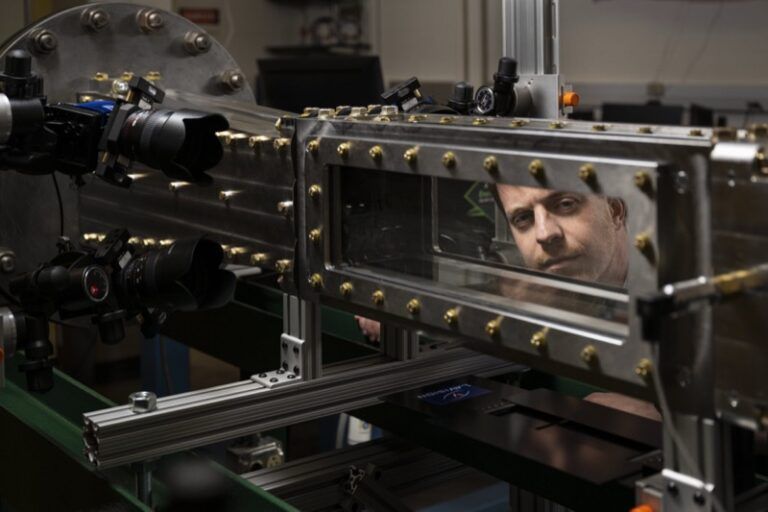
Researchers at the Missouri University of Science and Technology have developed a computational model that more accurately predicts conditions inside supersonic wind tunnels operating at speeds of up to Mach 4, equivalent to more than 3,000mph (4,828km/h).
The physics-based model accounts for heat transfer, pressure losses and air behaviour under extreme conditions, factors that traditional prediction methods have simplified. When validated against measurements from Missouri S&T’s actual supersonic wind tunnel, the model reduced the discrepancy between predicted and measured temperatures from around 10% to less than 2%.
“Traditional approaches to predicting conditions in supersonic wind tunnel tests have simplified the physics, so they haven’t fully captured changes in temperature and other factors,” said Davide Viganò, assistant professor of aerospace engineering at Missouri S&T.
“Because we rely on those models to predict test conditions, even small changes in temperature can affect the conditions we think we’re creating. By accounting for those effects, we can now much more accurately predict the wind tunnel performance.”
Inaccurate wind tunnel conditions can affect how high-speed aircraft and other aerospace systems are evaluated, said the university. More accurate predictions help engineers better understand airflow, which can improve performance and safety in vehicles operating at supersonic and hypersonic regimes.
Viganò’s study, published in The Aeronautical Journalthis month, compared the model’s predictions against data collected from the university’s supersonic wind tunnel facility. The model captures thermodynamic and gas-dynamic effects that simpler approaches typically neglect, particularly under the temperature and pressure extremes generated during supersonic test runs.
“We were able to reduce the difference between our predicted temperatures and what we actually measured from roughly 10% with traditional methods to less than 2% with our new model,” said Viganò. “That’s a strong improvement and can give aerospace engineers much more confidence that what they’re predicting matches what’s actually happening.”
Co-author Noah Cain, a 2024 Missouri S&T aerospace engineering graduate, supported the work as a Dean’s Undergraduate Research Scholar in the university’s College of Engineering and Computing. Cain is now a PhD student at the University of Kansas.