

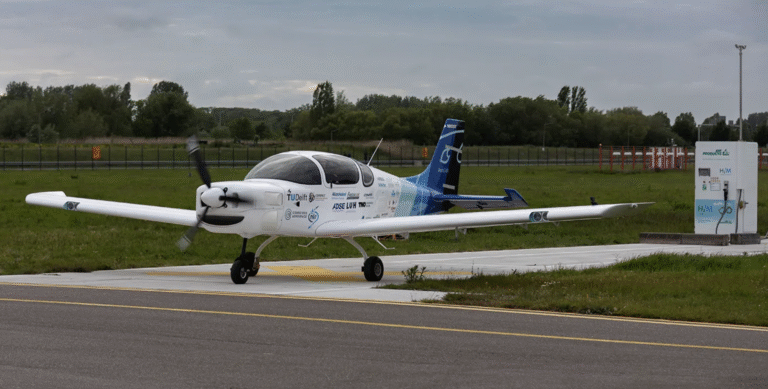
Student team AeroDelft has successfully conducted what it says are the first taxi tests of a hydrogen-powered aircraft at an operational airport in the Netherlands.
The ground tests took place at Rotterdam The Hague Airport and included hydrogen refueling, propulsion system checks, and the team’s first taxi run at an active airfield. The single-seat aircraft, designed and built by AeroDelft, is being developed to fly on liquid hydrogen.
“We want to demonstrate that flying on hydrogen works and that it’s safe in the air and at the airport,” said Isha Moharir, team manager at AeroDelft.
The tests used gaseous hydrogen, which Moharir described as a more developed technology at this stage. The team has previously tested its full powertrain on liquid hydrogen in a laboratory setting and views the airport trials as a critical step toward scaling up.
Risk analyses and an operational taxi test plan were developed in collaboration with research test pilots Alexander in ‘t Veld and Hans Mulder from TU Delft’s Flight Test Laboratory, which is based at the airport’s Fieldlab Next Aviation facility.
AeroDelft expects the aircraft to remain airborne for around 40 minutes on a full tank of gaseous hydrogen. The higher energy density of liquid hydrogen is projected to extend that endurance to approximately two hours once a suitable cryogenic storage and distribution system has been integrated.
The tests form part of the DutcH₂ Aviation Hub project, a collaboration between AeroDelft, Rotterdam The Hague Airport, Air Products, and TU Delft. The program is coordinated by the Rotterdam The Hague Innovation Airport (RHIA) Foundation, with funding from the City of Rotterdam, and aims to develop and test hydrogen aviation infrastructure using the airport as a fieldlab.