

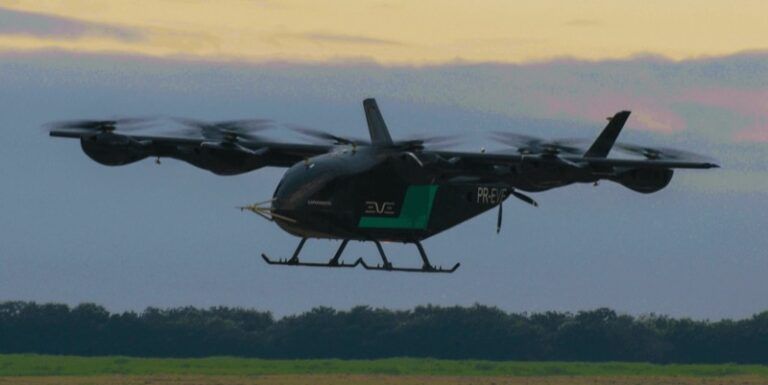
Eve Air Mobility has closed out the hover and low-speed flight test block for its full-scale eVTOL prototype, completing 59 flights and accumulating almost two and a half hours of flight time at Embraer’s facility in Gavião Peixoto, Brazil.
The test campaign generated data across aerodynamics, propulsion and load models, and follows the prototype’s maiden untethered hover flight in December 2025. Eve said it uses a building-block test strategy, progressively expanding the flight envelope and validating simulation predictions against real-world data before advancing to more demanding phases.
“Closing this phase validates the discipline behind our flight test strategy,” said Johann Bordais, CEO of Eve. “Across 59 flights, we confirmed stable hover performance and predictable control behavior within the envelope, while expanding our understanding of loads, aerodynamics, propulsion and energy management, key foundations for the transition phase and the certification path ahead with the conforming prototypes.”
During the block, the aircraft first completed a low-speed input phase below 15mph (24km/h), focusing on validation of control laws, downwash effects, thermal behavior and the propulsion model.
Operations subsequently expanded to approximately 23mph (37km/h) of ground speed, with simultaneous four-axis maneuvers used to further validate aerodynamic and load models. The aircraft reached a peak altitude of 215ft (65m) above ground level and logged a maximum single-flight duration of 3 minutes 48 seconds. More than 100 flight test points were executed during the block.
The phase also saw the first demonstrations of autoland and of the simplified fly-by-wire mode, a secondary control layer activated when the normal mode is unavailable. Eve reported noise levels in line with expectations throughout, with propulsion and battery performance described as better than anticipated.
“Completing hover and low-speed testing gives us high-confidence data to validate and refine our aerodynamic, propulsion and load models,” said Marcelo Basile, head of tests at Eve. “That model correlation is what enables disciplined envelope expansion. With planned ground tests next, we will be ready to begin transition flights, in which we validate the lifter-pusher synchronization before moving on to the cruise phase.”
The aircraft’s March 2026 demonstration flight for senior Brazilian government officials, including President Luiz Inácio Lula da Silva, marked a significant mid-campaign milestone.
The prototype uses a lift-plus-cruise configuration, with eight fixed-pitch lifter rotors for vertical flight and a single rear-mounted pusher propeller driven by two motors for redundancy. Fixed wings provide lift during cruise, with no components required to change position in flight.
The production aircraft is designed to carry four passengers and a pilot over a range of 60 miles (97km) at a cruise speed of up to 125mph (201km/h).
Over the coming weeks ground tests will prepare for the transition flights block, which are scheduled to begin in summer 2026. In that phase, the team will validate lifter-pusher synchronization as the aircraft progresses toward wingborne flight.
Eve plans to build six conforming prototypes for its certification campaign with Brazil’s National Civil Aviation Agency (ANAC), the Federal Aviation Administration (FAA) and the European Union Aviation Safety Agency (EASA), with type certification, first deliveries and entry into service targeted for 2028.