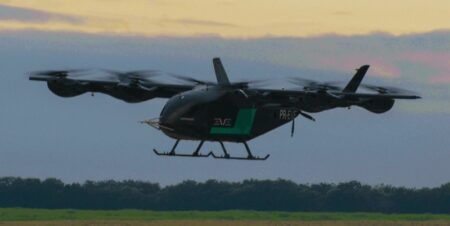


Eve Air Mobility has flown its full-scale engineering prototype for senior Brazilian government officials, including President Luiz Inácio Lula da Silva, at Embraer’s test facility in Gavião Peixoto, São Paulo state.
The demonstration marked further progress in the flight test campaign for Eve’s eVTOL aircraft, which made its maiden hover flight in December 2025. Since then, the prototype has completed 35 flights and accumulated almost 1.5 hours of total flight time.
The aircraft has reached a maximum altitude of 140ft (43m) above ground level, with maneuvers including simultaneous inputs across three axes. Flights to date have focused on low-speed operations of up to 17mph (28km/h), enabling validation of control laws, rotor aerodynamic efficiency, thermal behavior and the propulsion model.
Preliminary data indicate propulsion and battery performance that is above initial expectations, while noise levels remain within projections and below those of conventional helicopters, according to the company.
Johann Bordais, CEO of Eve, said, “We are reducing risk and building the foundation for future certification flights. The results so far reinforce our confidence in the aircraft’s architecture and our ability to deliver a safe, efficient and scalable solution for the urban air mobility market.”

Eve’s Lift+Cruise configuration
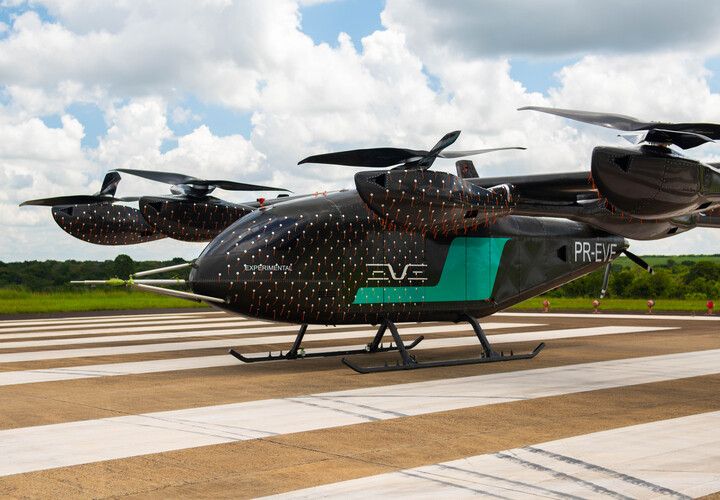
Eve’s eVTOL uses a lift-plus-cruise configuration with eight fixed-pitch lifter rotors for vertical flight and a single rear-mounted pusher propeller for forward cruise, driven by two motors for redundancy. Fixed wings provide lift during cruise, with no components required to change position during flight.
The eVTOL aircraft is designed to carry four passengers and a pilot over a range of 60 miles (100km) at a cruise speed of up to 125mph (201km/h).
Test campaign plans
The company plans to build six conforming prototypes for the full certification campaign and aims to complete approximately 300 test flights during 2026, progressively expanding the flight envelope toward wingborne cruise. Ground testing and sensor calibration for measuring aerodynamic loads during flight have also been completed, supporting an expansion to 30kts (56km/h) in the coming days.
Brazil’s National Civil Aviation Agency (ANAC) is the primary certifying authority for the aircraft. Eve is targeting type certification, first deliveries and entry into service in 2027.
The flight demonstration was also attended by the head of ANAC, the Brazilian minister of ports and airports and the president of the country’s national development bank.