

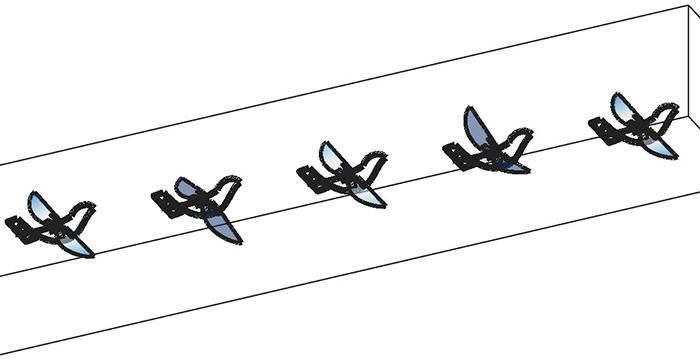
Engineers at Rutgers University in New Jersey, USA, have developed a bird-like drone whose wings flap and twist without motors, gears or mechanical linkages.
The solid-state ornithopter, described in a study published in the journal Aerospace Science and Technology, instead relies on the piezoelectric effect, in which special materials change shape when voltage is applied.
“We apply electricity to the piezoelectric materials, and they move the surface directly, without extra joints, extra linkages or motors,” said Onur Bilgen, associate professor in the department of mechanical and aerospace engineering. “The wing is a composite including a piezoelectric material layer and a carbon-fiber layer. Apply voltage to the piezoelectric layer, and the whole composite flexes.”
Thin strips called Macro Fiber Composites (MFCs) are bonded directly onto flexible wings. When electricity flows through them, the wings flap, twist and morph, with the carbon fiber acting as the structural element and the MFCs functioning as actuators.
Because the system has no gears or joints, the researchers describe it as a mechanism-free or solid-state ornithopter. Such bird-like drones could be well suited for tasks including search and rescue, environmental monitoring and inspection of hard-to-reach structures, where aircraft must navigate complex environments.
The research team also developed a computational model that simultaneously connects the key physics involved in flapping flight: wing and body motion, aerodynamics, electrical dynamics and control architecture. This allows engineers to test and optimize designs virtually before building physical prototypes.
“We’ve scientifically demonstrated that this type of ornithopter can be possible when we make certain material assumptions,” Bilgen said. “We can show the feasibility of designs that are not yet physically possible.”
The principal current limitation is the performance of the piezoelectric material itself. “Today’s piezoelectric materials are not capable enough,” Bilgen said. “However, our mathematical model allows us to look into the future with reasonable assumptions.”
Flapping wings offer advantages over spinning propellers at small scales. “When flapping wings come in contact with the environment, they’re less destructive to themselves and to what they contact,” Bilgen said.
The researchers say the approach could also have applications in renewable energy, with piezoelectric materials applied to turbine blades to subtly alter blade shape in real time and improve aerodynamic efficiency.