

Established in 1957, Hewland Engineering designs and manufactures high-performance transmission systems. Operating from two UK sites, it produces approximately 3,500 precision components and 900 transmissions annually, serving automotive and aerospace customers.
The company’s portfolio spans sequential race gearboxes, synchromesh gearboxes, EV transmissions and epicyclic transmission systems. Key product families include the HLS-200, HSC-200, 545-200 and advanced eVTOL gearing solutions, reflecting a progression from race-proven performance to safety-critical aerospace capability.
In 2024, Hewland opened a testing and validation facility in Southam, Warwickshire. The new technical center, combined with the company’s AS/EN 9100 certification at its Maidenhead production facility, underpins its move into lightweight transmissions for the aerospace sector.
Mark Ingram, technical director at Hewland Engineering says, “This facility represents a strategic pivot. It enables us to move from reactive, track-led development cycles to structured, qualification-led programs.”
From motorsport agility to aerospace assurance
Motorsport rewards agility, rapid iteration and close collaboration with customers. Although this environment honed Hewland’s engineering instincts, aerospace demands something different.
Ingram says, “Having committed to a future in aerospace, our vision became clear. We needed to close the loop between design, computer-aided engineering [CAE] validation and physical testing before a product reaches the customer. The new facility enables us to do precisely that.”
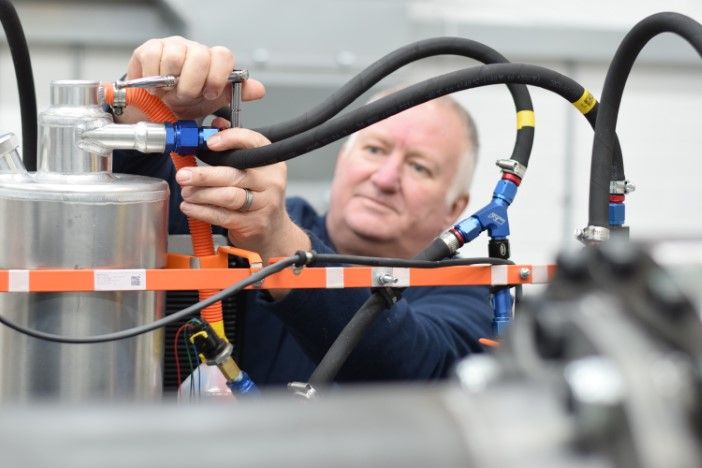
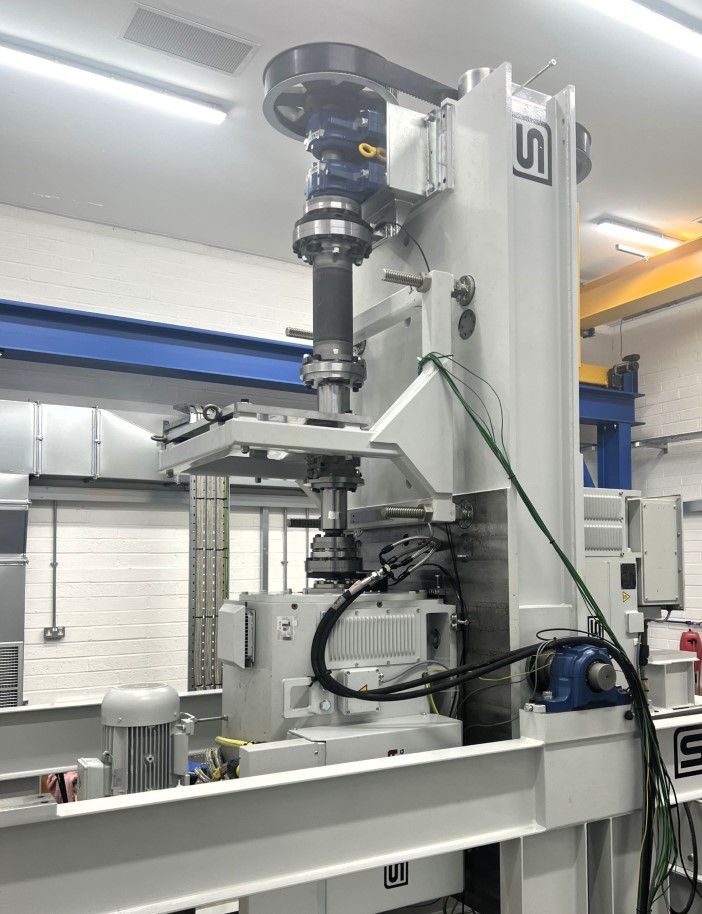
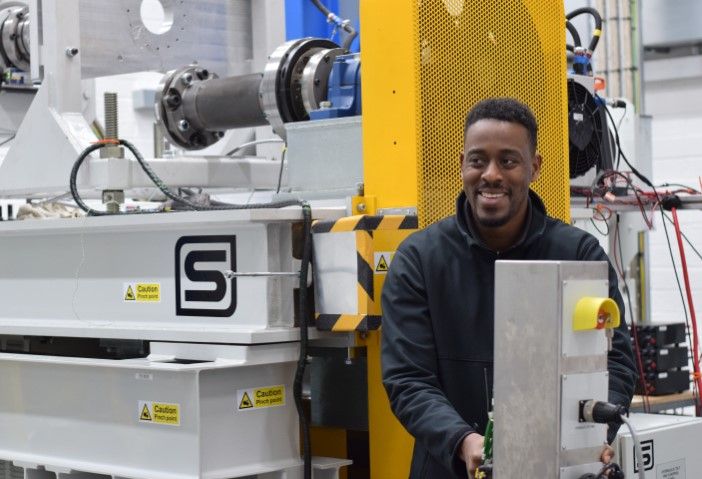
The Southam Technical Center houses a suite of advanced rigs designed to replicate real-world operating conditions. The 3E test rig, with a 750kW input, can achieve up to 885 lb-ft [1,200Nm] at 6,000rpm and is used for thermal (–40°F to 248°F [–20°C to 120°C]) and endurance testing, including gear contact and durability assessments.
A 2E loaded tilt table test rig offers 500kW absorption and 0–100° tilt capability, enabling simulation of vertical and horizontal flight orientations. A 34kW spin rig is used for lubrication testing at a variety of tilt angles, end-of-line (EOL) validation, transmission functional checks and shift quality assessment (SQA).
The facilities also include flexible development cells, fabrication and assembly areas, and 250kW battery emulators to support testing of a wide variety of driveline systems.
Testing in practice: eVTOL transmission development
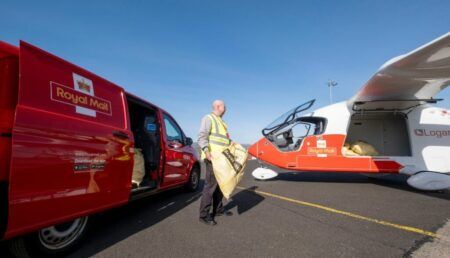
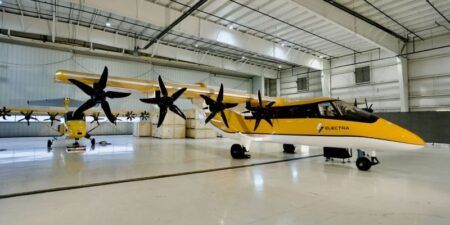
Hewland’s transition into aerospace was accelerated through an eVTOL gearbox program developed in 2024–2025, an opportunity to support an emerging industry requiring rapid innovation under stringent safety requirements.
Ingram says, “Approaching this eVTOL project, we applied our transmission design and development cycle, but enhanced it with aerospace-grade safety factors and controls.”
This approach also required a culture shift within the business, involving a new set of test criteria including capture and compliance tracking, weight statement monitoring, design decision registers (DDR) and design failure mode and effects analysis (DFMEA)/risk management.
Safety of flight: engineering for infinite life
Aerospace structural requirements for the eVTOL project demanded high safety factors against yield and ultimate tensile strength, infinite life assessment (using the Goodman methodology), fatigue knockdown and casting factors, and full traceability of material sources.
The transmission casing, manufactured from magnesium alloy for weight reduction, became a focal point. Once aerospace knockdown factors were applied, the effective endurance limit reduced considerably, requiring additional structural mass to meet fatigue targets.
Ingram says: “Extensive finite element analysis [FEA] modeling of the complete assembly allowed us to evaluate quasi-static mean stresses from assembly preload, bearing fits and thermal expansion, alternating stresses from gear and planetary load fluctuations, and combined flight load cases.
“Multiple design loops were required to meet stress margins, and ultimately we learned a valuable lesson: in aerospace, theoretical material weight savings can be canceled out by safety factor-driven mass increases.”
Advanced analysis: MASTA optimization
Using MASTA for system-level modelling, Hewland generated and evaluated multiple layouts, optimising for durability, efficiency, packaging and NVH performance.
Key activities included spur vs helical gear trade studies, tooth count and ratio optimization, frequency separation to avoid excitation of torsional modes, bearing selection, micro-geometry optimization using Taguchi arrays and case depth/tip thickness validation.
For bolted joints, Hewland applied VDI 2230 methodology combined with detailed FEA models to ensure robustness against separation, slip and preload loss. Where analytical predictions suggested embedding risk, physical validation confirmed joint integrity.
Oil circulation was optimized using particle-based simulation tools to evaluate behavior under pitch, roll and cruise orientations. Iterative baffle development resulted in reduced captive oil volume, directing oil efficiently to the sump and improving thermal management.
Mission-critical validation
For endurance validation, the team aligned testing with Part 27.923 of the Code of Federal Regulations. This involved a 100-hour test profile including 60 hours at maximum continuous torque (vertical orientation) and 30 hours at cruise torque (horizontal orientation).
All gears underwent crack detection and re-graphing. Casings were dye penetrant tested and mid-point inspections verified conditions before final endurance testing was completed.
The result was full compliance, with no unacceptable damage and a validated design ready for flight demonstrator application.
Lessons from transition
Hewland’s aerospace transition revealed notable differences in the test and development phase compared with automotive equivalents.
Ingram says, “Supplier lead times increased considerably when full conformance and traceability documentation were required. Process, test administration and traceability all take time. Validation matrices were essential to ensure every requirement was supported by analysis or test evidence.
“We also realized that safety factors can substantially change material selection decisions. Informed by modeling, analysis tools and virtual testing, getting the balance right when it came to weight, performance and safety was a real challenge.”
Ingram adds that the investment in testing infrastructure created the foundation for Hewland’s move into aerospace, but that the company’s agile culture – honed through decades of motorsport collaboration – was equally important in making the transition work.