

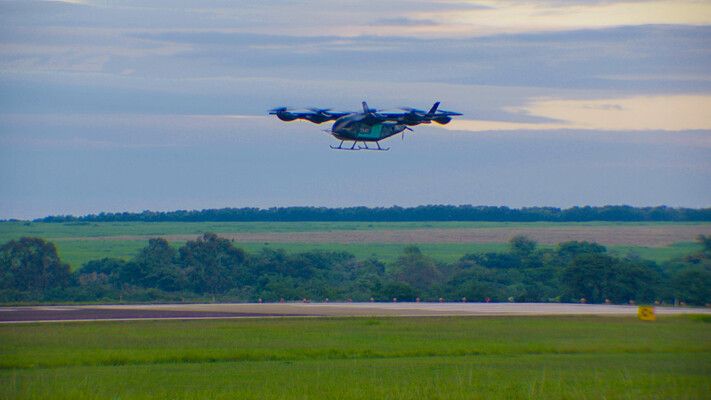
Eve Air Mobility has completed the first untethered hover flight of its full-scale electric vertical take-off and landing prototype at Embraer’s test facility in Brazil.
The remotely piloted aircraft lifted off vertically, hovered at 40ft (12m) for around a minute and then landed at the test site located near São Paulo. Embraer pilot Gerson de Oliveira Mendes operated the aircraft from a ground station while engineers monitored systems including motor temperature, battery state of charge and rotor speed from a nearby telemetry room.
The company, which is majority owned by Brazilian aircraft manufacturer Embraer, deliberately bypassed tethered flight testing to proceed directly to free flight. Ground testing with the aircraft tied down had previously validated propeller performance up to lift-off thrust levels.
Luiz Valentini, chief technology officer at Eve Air Mobility, said, “The pilot told us it felt like he was flying the simulator. And for us, that’s really important, because it means that the tests that we have done so far and the way that we build our models really represent the vehicle.”
The flight validated the integration of Embraer’s fifth-generation fly-by-wire system, along with eight fixed-pitch lifter propellers and electric motors supplied by Vermont-based BETA Technologies. Parameters, including turbine temperature and thrust-specific fuel consumption were within expected ranges during the test flight said Eve.
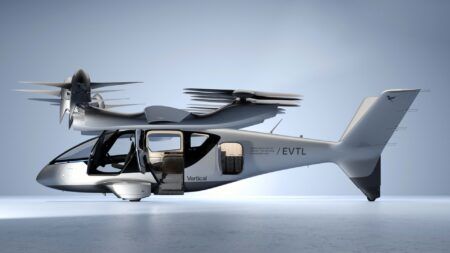
Eve’s design differs from competitors such as Joby Aviation, Archer Aviation and Wisk Aero by using fixed rather than tilting propellers. The aircraft features a rigid overhead wing with distributed rotors and an electric pusher propeller powered by dual motors.
The company will build six conforming prototypes to support its certification campaign with Brazil’s National Civil Aviation Agency (ANAC), the Federal Aviation Administration (FAA) and the European Union Aviation Safety Agency (EASA). Type certification, first deliveries and entry into service are targeted for 2027.
Valentini added, “With these data points, we will expand the envelope and progress toward transition to wingborne flight in a disciplined manner, ramping up to hundreds of flights throughout 2026.”
The production aircraft will accommodate a pilot and four passengers with a range of approximately 60 miles (97km). According to Eve it holds around 2,800 pre-orders for the aircraft, primarily in the form of non-binding letters of intent.