

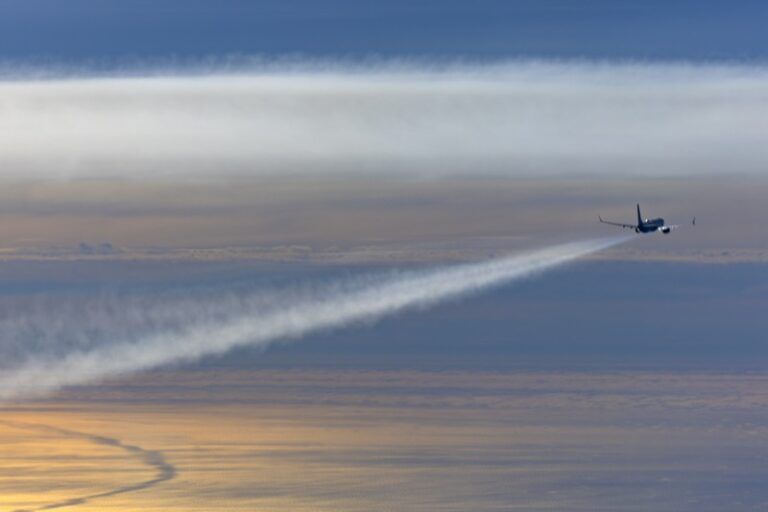
Late last year, a major study by Chalmers University of Technology in Sweden and Imperial College London confirmed that the contrails created by modern aircraft flying at high altitudes last longer than those from older aircraft. The research also found that private jets cause more contrails than previously thought.
If, as scientists believe, the globally averaged warming effect of contrails is greater than that from aviation fuel carbon emissions, modern aircraft would be contributing more to climate change – even though they emit less carbon.
“It’s long been recognized by scientists that contrail cirrus is a major source of aviation-induced warming,” says Chalmers’ Professor Daniel Johansson, who is also a lead author of the next IPCC climate report. “Our study places the impacts of contrails within a climate-economic framework. The economic damage caused by contrails is likely smaller than those from aviation CO emissions, but they still constitute a substantial share of aviation’s overall climate impact.”
Formation, persistence and variability
Contrails form when aircraft exhaust mixes with air colder than around -40°F (-40°C) that is sufficiently humid. In this scenario, the air parcel becomes supersaturated and the water vapor within it condenses onto available particles. This typically occurs at cruise altitudes above 8km (5 miles) but can also occur at lower or higher altitudes depending on season, latitude and meteorological conditions.
“Warming effects are determined by a variety of factors, so each flight is different,” says Peter Swann, product climate impact specialist at Rolls-Royce.
“During the day, contrail cirrus both reflect incoming solar radiation, which contributes to cooling, and absorb outgoing infrared radiation from below, which contributes to warming. The net effect of an individual contrail during daytime can therefore be either warming or cooling, depending on local conditions, although the warming contribution often dominates. At night, contrail cirrus always lead to warming.
“Contrails become persistent when they form in ice-supersaturated air,” he continues. “Under these conditions, water vapor from the surrounding atmosphere continues to deposit onto the ice crystals, allowing them to grow. A higher ice-crystal number density leads to a stronger radiative impact of contrail cirrus. Over time, these can become indistinguishable from natural cirrus clouds.”

Measuring contrails
To gain a better understanding of how we can minimize the creation and impact of contrail cirrus, researchers are working with industry partners to gather more data on their creation, composition and persistence.
A recent campaign saw NASA scientists take a mobile ground-based laboratory to Boeing Field, Seattle. This was positioned behind a blast fence, with sampling probes aligned directly with the engine centerline of a pre-delivery Boeing 737-9. Exhaust air was drawn through tubing into the laboratory, allowing the researchers to measure particle numbers and, to a limited extent, composition.
“These ground tests enabled extremely detailed measurements, but they also exposed a major limitation – measuring the chemistry of ultra-fine particles,” says Dr Richard Moore, research physical scientist at the LIDAR sciences branch of NASA’s Langley Research Center.
“We are particularly interested in particles in the 5–10 nanometer range, yet these have almost no mass, making them difficult to analyze even with sophisticated mass spectrometers.
“Existing techniques struggle to reliably characterize their chemical makeup, highlighting a key instrumentation gap.”
Scaling these measurements beyond research campaigns presents an even bigger challenge. Instruments used in research aircraft are often too complex, fragile or unsafe for routine airline use. For example, some research-grade water vapor sensors rely on lasers that transmit through aircraft windows to wing-mounted reflectors – a configuration that’s impractical in a commercial operating environment due to safety, certification and maintenance concerns.
From an airline perspective, the requirement is simple but demanding – a compact, rugged, self-contained sensor that can be installed in the avionics bay, operates without pumps or moving parts, requires minimal maintenance and that still delivers the precision needed for scientific analysis.
Designing an instrument that meets these standards and meets atmospheric science requirements remains a big challenge. Several organizations are developing commercial-grade water vapor sensors and NASA’s Small Business Innovation Research (SBIR) program is funding prototype sensors intended for eventual commercial deployment. However, Moore is clear that much more development and validation work remains.
The goal is to combine distributed measurements across commercial fleets with more advanced and robust modeling capabilities, in much the same way turbulence forecasting is already embedded in flight-planning tools today. “Bringing these two elements together would significantly improve airlines’ ability to predict and manage contrail formation,” he says.

SAF flight testing
While ground tests offer control and flexibility, flight testing remains the gold standard for contrail research and in obtaining the most accurate and valuable data. Engines behave very differently at cruise altitude. In addition, contrails do not form on the ground. Researchers, OEMs and airlines are therefore partnering on several airborne contrail testing projects.
Many are looking at whether sustainable aviation fuel (SAF) can reduce the climate impact of contrails, either alone or in combination with new engine technologies. A recent project saw NASA researchers fly its DC-8 research aircraft in formation behind a Boeing 737-10 at cruise altitude, repeatedly through the exhaust plume while sampling particles and trace gases in real time.
The test aircraft was configured with one engine burning conventional jet fuel and the other operating on 100% SAF, with researchers able to switch between the two fuel streams to observe how particle emissions and contrail properties changed.

The flight testing confirmed dramatic reductions in soot emissions from modern lean-burn engines – reductions so large that particle concentrations approached background atmospheric levels, making them increasingly difficult to measure. SAF also delivered an additional reduction, but crucially, contrails still formed.
Another major project is the European Emission and Climate Impact of Alternative Fuels (ECLIF3) program. This is one of the most detailed flight studies examining how SAF influences contrail formation. Participants include Airbus, Rolls-Royce, the German Aerospace Centre (DLR) – Institute of Atmospheric Physics, and biofuel producer Neste.
Global model simulations estimate a 26% reduction in contrails’ climate impact when using SAF, but engine design matters, notes Astrid Sonneveld, technical lead, renewable products business at Neste.
“ECLIF3 demonstrated around a 60% reduction in ice crystals for rich burn engine technology when operated on 100% Neste HEFA-SPK compared to the conventional fuel. As for lean-burn engines, first results indicate that linking fuel composition to emissions isn’t as clear.”
While recent measurements, both on the ground and in flight, have provided considerable insight, ongoing campaigns such as Particle emissions, Air Quality and Climate Impact related to Fuel Composition and Engine Cycle (PACIFIC) will provide yet more data and learnings, believes Swann. The PACIFIC project is focusing on understanding how soot forms during fuel combustion and is examining the impact of fuel composition in greater detail by testing an unprecedented range of fuels.
“Conventional jet fuel and SAF cannot be described by a single composition,” says Sonneveld. “Both exist across a spectrum, with different combinations of properties that influence emissions. To really understand their climate impacts, we need data across that entire spectrum, and that’s what PACIFIC is designed to deliver.”
Looking beyond combustion
The findings of R&D projects so far have pushed researchers to look beyond combustion alone. Measurements reveal the presence of non-soot particles, prompting a deeper investigation into engine oil systems. Gas turbine engines vent lubrication oil vapor through breather systems to equalize pressure during flight. Under high temperature and pressure conditions, these vents can emit a fine mist of oil droplets, which may act as additional nuclei for ice crystal formation.
As a result, testing programs are examining how different engine architectures influence not just soot emissions, but also oil vapor release and sulfur-related particles. Understanding these interactions will improve contrail prediction models and help assess the real climate benefits of new engine and fuel technologies.
Improving contrail mitigation
In the UK, Rolls-Royce, British Airways, Heathrow Airport and Imperial College London are currently undertaking the Quantifying Reduction in Thermal Contrails by Optimising SAF (QRITOS) program. The two-year research project is combining flight trials, advanced modeling and satellite observations to monitor contrail formation when SAF is used strategically.
QRITOS concludes in April 2027, and aims to improve forecasting methods and contrail modeling. Its research is similar to that of the A4CLIMATE program, which is led by DLR and includes an examination of the benefits of climate-optimized flight routing.
“This summer [tour operator] TUIfly will perform 400 contrail avoidance flights, which we will evaluate in respect to reduced contrail climate impact and additional fuel consumption,” says Professor Christiane Voigt, head of the DLR’s cloud physics department.
Contrail testing is next
From a testing perspective, the emphasis is now shifting from individual experiments to large-scale, operational validation. According to Voigt, early contrail avoidance trials have delivered encouraging results, but the priority is to expand these into broader demonstration campaigns capable of reducing uncertainty and assessing real-world trade-offs.
Prediction and evaluation tools now need to be tested at scale, using coordinated flight trials combined with independent observational assessment, to understand how contrail mitigation performs across different meteorological conditions, traffic densities and routing constraints. Such trials are also essential for developing robust risk assessments, particularly where avoidance strategies may increase fuel burn or operational complexity.
For SAF, these testing frameworks will be essential to distinguish fuel-specific climate benefits from those driven by engine design and atmospheric variability. Together, these priorities point to a testing agenda focused on scale, verification and uncertainty reduction, providing the evidence base needed to move contrail mitigation from promising trials into dependable operational practice.

Germany flight tests contrail avoidance strategies
The three-year D-KULT (demonstrator for climate and environmentally friendly air transport) project published its first phase of practical research on aviation contrail avoidance to reduce climate impact last month. The project, which was funded by the German Government, concluded testing last August.
D-KULT partners included the German Aerospace Centre (DLR), Germany’s air navigation service provider DFS Deutsche Flugsicherung, the German Meteorological Service and airlines.
Two approaches were tested. Tactical avoidance, which involves ATC guiding aircraft around contrail-forming regions in real time, proved impractical. Real-time simulations showed this approach leads to an up to 60% loss in airspace capacity and increased controller workload.
Strategic avoidance shows more promise. This approach sees airlines expanding flight planning systems to include climate optimization functions and enabling route selection before take-off to avoid potential persistent contrails (PPC) areas. A test with 100 flights successfully avoided PPC areas in a targeted manner, though the manual planning required means it cannot yet be transferred to regular operations.
Further research is now set to examine the effects on fuel consumption and carbon footprint. A positive climate impact will only occur if the benefits of avoiding PPC areas exceed additional CO₂ emissions required. Initial calculations show potential but highlight the need for continued development work.