

Researchers at the German Aerospace Center have completed the first flight tests of shape-changing aircraft wings steered by an adaptive artificial intelligence control system.
The flights form part of the Morphing Technologies and Artificial Intelligence Research Group (morphAIR) project, a research effort led by the German Aerospace Center (DLR). The project is using shape-changing wing structures to replace conventional flaps and ailerons and make fixed-wing aircraft more efficient, easier to control and safer.
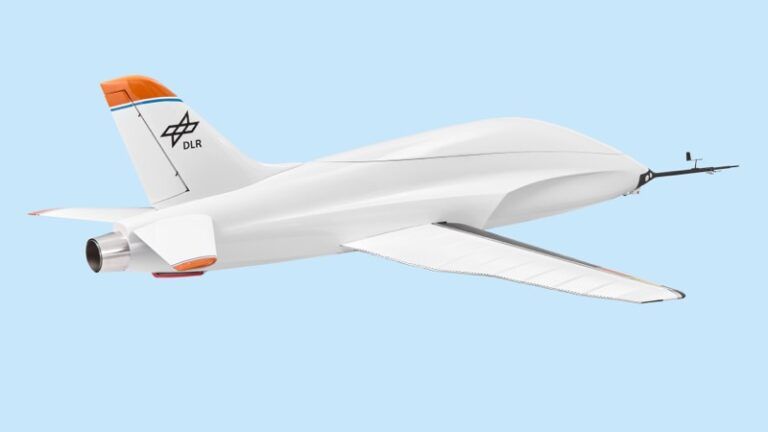
DLR equipped its Proteus uncrewed experimental aircraft with a conventional reference wing set and a morphing set in turn, with tests carried out at the agency’s National Experimental Test Center for Unmanned Aircraft Systems in Cochstedt, eastern Germany.
Both wing sets are built from fiber-reinforced composites. The morphing variant features a form-variable trailing edge – the Hyperelastic Trailing Edge Morphing system, or HyTEM – which replaces conventional flaps and ailerons with 10 small actuators distributed along the wingspan, enabling the wing to deform seamlessly and without steps.
“The morphing wing can change its shape during flight, allowing it to adapt optimally to different flight conditions,” said Martin Radestock, project leader at the DLR Institute of Lightweight Systems. DLR said the continuous profile reduces drag and allows lift, induced drag and aircraft control to be influenced in a targeted manner, while distributing control functions across the wing also improves fault tolerance.
AI-assisted flight control
A central element of the project is an AI-assisted flight control system developed by the DLR Institute of Flight Systems. The adaptive algorithm detects when behavior deviates from its trained model and updates its internal models in real time; training deliberately simulates damage and actuator failures so that the system can compensate using the remaining control surfaces.
The system also draws on a pressure-reconstruction method developed by the DLR Institute of Aerodynamics and Flow Technology, which rebuilds the surface pressure distribution over the wing from limited measurement data. Proteus can then compare the reconstructed flow field against its expected state and automatically flag local disturbances.
The initial flights primarily demonstrated airworthiness and system integration, providing a foundation for further measurement campaigns. DLR said the aerodynamic and structural design, with a top speed of 186mph (300km/h) and wing loading of 14.3lb/ft² (70kg/m²) that is also relevant to light aircraft despite being tested in scaled form.
A further flight test campaign is planned during 2026 using Proteus with a total mass of around 154lb (70kg) to demonstrate scalability. The findings will be taken forward in the Unmanned Aircraft Wing Adaption (UAdapt) project.