

“One of the most important things on this mission, different from Artemis I, is we now have environmental controls and life support systems. On this mission we are going to test those out and make sure that we can keep our crew healthy and safe throughout their mission.
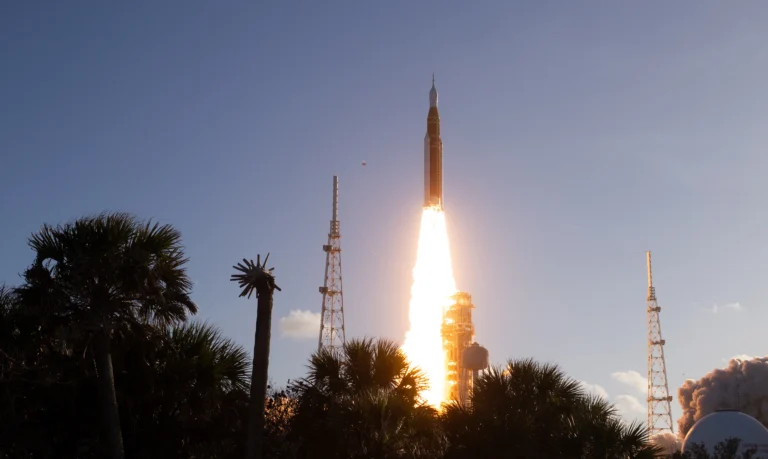
“We also have an activated launch abort system on this mission. We want the ability if something goes wrong to abort and get them back to the ground again, safe,” said NASA exploration systems development acting associate administrator, Lori Glaze during the live stream coverage of launch day one of the agency’s Artemis II mission which has sent four astronauts to go around the Moon and back.
The four astronauts on board the Lockheed Martin Orion crew spacecraft are commander Reid Wiseman, pilot Victor Glover and mission specialist Christian Koch, all from NASA, and Jeremy Hansen from the Canadian Space Agency (CSA). They were launched by the Boeing built Space Launch System (SLS) rocket at 1835hrs local time from NASA’s Kennedy Space Center (KSC) in Florida.
Test missions
The US space agency has always referred to its Artemis missions as test flights and as the crowds of media and NASA and industry partner staff swelled at the KSC Press Center this mantra was repeated often. It was the success of one much earlier test that led to the 1 April launch decision.
During February, the Artemis II propellant tanking exercise filled the SLS with its liquid hydrogen (LH2) and liquid oxygen (LOX). The 700,000 gallons of cryogenic LOX and LH2 take hours to pour into the rocket with a pre-filling process of chilling down the tanks and engines with small amounts of the super cold elemental liquid.
Two month later and the tank filling for Artemis II began early in the morning of April 1. When the international journalists at the KSC Press Center arrived at 9am and then again at 11am, the tanks had been filled and replenishment was underway to keep the rocket fully fueled.
Less than an hour after the tank had been filled with its propellants, Wiseman, Glover, Koch and Hansen, departed for the launch pad to board the Orion that they had named Integrity.
Launch day excitement
The smooth success of the tanking operation to fill the Artemis II SLS with LH2 and LOX led to a growing sense among the Press Center peoples that this launch really could happen. The bright warm day only enhanced that feeling that today could be a historic day. The Press Center was full of journalists writing for newspapers, magazines, websites with some broadcast outlets such as the BBC.
Adding to the sense of occasion was the string of large and small ad-hoc studio stages extending away from the Press Center building and its adjacent auditorium with their bustling mass of people reflecting the demanding preparations for the launch.
As the media progressed with their writing and reporting, on board Integrity testing the communications system was at one point the task at hand. The Orion test conductor spoke with Hansen to confirm that they could both hear each other clearly, test accomplished.
The crew’s Orion Launch and Entry Survival suits are connected to the spacecraft for life support and data links and communication. During the work to ready the crew and Orion for the launch, the integration of these functions between astronaut suits and spaceship was also tested.
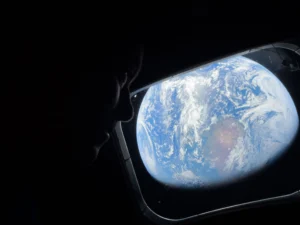
Another key test for crew was pressurizing their launch and entry suits, or spacesuits. With their helmet visors closed the air pressure inside the suit is increased.
The suits had had leak checks before launch day, but this test was finally with the crew on board Orion. In the event of a capsule depressurisation event, the crew could have to live in their suits for days before landing back on Earth.
These Orion and astronaut milestones were arising in the timetable and being passed again and again, as smoothly as the cryogenic tank filling stages had done. There was an intangible but present growing hope among the Press Center inhabitants that this launcher would fly defying the statistics of rocketry delays and it really could happen on the first of NASA’s April launch attempt days. The others were 2nd, 3rd, 4th, 5th, 6th and 30th as launch attempt dates.
Finally, the launch pad Closeout Crew responsible for Orion closed the two hatches. One is the Orion crew module’s and the second is a launch abort system (LAS) protective fairings’ hatch. This is part of the ogive shaped fairing that protects the crew module from the blast of the LAS motors in an emergency escape situation.
The Closeout Crew had to test the spacecraft’s hatch’s seals and again, the outcome was positive and the confidence of the journalists at the Press Center, and perhaps further afield, was reinforced.
Smooth preparations
Watching NASA’s real-time live coverage of its efforts to launch the first crewed Moon rocket in more than 53 years, the most remarkable aspect of it was how unremarkable it was.
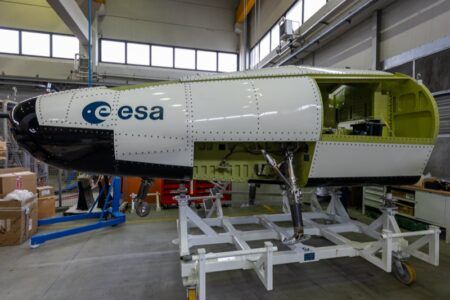
NASA and European Space Agency (ESA) officials and assorted astronauts were being interviewed outside the Press Center with the Space Launch System in the distance, 4 miles (6.4km) away. The Orion’s service module that provides power, propulsion and life support is supplied by ESA and its industrial partners.
The ESA officials were also confident about their service module and its performance, especially as it had been tested, flight proven, with the 2022 uncrewed Artemis I mission. While the Lockheed Martin developed and built Orion crew module also went to the Moon in 2022 for Artemis I, as part of the Orion spacecraft, that Orion had no Environmental Control and Life Support Systems (ECLSS). Hence Glaze’s comments about ECLSS’ importance.
Weather always bedevils launches and with the Artemis I mission, NASA had to roll the SLS back to the VAB (Vehicle Assembly Building) in September due to Hurricane Ian. This time, Artemis II had astonishing luck with the weather forecast, announced by the weather unit of the United States Space Force’s Delta 45 which oversees the ‘eastern range’ from Cape Canaveral Space Force Station (CCSFS) and also KSC.
The forecast was first announced on 30 March and was very positive with an 80% chance of the launch being able to go ahead. Another confidence building milestone in the road to the Moon. Delta 45’s forecast continued during the week to be upbeat. The weather was not going to test anyone’s patience this time, the right stuff for the Artemis II launch was to keep calm and carry on.