

US ITC opens investigation into Joby imports
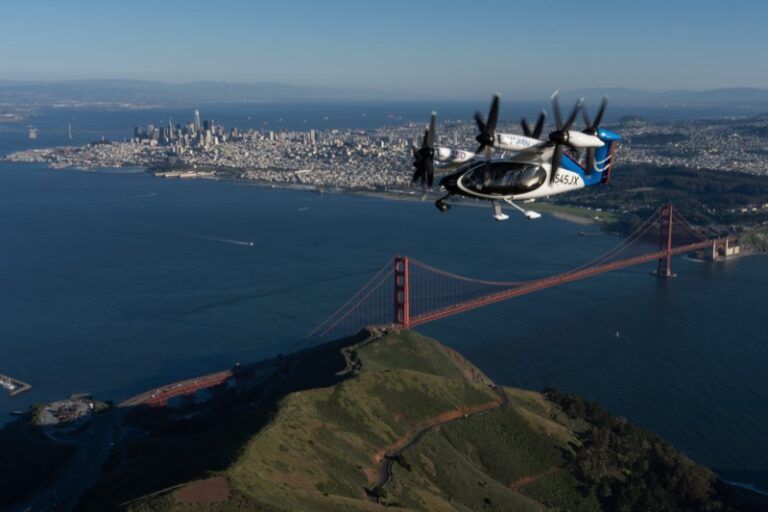
The US International Trade Commission has opened a formal investigation into Joby Aviation following a complaint by rival Archer Aviation alleging Joby misclassified Chinese-made components in shipping records and concealed Chinese manufacturing ties to evade tariffs.
The complaint cites alleged violations of the US Tariff Act of 1930. The investigation is expected to conclude within on May 24th. The action is the latest in a series of legal exchanges between the two California eVTOL developers, beginning with Joby’s late-2025 trade-secret suit against Archer and Archer’s subsequent counter-claim alleging fraud over manufacturing sources. (US ITC press release)
ZeroAvia progresses 600kW electric engine towards FAA certification
The FAA has published special conditions for ZeroAvia’s 600kW electric propulsion system as a Final Rule in the Federal Register, a step towards type certification of the engine.
The conditions establish additional safety standards for an aircraft engine technology not anticipated in existing airworthiness rules.
ZeroAvia’s 600kW unit, comprising motor and inverter, forms the electric end of the planned ZA600 hydrogen-electric powertrain for 10–20 seat aircraft, and builds on FAA G1 and P1 papers and a UK CAA Design Organization Approval issued in October 2025. (ZeroAvia press release)
US Air Force accelerates collaborative combat aircraft development
The US Air Force’s Experimental Operations Unit concluded a Collaborative Combat Aircraft experimentation period at Edwards Air Force Base, California using the Anduril YFQ-44A, flown by warfighters rather than test pilots, to refine operational and logistical procedures for autonomous wingmen in contested environments.
Run jointly with the 412th Test Wing, the activity is positioned as a pathfinder for the US Air Force’s new Warfighting Acquisition System.
Anduril maintenance technicians supported sortie generation on the flight line, working alongside operational personnel to develop sustainment concepts. (Air Force Materiel Command)
Autonomous H145 flies autonomously during test with combined tech
Airbus US Space & Defense, Shield AI, L3Harris and Parry Labs completed a fourth autonomous flight test of an H145 helicopter at Airbus’s Grand Prairie, Texas facility, integrating all four companies’ technologies on the aircraft for the first time.
During the tests, the H145 autonomously evaluated landing zones, detected obstacles and rerouted to alternates. The work supports the US Marine Corps Aerial Logistics Connector Middle Tier of Acquisition Rapid Prototyping Program, awarded by NAVAIR in May 2024 and based on an unmanned UH-72 Lakota variant for contested logistics. (Shield AI press release)
NASA’s Dragonfly rotorcraft moves through structural and EDL testing
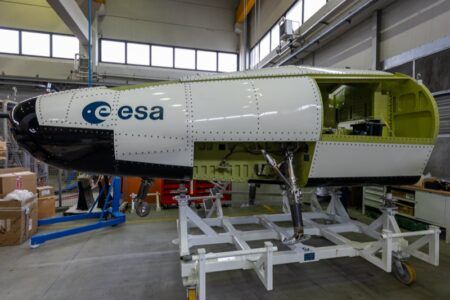
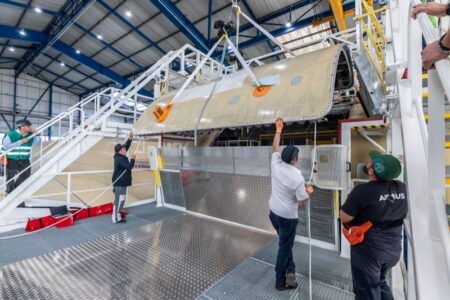
NASA’s Titan-bound Dragonfly rotorcraft is taking shape, with delivery and fit-check of body panels designed by Johns Hopkins APL and manufactured by Lockheed Martin Space. The aluminum honeycomb structure has face sheets just 0.01in thick, with the full frame weighing 230lb (104kg).
A full-scale parachute drop test of Dragonfly’s Titan entry, descent and landing system was completed in February at Eloy, Arizona, while the Dragonfly Mass Spectrometer at NASA Goddard finished initial laser system testing in April. Vibration and static-load tests are scheduled for May ahead of a launch to the Saturn moon no earlier than 2028. (NASA Science)
Sceye completes 12-day, 6,400-mile stratospheric flight
US-based HAPS developer Sceye has completed its Endurance Program with the SE2 stratospheric platform, flying 6,400 miles (10,300km) over more than 12 days from Moriarty, New Mexico to off the coast of Brazil, before controlled flight termination.
The mission closed Sceye’s pressure loop with the first fully in-house manufactured hull and sustained more than 88 hours of station-keeping, including station-seeking radii as low as 1km. A pre-commercial test flight with SoftBank Corp is planned in Japan this summer to demonstrate backhaul into the operator’s core network and emergency connectivity. (Sceye press release)
Aura Aero announces €50m of funding and confirms first firm orders
French electric aircraft developer Aura Aero closed a €50 million Series B round, taking total funding to €340 million, and confirmed 20 firm orders alongside more than 700 purchase intentions for its hybrid-electric ERA regional aircraft.
The company also secured a building permit for its Toulouse-Francazal factory in France and announced a 16-hectare manufacturing site at Daytona Beach International Airport in Florida, supported by Space Florida.
Investors include French Tech Souveraineté, EIC Fund, Safran Corporate Ventures and EDF Group, alongside US backers. (AURA AERO press release)
Luxaviation to be launch operator for Beyond Aero hydrogen bizjet
Beyond Aero has selected business jet operator Luxaviation as the launch operator for its hydrogen-electric business aircraft, a six-seat platform designed for ranges of up to 800nm (1,500km).
The partnership covers mission profile definition, hydrogen ground and airport infrastructure, operational procedures and fleet integration, with the partnership expected to evolve toward demonstration flights under EASA frameworks. Beyond Aero recently completed propulsion validation at TRL6, conducted France’s first manned hydrogen-electric flight and acquired the assets of Universal Hydrogen. The company has raised more than US$50 million. (Beyond Aero press release)
Vertical Aerospace closes $850m financing round
UK-based eVTOL developer Vertical Aerospace closed a funding round totaling up to US$850 million, securing the company’s runway to its target 2028 type certification of the Valo eVTOL.
The package combines a maturity extension and up to US$50 million in additional notes from Mudrick Capital, up to US$250 million of Series A Convertible Preferred Equity from Yorkville Advisors Global, and a US$500 million equity line of credit.
Vertical recently completed a full-scale piloted two-way transition flight on 16 April and reports approximately 1,500 pre-orders. (Vertical Aerospace press release)
Reliable Robotics raises $160m for autonomous technology
Reliable Robotics raised US$160 million in funding to accelerate deployment and production of its FAA-certifiable Reliable Autonomy System, with autonomous cargo operations targeted to begin later this.
Reliable said more than 200 systems are ordered across commercial and military customers, including a 2025 USAF contract for contested-logistics cargo operations in the Indo-Pacific.
The FAA has accepted the company’s certification plans and means of compliance. (Reliable Robotics press release)
SkyDrive and NEXCO West partner on expressway-based vertiports
Japanese eVTOL developer SkyDrive has signed a partnership agreement with West Nippon Expressway Company (NEXCO West) to investigate the use of expressway service and parking areas as vertiports for advanced air mobility.
Use cases under study include sightseeing flights, regional economic development and post-disaster damage assessment.
SkyDrive is targeting commercial operations of its three-seat SD-05 eVTOL in 2028, having flown public demonstrations at Expo 2025 Osaka and in Tokyo. (SkyDrive press release,)
VerdeGo Aero ships first aircraft hybrid powerplant
VerdeGo Aero has shipped the first VH-4T-RD hybrid-electric powerplant from its Daytona Beach, Florida facility to a customer.
The 375kW developmental unit shipped on schedule and on budget, with a 415kW production-intent VH-4T-415 due for ground testing later in 2026, with maturation supported in part by a USAF Phase III contract.
VerdeGo claims around a 10x range improvement over battery-electric four to six seat vertical take-off applications, with higher cruise speed and added payload. (VerdeGo Aero press release)
Vaeridion selects Garmin G600 TXi for Microliner test campaign
Germany-based Vaeridion has selected Garmin G600 TXi flight displays to equip the first test articles of its all-electric nine-seat Microliner ahead of first flight.
The touchscreen displays will support the company’s flight test campaign as the platform progresses toward a target 2030 entry into commercial service.
The avionics selection follows recent Vaeridion milestones including the opening of a battery manufacturing facility and test house at Oberpfaffenhofen special airport, a European Investment Bank advisory backing in early March and a partnership with battery firm Molicel announced in February. (Vaeridion press release)
Pangea Propulsion secures €2m from Catalan government
Spain’s Pangea Propulsion has secured €2 million in financing from the Government of Catalonia, via the public investment entity Avançsa’s Innova Creixement program, to expand its propulsion manufacturing and testing capacity. €1 million has been released in a first phase.
The funding follows a €23 million Series A and a €7.27 million grant from Spain’s Ministry of Science, Innovation and Universities in 2025. Pangea’s product line includes the Nereus in-space thrusters, the Cryox upper-stage engine, the Arcos aerospike and the Kronos engine, the latter under contract for ESA heavy-lift applications. (European Spaceflight)