


The aerospace industry is highly dependent on safety. Before an aircraft is released to service, several components are thoroughly inspected to ensure their structural integrity. This also applies to space shuttles and satellites. Many of these inspections involve non-destructive testing at different phases throughout the lifecycle of these parts.
What is NDT?
NDT is the evaluation of the structural integrity of a component without damaging the material. It is used to detect both surface and subsurface material flaws like cracks, discontinuities, deep scratches, nicks, and gouges, during manufacturing and while the vehicle is in-service during maintenance.
Unlike destructive testing, the material is returned to service if no defects are found after inspection. This is one of the major benefits of NDT.
The importance of NDT
In aerospace, NDT is performed in accordance with maintenance manuals, engineering specifications and regulatory requirements and determine how the inspection is carried out, the frequency of inspection and allowable material defect limits.
The methods are selected based on several criteria: The material composition of the component or part; the geometry and accessibility of the component or part; the type of defects to be identified, and the lifecycle phase of the component or part, i.e. manufacturing or in-service.
NDT inspection methods
Several NDT inspection techniques are used on aircraft and spacecraft components. Since no method is fully sufficient to certify every material, a combination of methods is often used for different aerospace parts before and during service.
The following is a short description of current NDT inspection methods:
Visual testing
This is the simplest and most direct method. It involves inspecting a material with the human eye and is used to identify visible surface defects such as corrosion, deformation and surface cracks. VT is commonly carried out with the help of visual aid equipment such as magnifying glasses and borescopes under suitable lighting, either visible light or ultraviolet (UV) rays.
Ultrasonic testing (UT)
A method where high-frequency sound waves are passed into a segment of the test component to determine the presence of defects in the material. Thick metallic structures, bonded joints and composites are inspected using UT to detect discontinuities like cracks, voids or delaminations. Other complex techniques, like phased array ultrasonic testing, provide better coverage, more rapid testing and clearer indications.
Radiographic testing (RT)
x-rays or gamma rays are used to visualize the internal structure of components. RT is used to evaluate volumetric defects such as porosity, inclusions and fusion gaps in the welds and castings. In aerospace, digital radiography is used due to the speed of image acquisition, the image quality and ease of data storage compared to film-based technology.
Eddy current testing (ET)
This method relies on electromagnetism. ET helps to determine the location and nature of surface and near-surface discontinuities in regions that are likely to experience fatigue cracking, e.g. mating faces and fastener hole locations. Eddy current testing is ideal for conductive materials while in-service due to its high sensitivity, speed and flexibility.
Magnetic particle testing (MT)
This is also used to detect surface and near-surface defects. A magnetic field is induced on the component and small magnetic particles accumulate in regions of discontinuity. This makes the defects visible. MT can only be used on ferromagnetic materials.
Liquid penetrant testing (PT)
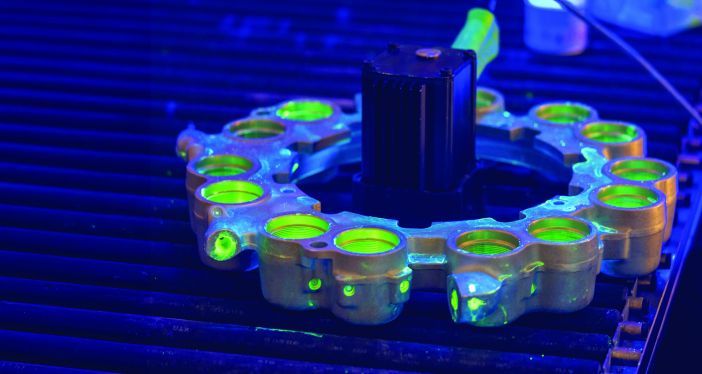
A technique used to test the surface of solid non-porous materials, a liquid penetrant is applied to the surface and is allowed to leak into defects. The excess penetrant is wiped off after a period of time, known as dwell time. A developer is then applied to draw out the seeped penetrant in any surface crack. This technique is used during routine checks to detect very small cracks.
Acoustic emission testing (AE)
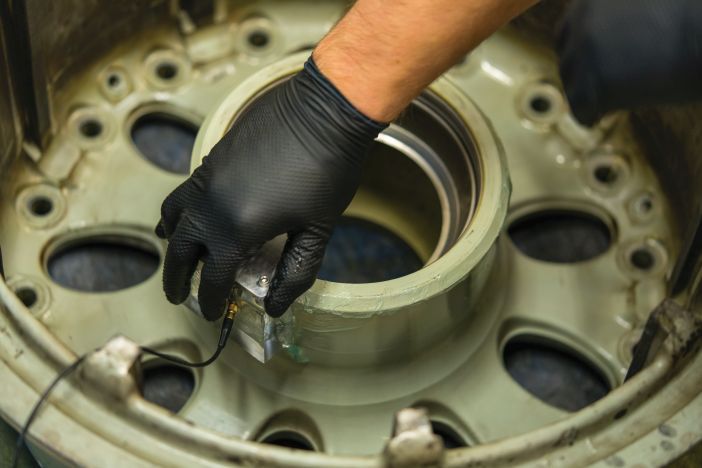
This involves using sensors to detect short bursts of ultrasound emitted by cracks or openings in a surface. Ideally, AE is used to detect leaks, corrosion and areas with high-stress concentration. AE can also be used to monitor structural damage in composite materials throughout their service life and may be combined with other NDT techniques, like infrared thermography, to give a detailed result of damage.
Thermal or infrared testing
Thermography is used to analyze the impact of a defect on the thermal conductivity and emissivity of materials. Dynamic thermography relies on the excitation of material surfaces either with light, ultrasound or eddy currents. It is useful in measuring composite materials.
Leak testing
The methods in leak testing are: bubble leak testing, observation using soap solution; pressure change testing, observation of the vacuum; halogen diode testing, and mass spectrometer testing with helium to record and observe any kind of pressure change that will cause a leak.
Laser methods (LM)
These are laser-based methods of detecting subsurface defects such as disbonds, delaminations and core damage in non-contact aerospace structures. These methods are best for inspecting tiny cracks on delicate structures where traditional NDT may cause damage and they include shearography, holography and profilometry.
NDT in manufacturing and maintenance
Aerospace materials must always be of the highest safety standards to prevent accidents. Right from manufacturing, NDT is used for quality assurance and certification of newly manufactured aerospace parts.
NDT ensures that the materials produced meet design requirements and regulations before entering service. Defects such as porosity, absence of fusion, inclusions and bonding defects introduced during material processing are detected here.
Most inspections are performed in controlled environments in which manufacturers use fixed, automated or semi-automated inspection equipment to attain a high level of repeatability and precise recording of the information.
New aerospace development projects are also subject to design validation using NDT. The information obtained during inspections helps engineers understand the behavior of the aerospace materials under loading, temperature and fatigue.
Such information is used to improve design and certification processes for future in-service maintenance. NDT inspectors in the manufacturing sector work with aircraft manufacturers like Airbus, Boeing, SpaceX, major engine manufacturers like GE Aerospace or Pratt & Whitney, and other component manufacturers.
In maintenance, parts subjected to high operational loads and environmental exposure are regularly tested using different NDT methods. Unlike manufacturing, NDT in maintenance, repair and overhaul (MRO) operations focuses on material degradation that occurs over time, such as fatigue cracking, corrosion, wear and impact damage.
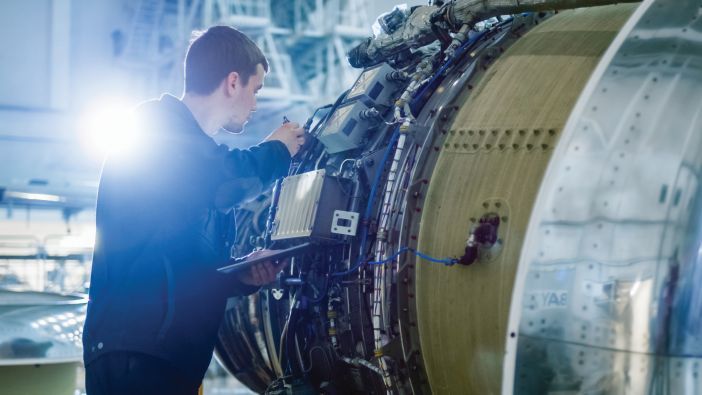
These MRO inspections are performed during scheduled checks or following specific incidents using portable NDT equipment, often in tight areas on the aircraft while they are in hangars. Airlines, MRO facilities and special shops fall under this category to ensure continued airworthiness.
Testing of composites
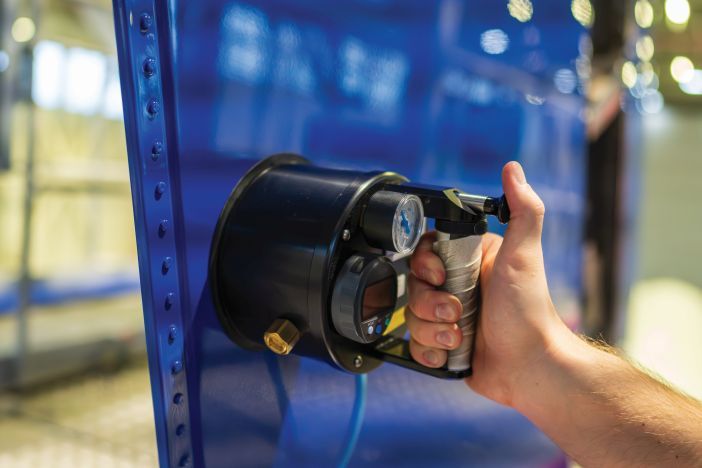
As the aerospace industry moves towards sustainability, there is an increase in the use of composite materials in aerospace manufacturing. Already, aircraft like the A350 XWB and Boeing 787 Dreamliner have many more composites compared to previous generations of aircraft, – in these cases more than 50% – mainly in the wings and fuselage.
These materials are used throughout airframes, engines and space structures and do not behave like metallic materials. Their damage modes are not usually visible on the surface and defects can exist under outer layers. More complex inspection methods are needed to detect material flaws.
Ultrasonic testing and other techniques such as thermography and shearography are often used to inspect parts made with composites.
Career opportunities
NDT professionals are in high demand in aerospace. This is mainly due to stricter safety requirements, aging aircraft and an increase in new materials.
NDT inspectors work as quality assurance inspectors, manufacturing or maintenance technicians and may ultimately become NDT instructors. This allows them to diversify in the industry and work in an environment that suits their interests, whether it is manufacturing, in-service aircraft maintenance or even aerospace research programs.
Unlike many aerospace careers, a four-year engineering degree is not required to become an NDT inspector. Most young professionals go through apprenticeships and on-the-job training with aerospace manufacturers or MRO facilities before completing official training at an approved school.
Aerospace NDT is highly regulated by qualification standards, EN 4179 in Europe/International and NAS 410 in North America. And to become a certified inspector, NDT aspirants must complete the required training and experience hours before taking the certification exam (General, Specific and Practical) and renew their certification every five years.
NDT certification is arranged in three levels: Level I technicians perform inspections under supervision; Level II technicians work independently and make accept/reject decisions, and Level III personnel establish procedures, train others, and provide technical authority.
Inspectors are required to be very detailed, ethical and thorough. They also need to possess a deep understanding of the required methods and be willing to commit to a career of continuous learning.
The impact of technology
The aerospace NDT sector is significantly influenced by technology. Inspection processes are becoming more efficient with the use of automation, robotics and digital inspection systems which reduce human error during inspection.
For example, the inspection of large composite structures is being automated using ultrasonic systems and robotic scanners. Such systems provide higher coverage and reduce inspection time.
AI is also gaining relevance as a support tool in the interpretation of data, particularly with regard to radiographic and ultrasonic inspection. Pattern recognition, anomaly detection and processing of volumes of inspection information can be done with the help of AI. Nonetheless, certified NDT personnel are still responsible for the final inspection and evaluation.
There is also an increase in the use of digital record-keeping and data management software. The use of digitally stored inspection records can help to monitor trends, predict maintenance and enhance traceability during the service life of an aircraft.
NDT may be one of the least recognized specializations in the aerospace sector. Yet it is among the most important. NDT forms the foundation of safety and ensures the continued airworthiness of aircraft and spacecraft throughout their serviceable life period. NDT professionals are directly involved in failure prevention in manufacturing and maintenance. And as aerospace technologies keep developing, the use of NDT will continue to remain significant in the safety and reliability of these systems.