

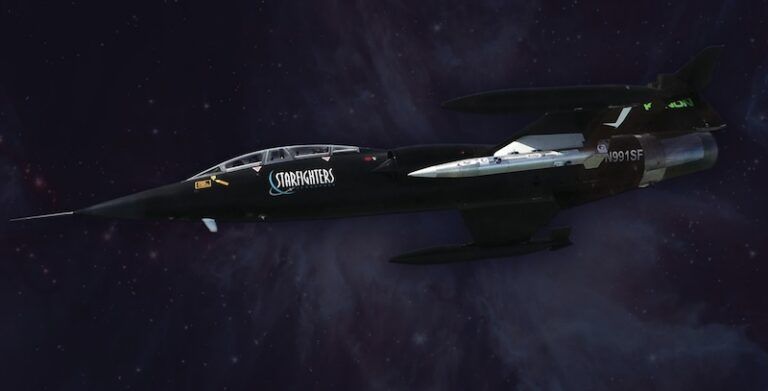
Starfighters Space is advancing a reusable airborne test platform that uses its supersonic F-104 fleet to expose hardware to sustained flight beyond Mach 2.
Called Wind Tunnel in the Sky, the modular underwing platform is designed to carry sensors, test articles and other payloads for long-duration exposure to both high-speed and low-gravity conditions. It is aimed at commercial, government, defense and research customers evaluating advanced technologies in real-world atmospheric conditions.
The platform is expected to host aerodynamic test articles, avionics, communications systems, electronic equipment and advanced materials for hypersonic programs and microgravity research. Starfighters says its F-104 fleet can also support R&D, test and evaluation for missile defense systems, spaceflight hardware and defense electronics.
A typical 45-minute mission can include a Mach 2+ test window of up to 10 minutes – far longer than traditional wind tunnel runs, which often last only seconds. Starfighters said this compresses what could otherwise take days of facility scheduling into a single flight, generating data equivalent to around 20 ground wind tunnel runs.
Tim Franta, CEO of Starfighters Space, said, “As demand for hypersonic and advanced aerospace systems continues to grow, access to specialized test infrastructure remains limited, increasing demand for complementary commercial flight-test capabilities. While ground wind tunnels remain essential for aerospace research and development, airborne testing can expose hardware to combinations of weather variation, vibration, acceleration, dynamic pressure, temperature and operational conditions that cannot always be fully reproduced in a fixed facility.”
Wind Tunnel in the Sky builds on the company’s subsonic and supersonic flight-test experience, including work supporting its STARLAUNCH 1 demonstrator, which recently completed a wind tunnel test campaign. STARLAUNCH 1 is a sub-orbital vehicle for short-duration microgravity missions, and a pathfinder for future air-launched orbital concepts, that has since advanced to critical design review with GE Aerospace, according to Starfighters.
The F-104 fleet operates from NASA’s Kennedy Space Center in Florida and the Midland Air and Space Port in Texas, and Starfighters describes it as the only commercial capability for sustained Mach 2+ flight. The jets have previously flown captive-carry tests for hypersonic programs, including GE Aerospace’s Atmospheric Test of the Launched Airbreathing System vehicle, which an F-104 carried at supersonic speed.
As development continues, Starfighters expects the reusable platform to widen commercial access to its F-104 fleet for testing next-generation aerospace, defense and space technologies, as demand grows for test capacity that ground facilities alone cannot meet.