

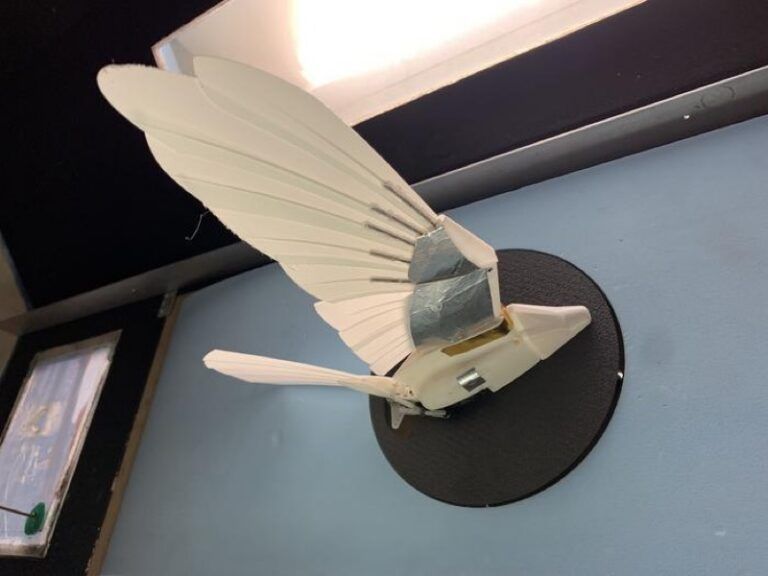
Researchers at RMIT University and the University of Bristol have built a robotic kestrel that replicates the wing and tail movements that enable the bird to hover with stability in turbulent air so engineers can investigate how to design more stable small aircraft.
Small unmanned aerial vehicles (sUAVs) are widely used for aerial photography, search and rescue, agricultural monitoring and package delivery, but are frequently grounded when conditions become too turbulent. As atmospheric turbulence is expected to worsen due to climate change, understanding how birds cope with rough air could help engineers design sUAVs that fly more smoothly and safely.
The nankeen kestrel is among the most stable fliers in the avian world and was tracked using motion capture technology in Royal Melbourne Institute of Technology’s (RMIT) industrial wind tunnel facility, one of the largest of its kind, in Australia. The research has been published in two papers in the Journal of the Royal Society Interface.
Matt Penn, a researcher at RMIT who led part of the investigation into how the birds handle turbulence, said, “Birds don’t rely on a single response to wind gusts. They constantly adjust their wings and tails to stay balanced, while the natural flexibility of their feathers and joints helps absorb sudden changes in airflow. They can also sense disruptions very quickly, which allows them to respond almost instantly and maintain control.”
A robotic replica capable of mimicking the movements most crucial to the kestrel’s stability allowed the team to investigate the subtle wing and body adjustments behind its flight control.
Mario Martinez Groves-Raines, who completed the research at RMIT and the University of Bristol and is now based at the Royal Veterinary College in London, said the robot enabled more precise measurement of the forces involved.
“By creating a robot replica, we were able to measure how specific movements were contributing to steadiness in flight,” Groves-Raines said. “We uncovered several techniques behind the kestrel’s impressive stability, many of which have the potential to improve maneuverability of small aircraft that encounter similar challenges.”
Abdulghani Mohamed, a senior researcher at RMIT, said the study highlights the value of cross-institution collaboration for aviation design. “Our findings open new pathways for designing aircraft that can better handle turbulence,” he said.
The team now plans to examine how kestrels sense their environment, including small amounts of turbulence encountered where sUAVs operate. While the current research is focused on smaller aircraft, the researchers hope to adapt their findings for larger-scale aircraft design, and RMIT is seeking industry partners to help advance the work.
The findings are detailed in two papers published in the Journal of the Royal Society Interface: “Bridging the Gap: A Review of Gust Mitigation in Birds and Small UAVs” and “Stability and control benefits of coupled wing and tail morphing in kestrel wind-hovering flight explored using a robot replica”.