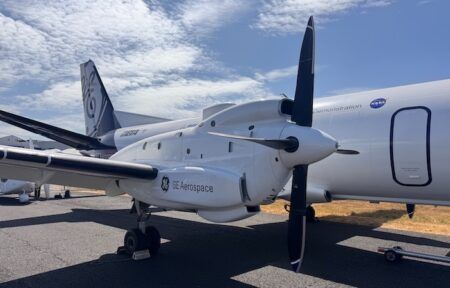


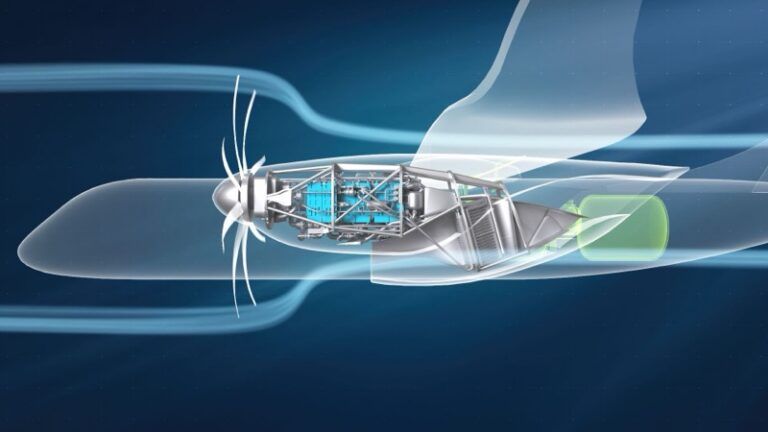
MTU Aero Engines has validated the central hydrogen and air supply systems for its Flying Fuel Cell and is now advancing to integrated demonstrator testing.
The tests mark an important step in developing the Flying Fuel Cell (FFC), MTU’s hydrogen fuel cell propulsion system. After the liquid hydrogen fuel system was validated, testing of the Fuel Cell Hydrogen System, which supplies gaseous hydrogen to the fuel cell, was completed under rigorous operating conditions.
The air supply tests also succeeded, with central performance and regulation models validated at MTU’s site in Munich and qualified for the next development steps. The two supply systems form the basis for the upcoming integration and demonstration programs.
Attention will now shift to integrated testing of the FFC, with the first close-to-production 350kW fuel cell stack being built at MTU in Munich. A full-system demonstrator is also being built there to test the interactions between all components, subsystems and regulation functions under flight conditions.
Both test campaigns will start this year in Munich, laying the groundwork for the next phase of technology validation and scaling. The test runs will take place in two fuel-cell test cells that are currently being brought into operation.
The European Clean Aviation research project HEROPS (Hydrogen-Electric Zero Emission Propulsion System) is contributing to the FFC, with MTU and its partners developing technologies for a hydrogen-driven powertrain that could power regional airplanes from 2035. Now that the design phase is complete, the focus shifts to validating the key technologies.
The centerpiece is a system scaled for 1.8MW, which is being developed and simulated at MTU in Munich. It aims to prove the feasibility of the new technologies and demonstrate they can be scaled to outputs between 2MW and 4MW, based on a modular engine architecture.
Industrial implementation is also gaining momentum, with MTU and Airbus saying in early July that they would deepen their collaboration on hydrogen-based fuel cell propulsion systems. The planned joint venture will cover the entire lifecycle, from technology, development and testing to production, certification, market launch and customer support.
Dr Stefan Weber, MTU’s senior vice president of engineering and technology, said, “Our ambitious goal is to pave the way for a newly developed, safe, reliable and economical propulsion system that will contribute to climate-neutral aviation.”
Weber described the project as a “crucial milestone” on the path to the first hydrogen-powered propulsion system, and as “true European technology leadership”. The partners began collaborating in 2025.
MTU is also working with the European Aviation Safety Agency (EASA) to prepare the regulatory groundwork for certifying flying fuel cells, a collaboration that has run for five years. By renewing the innovation partnership, the two organizations aim to build a reliable framework for the next generation of zero-emission aviation propulsion.