

GE Aerospace has flown a hybrid-electric testbed aircraft above 30,000ft for the first time, completing a flight across the Atlantic to exhibit the aircraft at the Farnborough Air Show this week.
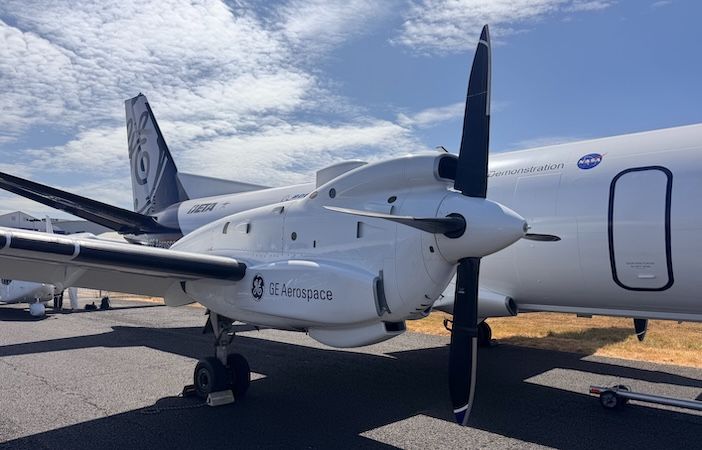
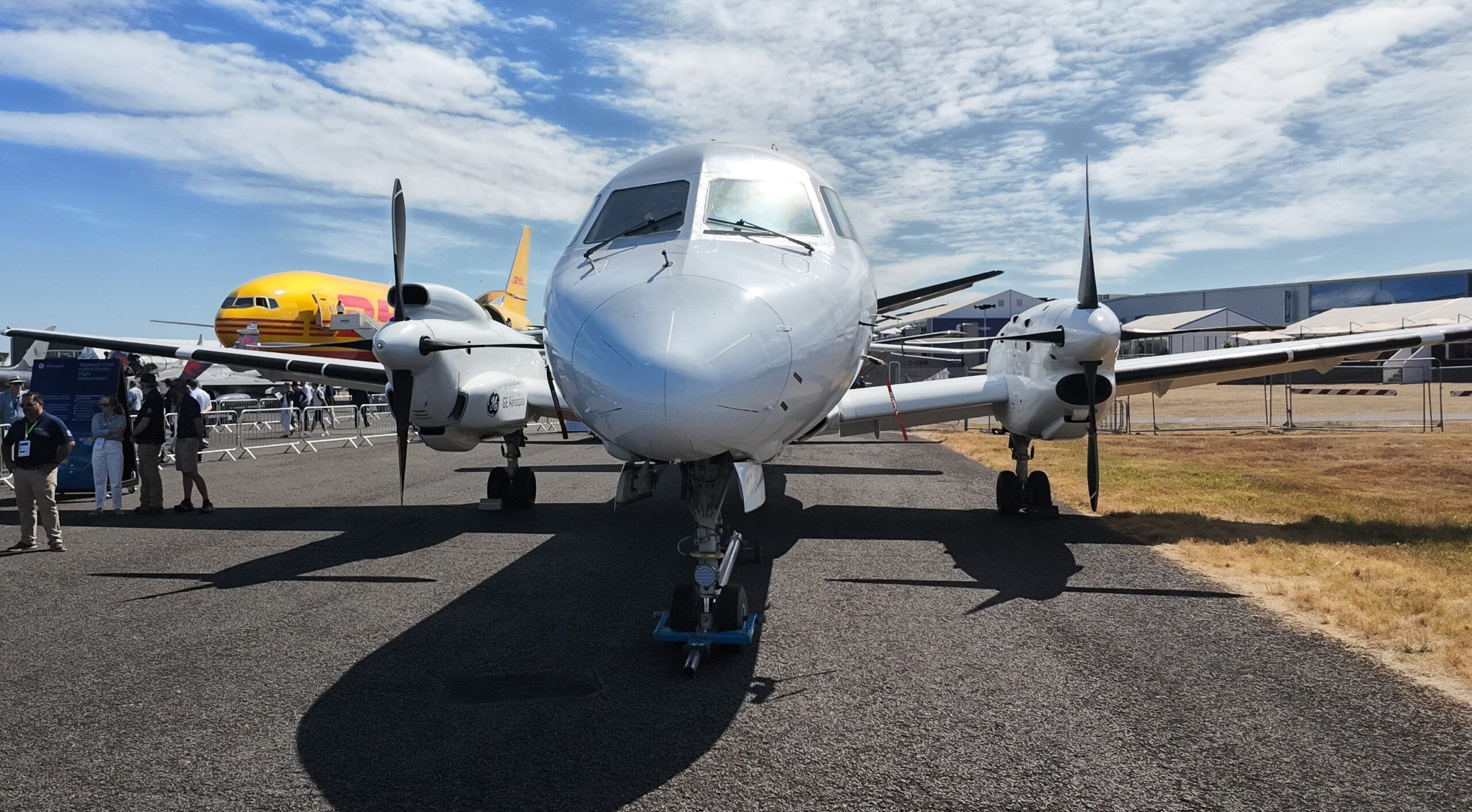
The modified Saab 340B has been equipped with a 1MW hybrid electric propulsion system on the right side, while the aircraft’s original CT7 gas turbine remains on the left. First flight using the hybrid configuration happened on May 3, 2026, with the first hybrid-electric flight above 30,000ft on May 20.
The testbed aircraft is flying demonstration flights and can be viewed on the static display at the Farnborough Air Show this week. The flight from the USA to Farnborough in the UK is also the first time a hybrid-electric aircraft has been flown across the Atlantic.
It was developed under NASA‘s US$260 million Electrified Powertrain Flight Demonstration (EPFD) program, which launched in October 2021 to demonstrate the flight readiness of hybrid electric technologies for single-aisle aircraft. Other partners on the project include Boeing’s R&D subsidiary Aurora, and Vermont, USA-based eVTOL aircraft developer Beta Technologies.
Speaking at the Farnborough Air Show, NASA administrator Jarod Isaacman said, “We have spent years working through the hardest technical problems: electrical components, batteries, size, weight, thermal management, and the power systems needed for megawatt class performance.
“The engine GE Aerospace is demonstrating integrates electric motors, a gas turbine, and energy storage capabilities in a megawatt-class hybrid electric propulsion powertrain. That means lower operating costs for airlines, which ultimately means lower costs for passengers.”
Another testbed aircraft is being developed as part of the EPFD program by electric propulsion systems developer magniX and aerospace engineering and testing firm AeroTEC. The Washington State-based companies are working with NASA to modify a De Havilland Dash 7 test aircraft with magniX’s magni650 powertrain. Flight testing is expected to start later this year.
First hybrid-electric flight across the Atlantic
The Saab 340B flight across the Atlantic left Plattsburgh, USA on June 26th, with stopovers in Goose Bay, Canada, Nuuk in Greenland, Kefalivik in Iceland, Wick in Scotland and Bournemouth in England before arriving at Farnborough on July 14th.
BETA pilots flew the aircraft, operating in hybrid-electric mode during each leg of the journey. During tests, the team’s single longest flight in hybrid electric operation was more than two hours.
Christine Andrews, executive hybrid electric systems leader at GE Aerospace said, “The journey across the Ocean was flawless and the hybrid-electric system operated exactly how we thought it would at 30,000ft, seamlessly.
“I’ve never been a part of a test campaign on the ground or in flight that went as smoothly or as quickly through each milestone as this one.”
The service ceiling for a Saab 340B is 25,000ft and flying above 30,000ft was only made possible with the hybrid-electric mode, said Andrews. 30,000ft is same altitude levels of passenger commercial aircraft.
“This shows that the technology is ready for the next step. It’s one thing to do it in the lab – it’s another thing to really put it into flight.”
Heat transfer and high voltage safety
Engineering and test teams addressed heat management, lower atmospheric pressures and power density using flightworthy components that meet higher safety and reliability requirements than typical test hardware, said GE.
Mohamed Ali, president and CEO, GE Aerospace commercial engines and services said, “Transmitting high power voltage is not easy, especially at high altitude where the density of the air is quite low, and it is prone to arcing, so you have to develop an insulation system that will protect against that.
“There is a lot of thermal management that has to happen to achieve flight. And there is electromagnetic interference from the motor generator and the 1MW cabling. The avionics of the aircraft also have to be protected to achieve a safe flight.”
Kyle Clark, founder and CEO of Beta, said, “This hybrid-electric system improves the high-altitude performance and climb capability while creating a flying laboratory to inform all future hybrid designs.
“There are lots of non-obvious learnings that go on when you really go fly that will be important. Human factors for a pilot, energy management, displays. Something that’s extremely important is absolute noise mitigation for telemetry and sensor systems and radios.
“The EMI is like having three and a half million cell phones running at the same time. We flew IFR over here and now we’ve got this on board, and we have to have pristine navigation instrumentation all the time. These are things that had to be solved.
“This is the type of learning that puts us in position to move into commercial aviation, as well as how the hybrid-electric system responds and maneuvers.”
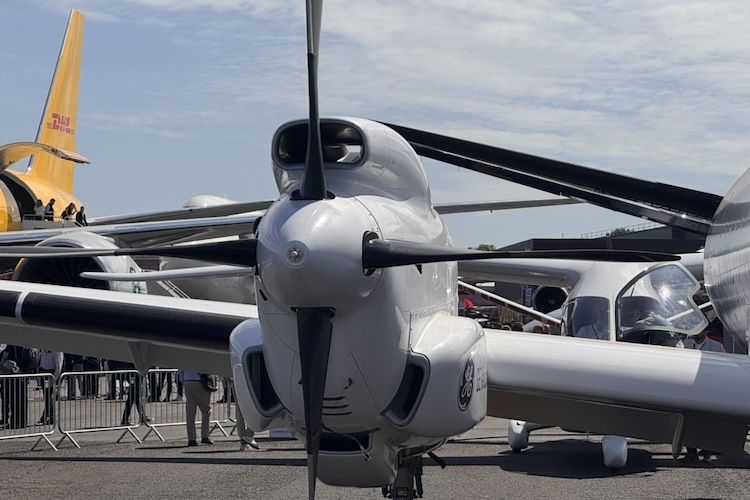
Modifications made
The hybrid electric system fits inside an inverted nacelle with extra inlets to provide extra ventilation for cooling.
The system includes GE Aerospace-developed motor/generators, power converters and inverters, controllers, Avio Aero gearboxes, Dowty propellers, Unison heat exchangers, torque sensing, and engine harnesses, and a CT7 engine. BAE Systems provided the batteries used and Boeing subsidiary Aurora Flight Sciences supplied the complete nacelle.
Extra levers and a display have also been added to the cockpit to operate the hybrid-electric system.
Work on the Saab 340B took place at Beta and GE Aerospace facilities at Burlington, Vermont and Dayton, Ohio. Flight testing has so far taken place out of Beta’s Plattsburgh, New York site, although future flight testing will be based at Aurora’s facilities, including in Manassas, Virginia.
As well as testing maneuvers, engineers will likely now use the aircraft to test how a hybrid-electric propulsion system can optimize power management during different phases of a flight, such as take-off and cruise.
Hybrid-electric systems are also open up the option of using different fuels, including hydrogen in fuel cells, and different architectures such as distributed electric propulsion and open fan engines, like the one being developed under CFM’s RISE (Revolutionary Innovation for Sustainable Engines).