

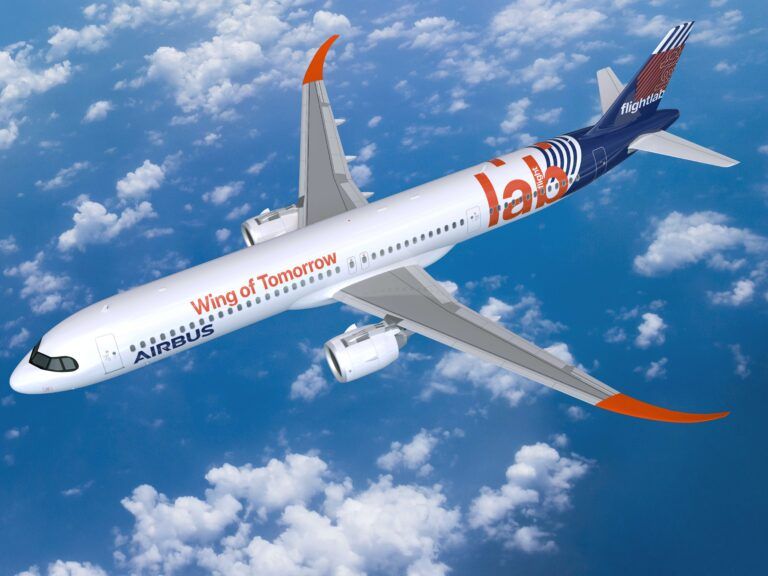
Airbus is preparing to fly a series of full-scale wing extensions on an A321neo aircraft over the next three years, to test how a folding wing would behave once fully extended in flight.
The flight test campaign is the next phase of the Wing of Tomorrow program, one of Airbus’ largest research and technology efforts, and will see the company design, build and test wing extensions measuring several metres.
Each extension will be fitted with instrumentation to capture how the wing geometry performs in real flight conditions, giving engineers data to evaluate how a longer wingspan affects aircraft handling and overall performance.
Sue Partridge, head of the Wing of Tomorrow program at Airbus, said, “The wing is one of the biggest levers we have to improve flight efficiency, which is why the Wing of Tomorrow is so critical for our next generation single-aisle aircraft.
“This flight-test campaign will allow us to safely challenge traditional design limits and explore the benefits of longer wings.”
Airbus is using digital modeling and wind tunnel testing to finalize the wing extension designs before they are fitted onto the A321neo, work the company says can only go so far in predicting how a longer wingspan will behave once airborne.
The flight data gathered over the three-year campaign is intended to de-risk the concept and unlock the potential that longer, folding wings could bring to Airbus’ next generation of single-aisle aircraft.
The Wing of Tomorrow program centers on developing longer, lighter and more slender wings to maximize aerodynamic efficiency and reduce fuel burn on future single-aisle aircraft.
The wing extensions will be assembled at Airbus’ Wing Technology Development Centre in the UK and flight tested in Toulouse, France.
Airbus has already built three 56ft (17m) ground-based wing demonstrators to explore the benefits of increased wingspan, alongside more than 100 manufacturing and assembly technologies that could be used in production.
Meanwhile, the company continues to work towards the maiden flight of its eXtra Performance Wing demonstrator by the end of this year, a program being run by its UpNext internal innovation incubator.
The eXtra Performance Wing can change shape during flight to maximise aerodynamic efficiency. The assembly of the flight demonstrator is nearing completion in Cazaux, southern France, said Airbus
The Wing of Tomorrow program was launched in 2014 and has been backed by £227 million (US$304 million) in funding from the UK government via the Aerospace Technology Institute (ATI).