

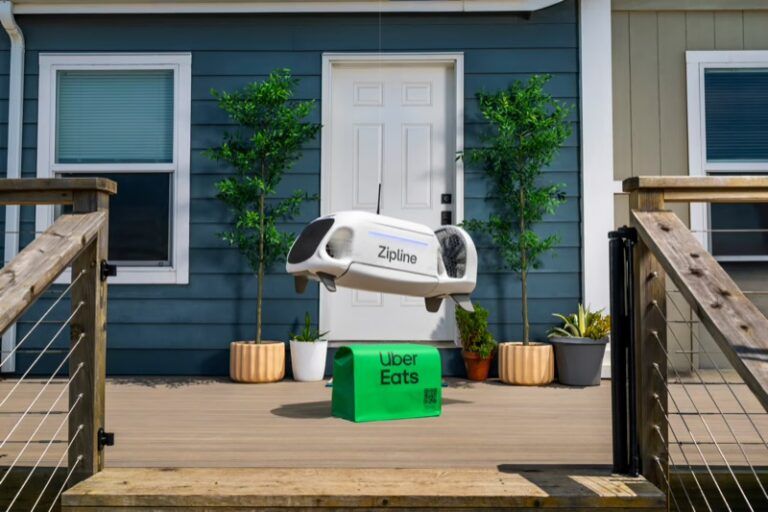
Drone delivery and logistics company Zipline has developed a way to make its aircraft quieter over customers and communities by changing how each drone flies.
The technique, which Zipline calls sound-optimized dynamic flying, lets each drone pick the quietest route in real time rather than following a fixed, pre-planned trajectory. Using onboard wind sensors and a custom acoustic model, the drone works out the quietest way to climb, cruise and descend, using gravity and wind to speed up and slow down instead of relying on its motors.
Because Zipline’s drones have a fixed wing and glide like a plane, they can shut off all but one motor once at cruising speed and altitude, reducing noise with fewer propellers spinning . Dynamic flying moves the aircraft onto the wing sooner and more smoothly, dipping the nose to gain speed, or pitching up to slow gently at the end of a flight.
Zipline said the approach, combined with other hardware and software changes, has cut overall sound exposure per flight by 68% and made flights 24% quieter at peak volume compared with its 2025 fleet, based on internal modeling. The dynamic flying alone cut the median flight time by 53 seconds and energy use per flight by 21%, with drones spending about 50% longer on the wing.
Keenan Wyrobek, Zipline co-founder and chief technology officer, said, “We want people to love having Zipline available, not just tolerate it, and that starts with making it the quietest way to get a delivery. We’ve spent years pushing the limits of engineering to make that true.”
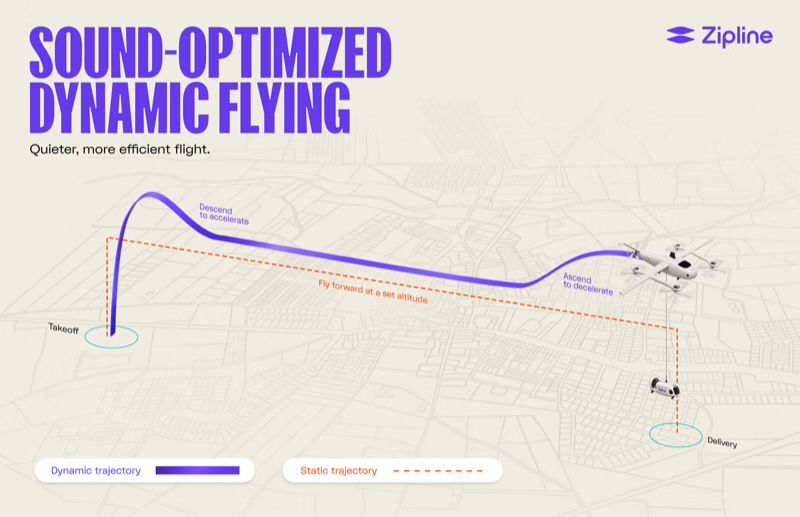
Zipline said the update builds on years of aeroacoustic work, including proprietary ultra-quiet propellers and a two-part architecture that keeps the drone about 330ft (100m) above the ground during delivery, lowering packages on a tether rather than descending. Zipline said that compares with an average of about 32ft (10m) for other delivery-drone services.
Zipline bills itself as the world’s largest drone delivery service, operating on multiple continents, making a delivery somewhere in the world every 15 seconds and serving more than 5,000 hospitals and health facilities alongside retailers and restaurants. It has flown nearly 150 million commercial autonomous miles.
Having started in Rwanda delivering blood and vaccines, the company has expanded rapidly in the USA with its latest Platform 2 system, operating with partners including Walmart and Uber Eats across Texas and other states, and raised substantial new funding during 2026 to scale up.
Zipline said that sound-optimized dynamic flying also opens the way to higher-altitude flights and more sophisticated maneuvers that could make its drones quieter still.