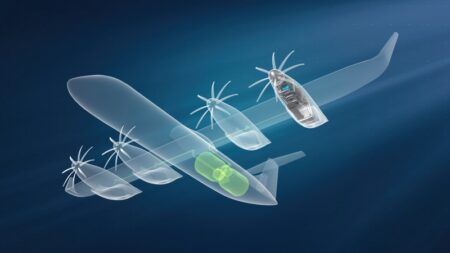


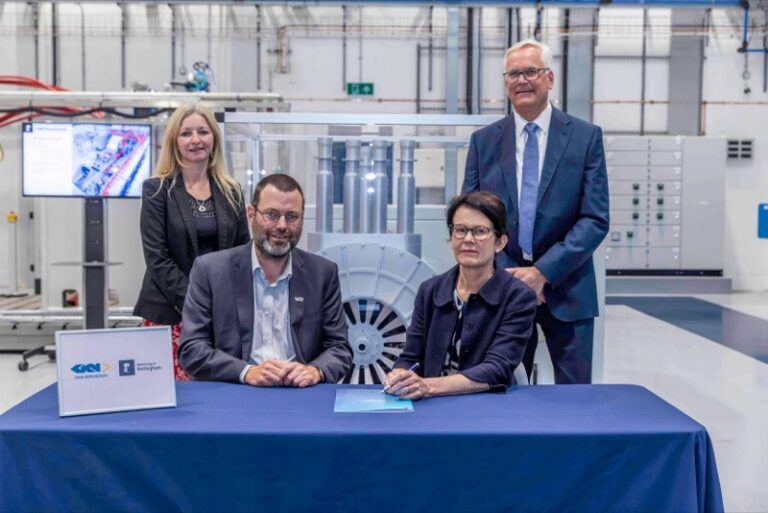
GKN Aerospace has set up a startup with the University of Nottingham to develop cryogenically cooled electric motors for hydrogen-electric aircraft.
The venture, HPDrive Technologies, builds on the cryogenic electrical machine technologies developed through GKN Aerospace’s UK government-funded H2GEAR program.
H2GEAR, which at £40 million (US$54 million) is the single largest R&D program funded by UK body the Aerospace Technology Institute, ran from 2020 to 2024. However, its successor programs, HyFIVE and H2FlyGHT, were shelved and deprioritized when GKN pulled out of the program after Airbus scaled back its hydrogen ZEROe project.
GKN was developing the 1MW-capable cryogenically cooled motor at its Global Technology Centre in Filton, UK. This will now be further developed by HPDrive, which aims to commercialize the technology.
Speaking at a press briefing in London in April, Russ Dunn, chief technology officer at GKN, said, “The University of Nottingham is the strongest electric motor research organization in the UK and decided to take over the responsibility for the electric motor in our H2FlyGHT program.
“HPDrive will now inherit and have access to all our IP from the cryo-motor, and will also be open to other investors in order to then take that technology further. All of the good, innovative work we’ve been doing will have somewhere to go.”
Cryogenically cooled motors, also called cryo-motors, are a key technology for future large hydrogen-electric aircraft because standard motors are too heavy for flight once power requirements rise to around 1MW and beyond.
Max Brown, vice president of technology, GKN Aerospace, said, “The company creates a dedicated route to build on the technologies, expertise and capability developed through H2GEAR and take advanced cryogenic electrical machines closer to future industrial and aerospace applications.
“Through this venture with the University of Nottingham, we are supporting the continued development of a strategically important UK capability and helping to advance the technologies required for the longer-term transition toward zero-emission flight.”
Henner Wapenhans, CEO of HPDrive, said, “Through this new venture, we will further develop advanced cryogenic electrical machine technologies and accelerate their route toward future industrial and aerospace applications.”
The University of Nottingham said in a press release that HPDrive is currently progressing its technology-development roadmap and engaging with prospective partners.